OURANG MEDAN
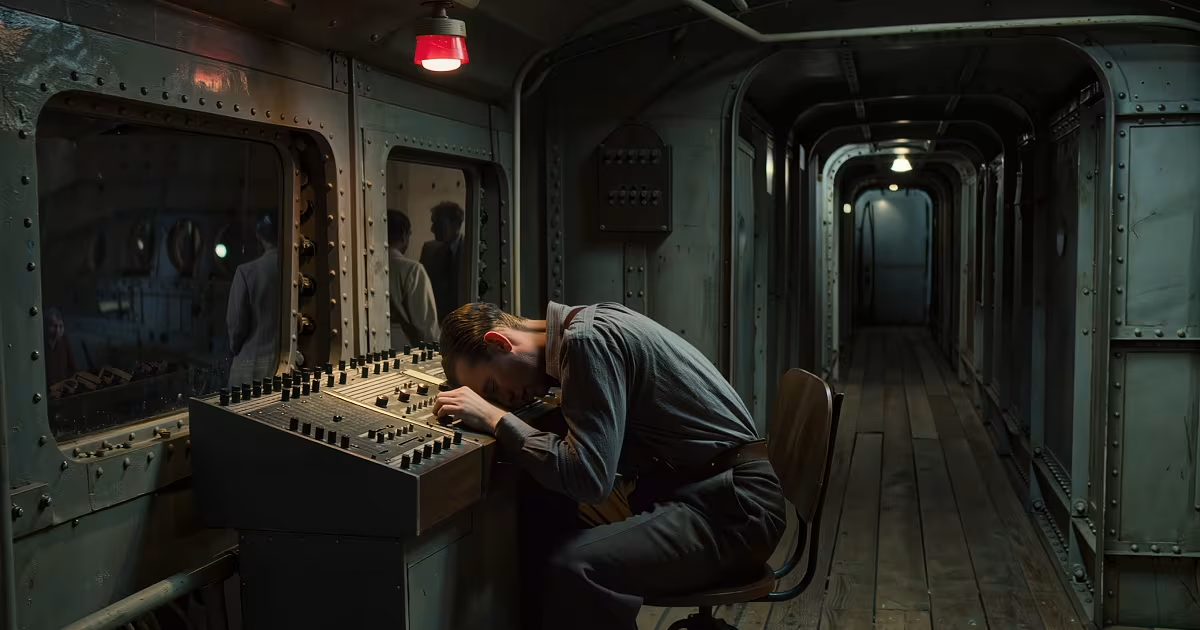
Empty tropical sea. No ship on the horizon.
Illustration, not a period photograph.
Opening
Sometime in 1947 or 1948, in the telling that will not sit still, a vessel named Ourang Medan is said to have been found in the Strait of Malacca with her whole company dead on deck, faces turned up, a distress call already in the air: officers and crew dead, and then the sender dead too. Rescuers board. The ship is a room of bodies. Fire or an explosion follows. She is gone before a proper inventory.
No register everyone accepts has produced that name on a wartime or immediate-postwar list. No official Dutch or British wreck file that later researchers can hold without a fight. The story lives in magazines and in forwarded cables that may themselves be copy. The death-ship is a tradition with a thin keel.
The spine of the file is a distress sentence and a missing register. Ourang Medan is a story that wants a deck. It is not a named wreck with a closed book in Rotterdam.
Timeline
The year slides. June 1947 in some tellings, February 1948 in others. Location slides: Malacca, an unnamed Indonesian water. A distress in broken English or German, received by American or British stations, naming the ship and the dead.
A rescue ship, Silver Star in the most repeated version, finds her. Bodies on deck, no visible wound in the popular paragraph, a dog dead among them. Then smoke, fire, a decision to leave, an explosion, the sea taking the evidence.
Postwar papers and men's magazines run it. Researchers later hunt Lloyd's and Dutch colonial lists and do not find a comfortable Ourang Medan. Possible misspellings are offered. None has become the ship.
The case remains a forwarded horror with no keel the file can dry-dock. That thinness is the fact, not a failure of nerve.
Key figures
The unnamed crew of the Medan are the dead in the story. They have no register page that holds.
The Silver Star, if she was there, owns a boarding no log has been produced for in public.
Magazine editors own the survival of the paragraph.
Later wreck researchers own the empty search of the lists.
Physical and documentary trail
On the paper, 1947-48 give you four thin objects and no dry-docked name.
One: the circulated distress text naming Ourang Medan and a dead company.
Two: the boarding-and-fire paragraph attached to a rescue ship called Silver Star.
Three: postwar magazine and forwarded-cable versions.
Four: the failure of standard registers to hold that name without strain. There is no official wreck file the later searchers will sign as hers.
There is no photograph of that deck. There is no survivor statement taken by a named officer. There is no yard number.
Competing explanations
A real poisoned or gassed ship under a misspelled name. Possible. Needs a register.
A wartime rumour that hardened into a magazine piece. This fits the sliding dates and the missing list.
A fiction that borrowed a strait. Also possible. The distress sentence is good copy.
Hybrid caution. A story of a dead ship has been told for seventy years. The lists have not stood her up.
Later life of the case
Internet death-ship lists and documentary voiceovers. I keep those on the later-life shelf. The missing register stays first.
Finding
A ship called Ourang Medan is said to have been found full of the dead in the late 1940s and then lost to fire, and the registers have not given her a comfortable page. Believe the thinness. A missing name is also a fact.
What still will not resolve: a yard book or a wreck file that is hers, or a boarding log from a named rescue ship. Either one would take her off the tradition shelf. The proving object is still that register line, written while she floated.