JOYITA
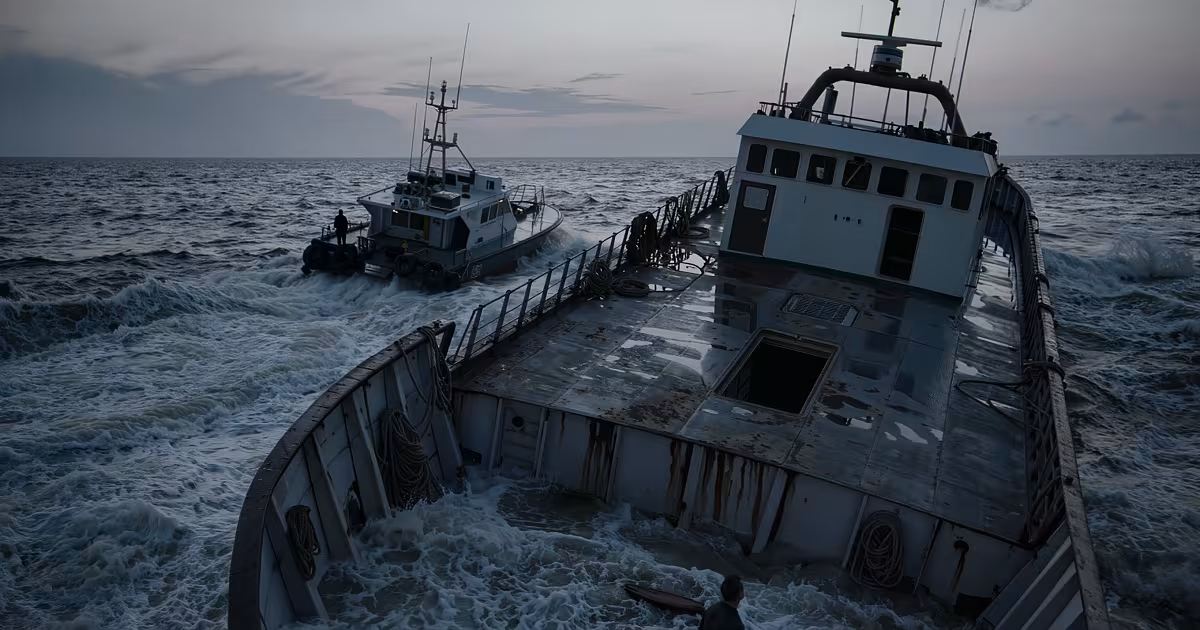
Listing Pacific trader. Empty deck and tropical sea.
Illustration, not a period photograph.
Opening
On 10 November 1955 the merchant ship Joyita was found drifting in the South Pacific north of Fiji, partially flooded, listing, her radio tuned, her boats missing, and twenty-five people gone. She had left Apia, Western Samoa, on 3 October bound for the Tokelau Islands with crew and passengers, a cargo of copra and stores, and a doctor on a medical run. She was overdue. When she was boarded she was empty of the living and of the dead.
Food was still aboard. The clocks had stopped. A flying-boat doctor and a cargo of medical supplies were among the missing. Courts of inquiry in Samoa and beyond argued weather, injury to the captain, a bad pump, and worse. No boat with those twenty-five was walked ashore in a way the file kept.
The spine of the file is a ship that kept floating without her people. Joyita is an empty deck in warm water. It is not a found boat with twenty-five names on the thwarts.
Timeline
3 October 1955. Joyita leaves Apia for Fakaofo. Captain Thomas "Dusty" Miller, a crew, passengers including medical staff, cargo. She is a wooden vessel with cork lining that made her hard to sink, which is why her empty survival later looks so strange.
She does not arrive. Searches. 10 November the MV Tuvalu finds her north of Vanua Levu, listing, awash on one side, no boats, no people. Boarding: radio set toward distress in some tellings, log incomplete, blood on a rail in some inventories and not in others, doctor's bag, clocks stopped, engines not in a state that explains a calm abandon.
Inquiry in Western Samoa. Weather is considered. Miller's health is considered. A theory of injury and a panicked launch of boats that then vanished is considered. No conviction. No recovery of the boats with bodies the court could name.
Later Pacific mystery lists put her next to Mary Celeste. That neighbour is later life. The November boarding is first.
Joyita was known as a ship that wanted to float. Cork lining is why an empty, listing find looks worse, not better: someone left a vessel that should have kept them alive. Miller's health and the mate talk from Barbados sit in the inquiry as human weather, not as a close.
The November boarding is clocks, radio, stores, boats gone, people gone. Stains on a rail appear in some inventories and vanish in others. Keep the stain as disputed. Keep the empty deck as not disputed.
Key figures
Thomas Miller is the master who should have been on that deck. He is not.
The twenty-five missing are the file. Crew and passengers, including medical names the Tokelau run needed.
The Tuvalu boarding party owns the first inventory of an empty, still-floating ship.
The Samoan inquiry owns a close that does not produce the people.
Physical and documentary trail
On the paper, October-November 1955 give you four hard objects and no boat of survivors.
One: the 3 October departure from Apia with a named complement.
Two: the 10 November find, listing, boats gone, people gone, ship still afloat.
Three: the boarding inventory of radio, clocks, stores, and disputed stains.
Four: the official inquiry. Western Samoa inquiry papers on the Joyita, 1955-1956, are the official tray.
There is no identified lifeboat. There is no survivor who walked into a station with the night in his mouth. There is no wreck of the boats tied to those twenty-five.
Twenty-five names left Apia. None of those names walked into a station with a boat. That arithmetic is the file even when the cause stays open.
The ship was found drifting. No one was on board.
Competing explanations
A flooded ship, a decision to take to the boats, boats lost. This respects the cork lining and a listing deck. It needs the sea to keep twenty-five.
Foul play, injury to Miller, a fight, a launch that hid a crime. Offered. Not proved.
A sudden medical or mechanical night that emptied the deck for no good nautical reason. Possible. Thin.
Hybrid caution. A ship that should have gone down was empty and still there. The people were not.
Later life of the case
Pacific ghost-ship lists. I keep those on the later-life shelf. The November inventory stays first.
Finding
Joyita left Apia on 3 October 1955 with twenty-five people and was found drifting on 10 November with the boats gone and nobody on the deck. Believe the boarding party. A merchant crew does not invent an empty ship.
What still will not resolve: one of those boats, or a paper from the days between Apia and the find that names why they left a vessel that still floated. Either one would finish the only job the inquiry had. The proving object is still the twenty-five, held by the water or by a hand that has not said its name.