USS CYCLOPS
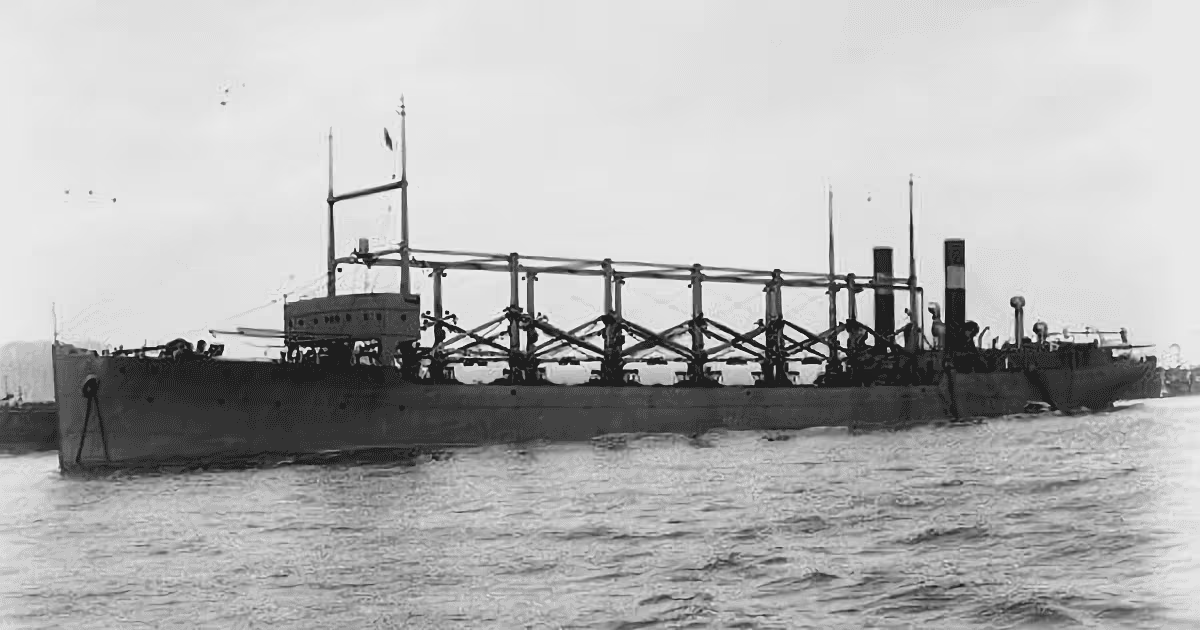
USS Cyclops, a large collier with tall gantries, on a grey sea.
Illustration, not a period photograph.

Opening
On 4 March 1918 the collier USS Cyclops left Barbados for Baltimore with a cargo of manganese ore and 309 people on board. She did not arrive. No distress that the Navy kept as hers. No wreck that a court of inquiry could walk. She was a Proteus-class naval auxiliary, overloaded in some later calculations, with a captain named George Worley whose manner had already made enemies, and with a world still at war in the Atlantic.
The Navy searched. German records after the war did not hand over a sinking they wanted to claim. Storm, structural failure, a shift of ore, a submarine, mutiny: all offered, none proved. Three hundred and nine is the number that does not move.
Timeline
January-February 1918Cyclops in Brazilian waters, loads ore, calls at Barbados. Worley in command. Complaints about the ship and the man already sit in mess talk.
4 MarchShe sails north. Expected in Baltimore about the 13th. She is not there. Radio silence that the Navy cannot turn into a last position everyone accepts. Patrols and inquiries through the spring.
Official declaration of loss. Next of kin. No lifeboat with a name the record can hold. After the Armistice the German navy is asked and does not produce a kill they are proud of.
Cyclops loaded manganese in Brazilian waters and called at Barbados. Worley was already a captain people complained about. That complaint is not a wreck. On 4 March 1918 she sailed north with 309 and did not make Baltimore. No distress the Navy kept as hers. No last position everyone accepts.
Postwar German files did not hand over a sinking they wanted to claim. Storm, a shift of ore, a weak structure, a submarine, mutiny: all offered. Three hundred and nine is the number that does not move. Triangle geography is later paint.
Key figures
The 309 are the record. Crew, passengers, naval and civilian names.
George Worley is the captain the later books like to try. He may have been a bad master. He is not a proven wrecker.
The Navy owns the search and the empty close.
Next of kin own the years of no grave.
Physical and documentary trail
The sources:
One: the Barbados departure of 4 March with a named complement and a cargo of ore.
Two: the failure to arrive at Baltimore and the silence that followed.
Three: Navy search and inquiry paper that names no position.
Four: the postwar German denial of a claimable kill.
There is no identified wreck. There is no boat. There is no last signal the Navy will stand on as hers.
A collier and a full complement that never step onto a pier is already a loss file. The missing wreck is the gap. Worley's manners are not a substitute for a position.
Things you might not know
- The captain had changed his name. Naval intelligence found that George Worley had been born Johan Frederick Wichmann in Sandstedt, Hanover, in 1862.
- She was carrying a third too much. Cyclops had about 10,800 long tons of manganese ore aboard. Her normal maximum was 8,000.
- One engine was broken. Before leaving Brazil, Worley reported a cracked cylinder in the starboard engine, and a survey board recommended taking her home to the United States for repair.
- A consul-general was aboard. Alfred Gottschalk, the US consul-general in Rio de Janeiro, was a passenger. Like Worley, he was rumoured to have pro-German sympathies.
- Her sisters vanished too. Her sister ships Proteus and Nereus were sold in 1941, and both disappeared without trace later that year while carrying bauxite.
Competing explanations
Storm and a ship that was unhappy with her load. This is the seaman's door. It has weather. It has no wreck to prove the break.
A U-boat. War makes it cheap to say. Germany did not claim her in the way that usually follows a prize.
Foul play on board, Worley or others. Offered. Not shown.
Later life of the case
The loss of Cyclops is still the largest loss of life in US Navy history not directly involving combat. Bermuda Triangle writers made her a founding case, though her route and the overloaded, damaged ship give ordinary explanations plenty to work with, and the fate of her sister ships in 1941 only added to the legend. For the case that gave the Triangle its name, see Flight 19.
Finding
USS Cyclops sailed from Barbados on 4 March 1918 with 309 people and did not arrive.
What still will not resolve: the wreck, or a last signal that fixes a position.
Evidence signature
4/9 Solid
- Witnesses
- several people
- Instruments
- nothing on record
- Paper
- official records at the time
How well documented the case is, not whether it's true. A strong record can still have an ordinary answer, and a thin one can still be real.
You decide · USS CYCLOPS
What do you think happened?
One vote per case, anonymous. You'll see how other readers voted once you've voted.