AURORA 1897
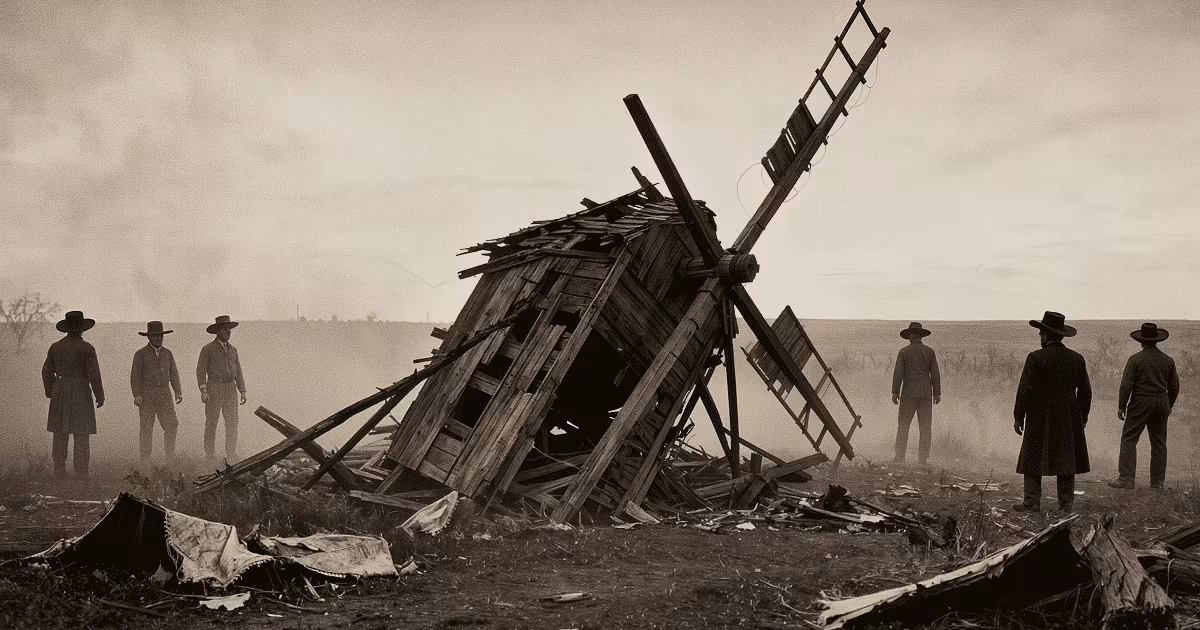
Texas cemetery grass. A windmill lot and 1897 town.
Illustration, not a period photograph.
Opening
On 19 April 1897 the Dallas Morning News printed a letter from S. E. Haydon of Aurora, Texas: an airship had struck Judge Proctor's windmill at dawn, exploded, scattered debris, and killed a pilot who was not built like the men of Wise County. The town, Haydon wrote, had given the pilot a Christian burial. Papers already full of great-airship stories that spring ran the item. Aurora was a small place with a drought and a railroad that had disappointed it. The windmill story gave it a grave.
No 1897 photograph of the wreck sits in a chain the file can trust. No inquest paper has been produced that names the dead pilot in a county hand. Later metal on Proctor's ground has been argued as aluminium and as old farm junk. The cemetery marker is later than the morning.
The spine of the file is a newspaper letter and a town that liked a grave. Aurora 1897 is a printed crash. It is not a kept pilot in a Wise County drawer.
Timeline
April 1897. The great airship wave is already moving the Texas papers: lights, cigars, inventors from New York or from Mars, depending on the desk. 17 April in some tellings the crash, 19 April the Haydon letter in the Morning News.
Local memory splits. Some old residents later said they remembered a fuss. Some said Haydon could write a joke. The cemetery acquired a stone in the twentieth century that tourists could find.
1970s investigations dig, test metal, argue. Nothing comes up that a county would bury again as a pilot from 1897.
Every airship-wave chapter keeps Aurora because the burial sentence is perfect. That chapter is later life. The Morning News page is first.
Key figures
S. E. Haydon owns the letter. A local writer with a town to talk about.
Judge Proctor owns the windmill in the sentence. Whether the mill took a ship is the whole fight.
The unnamed pilot is a grave without a 1897 name the courthouse will sign.
Later metal-detector years own junk and hope. They do not own the dawn.
Physical and documentary trail
On the paper, April 1897 gives you four thin-to-hard objects and no inquest.
One: Haydon's letter in the Dallas Morning News describing a crash and a burial.
Two: the airship-wave context already in Texas papers that month.
Three: later cemetery marking and local memory that does not agree.
Four: twentieth-century metal tests. Dallas Morning News, S. E. Haydon letter, 19 April 1897, is the originating tray.
There is no 1897 photograph of wreckage. There is no signed burial register line everyone accepts. There is no pilot's paper.
The pilot, who was not an inhabitant of this world, was given a Christian burial.
Competing explanations
A real crash and a real grave. This is what tourists want. It has a letter. It has no 1897 courthouse page.
A newspaper hoax in a wave that already rewarded airship copy. Fits the drought town and Haydon's pen.
A balloon or a wrecked tinker's ship dressed as a Martian. Possible. Still needs remains.
Hybrid caution. A letter put a grave in Aurora. The courthouse has not stood the pilot up.
Later life of the case
Cemetery stones and metal hunts. I keep those on the later-life shelf. The Morning News page stays first.
Finding
Aurora went into the Dallas paper on 19 April 1897 as the town that buried an airship pilot after a dawn crash on a windmill. Believe the print as print. A letter is a fact. A body is another.
What still will not resolve: an 1897 burial line in a county hand, or a piece of that machine with a chain to Proctor's yard. Either one would take Haydon off the joke shelf. The proving object is still the pilot in the ground, named by more than a newspaper.