D.B. COOPER
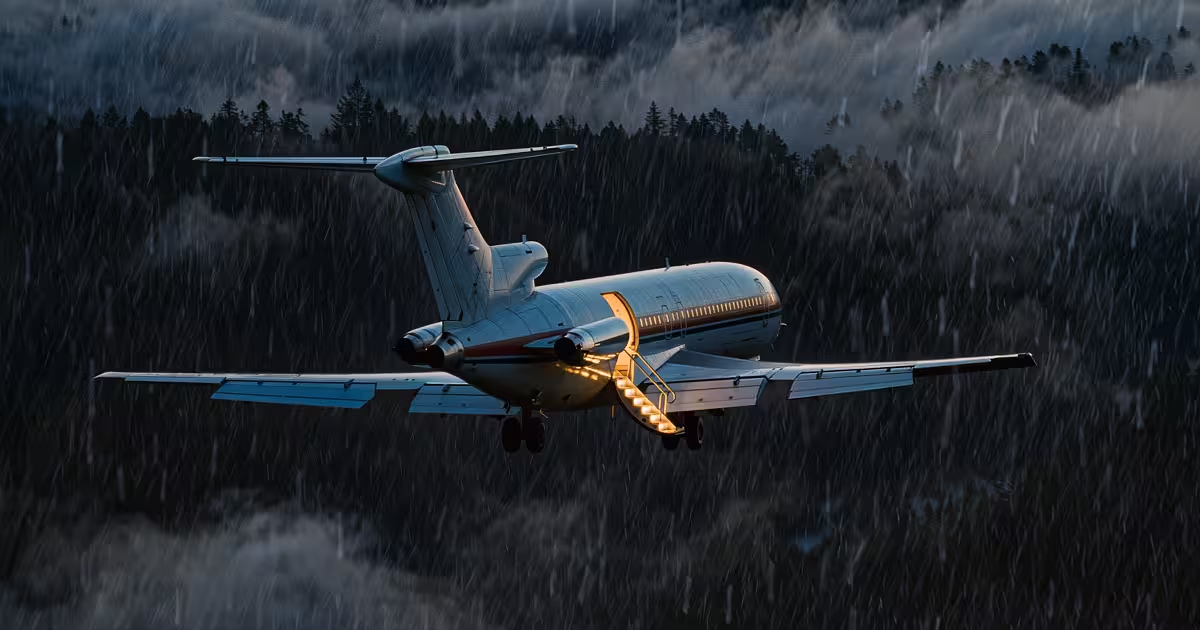
A Boeing 727 flying through rain over dark forest, rear stairs down.
Illustration, not a period photograph.

Opening
On the afternoon of 24 November 1971, the day before Thanksgiving, a quiet man in a dark suit paid cash for a one-way ticket on Northwest Orient Flight 305 from Portland to Seattle under the name Dan Cooper. Soon after take-off he handed a flight attendant a note saying he had a bomb in his briefcase. He showed her wires and red cylinders, and demanded $200,000 in twenty-dollar bills and four parachutes.
In Seattle he let the passengers go, took the money and the parachutes, and ordered the crew to fly toward Mexico City, slowly and low, with a refuelling stop at Reno. Somewhere over the forests of southwest Washington, a little after 8 p.m., he lowered the 727's rear stairs and jumped into the dark and the rain. He has never been identified. It is the only unsolved airliner hijacking in American history.
Timeline
24 November 1971, 2:50 p.mFlight 305 leaves Portland with 36 passengers and six crew. Cooper, in seat 18E, orders a bourbon and 7-Up, then passes his note to flight attendant Florence Schaffner.
5:46 p.mThe 727 lands at Seattle-Tacoma after circling while the FBI gathers 10,000 twenty-dollar bills, all serial numbers recorded on microfilm, and four parachutes. The passengers leave.
About 7:40 p.mThe jet takes off again with Cooper, the pilots and flight attendant Tina Mucklow, flying low and slow with the flaps partly down, as he ordered.
About 8:13 p.mThe crew feel the tail pitch up as the rear stairs drop. Cooper is gone.
11:02 p.mThe plane lands at Reno with the stairs still down. Cooper left behind his black clip-on tie, a tie clip and two of the parachutes.
10 February 1980Eight-year-old Brian Ingram, raking sand to build a campfire on the Columbia River at Tena Bar, finds $5,800 of the ransom in three rotting bundles.
8 July 2016The FBI ends its active investigation, after 45 years and a 66-volume file.
2022 to 2025Researcher Dan Gryder finds an old parachute rig on the North Carolina family property of Richard McCoy II, a convicted 1972 hijacker. McCoy's children say their father was Cooper. The FBI takes the rig in 2024 for testing and returns it in December 2025 without reaching a public conclusion.
Key figures
"Dan Cooper" became "D. B. Cooper" by accident, when a reporter under deadline pressure wrote down the wrong name for an unrelated suspect and wire services repeated it.
Flight attendants Florence Schaffner and Tina Mucklow spent the most time with him, and their descriptions made the famous sketch: a calm, polite man in his mid-forties. Captain William Scott flew the plane.
The many suspects include Richard McCoy II, who carried out an almost identical hijacking over Utah in April 1972 and was killed by the FBI in 1974 after escaping from prison; Kenneth Christiansen, a Northwest employee; and Robert Rackstraw, a former Army paratrooper. The FBI ruled out McCoy decades ago on witness descriptions and an alibi. None of them has been proved to be Cooper.
Physical and documentary trail
The record: the FBI's case file, the ransom serial numbers, the crew's statements, the tie and tie clip, two cigarette butts, the parachutes he left behind, the Tena Bar money, and recent scientific work on particles from the tie.
Still missing: Cooper, his body, his parachute, and the other $194,200.
Things you might not know
- One of his parachutes didn't work. One of the reserve chutes given to him was a training dummy with its canopy sewn shut.
- The money weighed about 19 pounds. Ten thousand twenty-dollar bills, every serial number photographed. None has turned up anywhere except Tena Bar.
- The tie was out of date. His black clip-on tie was a J.C. Penney model the store had stopped selling in 1968.
- The tie had titanium on it. Researchers found particles of pure titanium and other metals on the tie, the kind used in aerospace manufacturing, which suggests he may have worked around the Boeing industry.
- The plane gave him away. The 727's rear stairs could be lowered in flight from the cabin, a feature most people didn't know about. After the hijacking, Boeing fitted a device called the "Cooper vane" to stop it.
- He tipped well. Cooper reportedly offered to pay for his drink and tried to give the flight attendants some of the cash.
Competing explanations
He died in the jump. The FBI's long-held view: a man jumping at night, in rain, in a business suit and loafers, into rough wooded country, probably didn't survive. The money in the river fits a body or a bag washed downstream.
He survived and vanished. He picked his plane, knew how the stairs worked, and planned the flight path. If he lived, he never spent the money where it could be traced.
He was McCoy. The 1972 copycat hijacking, the recovered rig and his children's statements. Against it: the witness descriptions and the FBI's own alibi evidence.
Later life of the case
Cooper is a folk hero in the Pacific Northwest, with an annual festival in Ariel, Washington, and endless books, documentaries and amateur investigations.
Finding
A man hijacked a jet, collected a ransom and jumped from it, and that is all solidly recorded. Who he was, and whether he lived, has never been established, and the 2025 return of the McCoy parachute without a conclusion left the question as open as ever.
What still will not resolve: where Dan Cooper landed, and how $5,800 of his money ended up in the Columbia River.
Evidence signature
6/9 Solid
- Witnesses
- trained, independent witnesses
- Instruments
- photo, film or physical traces
- Paper
- official records at the time
How well documented the case is, not whether it's true. A strong record can still have an ordinary answer, and a thin one can still be real.
You decide · D.B. COOPER
What do you think happened?
One vote per case, anonymous. You'll see how other readers voted once you've voted.