ALDERNEY
Small island airstrip. Trislander-scale apron, empty sky.
Illustration, not a period photograph.
Opening
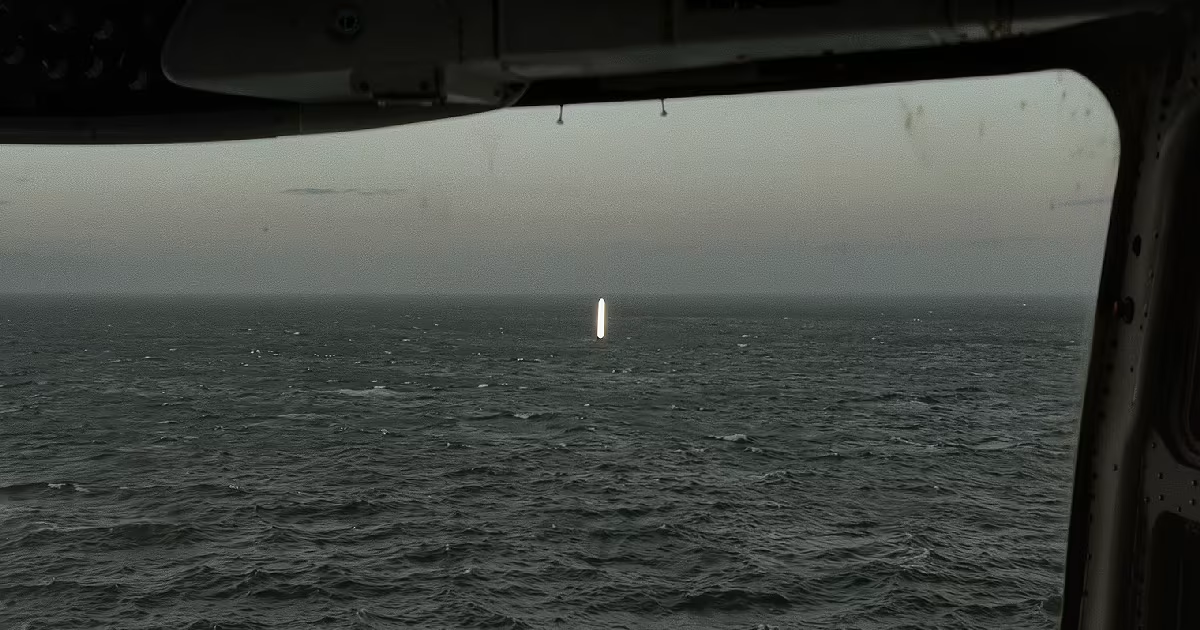
At around 14:09 on 23 April 2007, Captain Ray Bowyer, a fifty-year-old pilot with eighteen years' experience flying for the Channel Islands airline Aurigny, was fifteen minutes from landing at Alderney when he saw a brilliant, cigar-shaped light hanging stationary in clear afternoon sky. He watched it for roughly nine minutes, through binoculars for part of that time, reported it live to air traffic control, and was told a second airline pilot on a separate flight had just reported something similar in the same stretch of sky. Both men filed formal reports. One of Britain's more sophisticated air traffic radar systems appears to show two faint, slow-moving returns at the same time and place.
This is not a case built on memory decades later or a single grainy photograph. It happened over a small, radar-covered stretch of airspace between two working commercial aircraft, was reported to the Civil Aviation Authority within the hour, and generated a dedicated technical investigation within weeks. It is also, on its own investigators' conclusion, not a solved case.
Timeline
23 April 2007, approximately 14:09 GMT. Bowyer, flying an Aurigny Britten-Norman Trislander from Southampton to Alderney, spots a bright yellow-orange light roughly ten miles west of the island. His first instinct is that it is sunlight reflecting off Guernsey's commercial greenhouses, a known local light source he had seen before. He revises that view as he watches it stay in a fixed position.
Same flight, minutes later. Bowyer reports the object to Jersey air traffic control by radio. The controller, Paul Kelly, tells him he is not the only one seeing something, that a second pilot has just called in a similar sighting. Bowyer identifies a second, apparently identical light farther off toward Guernsey, moving in loose formation with the first.
Same window. Captain Patrick Patterson, flying a Blue Islands BAe Jetstream on a separate route between the Isle of Man and Jersey, independently reports an object behind and to the left of his aircraft at approximately 1,950 feet. Two passengers on Bowyer's own aircraft, John and Kate Russell, separately describe an unusual coloured light to journalists afterward.
After landing. Bowyer files an official report to the UK Civil Aviation Authority and, notably, characterizes the event as a near-miss, a formal safety category, rather than simply an odd sighting.
25 April 2007. The Ministry of Defence states publicly it will not investigate. About a week later it revises its position, saying the sighting occurred in French, not UK, airspace and was outside its remit regardless.
Two weeks after that. The MoD releases its file on the report, including Patterson's corroborating statement, confirming the case had in fact been logged and briefly reviewed despite the earlier public statements.
2013. Journalist and folklorist David Clarke publishes a partial transcript of the Bowyer-to-Jersey-control radio exchange, in which the controller states he saw no solid radar contact ahead of Bowyer's aircraft, only a very faint primary return he judged to be weather-related.
2021. Bowyer gives new interviews, including to The Times, describing the object in more dramatic terms than his original 2007 statements, at one point comparing its scale to five or six battleships.
Key figures
Bowyer is the case's central witness and its most consistent narrator, an experienced professional pilot with no prior public involvement in UFO reporting, whose description of the object's size and distance changed over successive retellings from 2007 to 2021, a normal feature of eyewitness testimony over time rather than evidence of fabrication on its own.
Patterson is the independent corroborating witness, flying a different aircraft on a different route for a different airline, whose report of an object in a similar position at a similar time is the detail that elevates this case above a single-witness sighting.
Kelly, the Jersey air traffic controller, is the case's most important skeptical voice from inside the event itself: he told Bowyer in real time that he was not seeing a solid radar contact, only a faint return he attributed to weather.
David Clarke, Paul Fuller, Martin Shough, and Jean-Francois Baure produced the fullest independent technical investigation, drawing on radio traffic, radar recordings, CAA documents, and witness interviews, and their published report lays out several candidate explanations without endorsing one as conclusive.
Michael Maunder, a local Alderney astronomer, argued in a 2007 piece for the Alderney Journal that weather conditions that afternoon were consistent with sun dogs, an optical halo effect caused by sunlight refracting through atmospheric ice crystals, and noted the reported position of the lights was close to the 22-degree angle from the sun at which sun dogs characteristically appear.
Physical and documentary trail
On the paper, this file has more than most: two independent pilot reports filed the same day, a recorded and later partially transcribed air traffic control exchange, a formal CAA near-miss report, an MoD file including Patterson's statement, and a published multi-author technical analysis.
The radar record is the case's most argued-over piece of physical evidence. Jersey's primary radar, used for air traffic control and set to screen out stationary ground clutter, reportedly showed two slow-moving returns during the relevant window, appearing and disappearing at close to the same times. Skeptical analysis has proposed these tracks could correspond to a large ship in the Channel, since a slow-moving surface vessel can occasionally register as a faint primary return under certain conditions; this has not been confirmed as the specific source of the recorded tracks, and Kelly's own real-time assessment leaned toward a weather-related return rather than a fixed object.
There is no photograph or video from the incident itself. There is no wreckage or physical trace, consistent with an aerial light phenomenon rather than a landing. The official MoD summary of the report, released after initial delay, is a single terse line: two identical bright orange-yellow objects with a gap or darker band across each.
It was a very sharp, thin yellow object with a green area. It was 2,000ft up and stationary.
Competing explanations
Sun dogs. Maunder's proposal is well-grounded in known optics and matches the reported angular position relative to the sun and the weather conditions that day. Its weak point is duration and behavior: sun dogs are static relative to the sun's position and an observer's viewpoint, and do not typically explain an object independently reported as changing apparent distance and forming up with a second identical light as Bowyer's plane moved.
Reflected greenhouse light off haze. The investigating team's own report favored a version of this: intense sunlight from Guernsey's commercial glasshouses scattering off a thin haze layer, which could produce an elongated, glowing shape unfamiliar to a pilot who had only seen the ordinary version of that reflection before. This explanation is notable for coming from the investigators most skeptical of an exotic reading, and for being offered as a plausible rather than proven account.
Earthquake lights. Proposed publicly by the BBC and entertained by Bowyer himself, tied to a minor earthquake in southeast England five days later. Earthquake lights are a real, if scientifically debated and poorly understood, phenomenon, and the timing connection here is loose enough that most investigators treat this as a weaker candidate than the optical explanations.
Radar clutter or a slow-moving ship. Explains the radar returns without requiring an aerial object at all, but does not by itself account for two separate pilots' visual sightings of a light in the sky, which is a distinct line of evidence from the radar record.
Genuine unidentified aerial phenomenon. This remains the reading favored by Bowyer and by researchers who weight the combination of two independent pilot reports, sustained duration, and a correlated radar signature as together exceeding what any single proposed conventional explanation accounts for on its own. The 2007 investigating team's own conclusion was explicitly that no single explanation fully satisfied every strand of evidence.
Later life of the case
The Alderney sighting entered the broader 2007-2008 UK press narrative about a reported rise in UFO reports, and later became a recurring reference point in post-2017 mainstream UAP coverage, cited by The Times and The New Yorker among others as one of the more procedurally solid British cases on record, precisely because it involves professional aviators, contemporaneous official reporting, and a radar trace rather than only after-the-fact testimony.
Clarke's 2013 partial transcript release added the controller's real-time skepticism to the public record, a detail that had not been prominent in earlier retellings and that meaningfully complicates the case rather than resolving it either way.
Finding
Two professional pilots on separate aircraft independently reported a bright, structured light in the same general airspace within minutes of each other, one of them formally classifying it as a near-miss, and a radar system in the area logged two correlating slow-moving returns. That much sits on solid documentary ground. What sits on much less solid ground is any single explanation that accounts for all of it at once: the leading optical candidates fit the light description better than they fit the radar and multi-witness timing, and the leading prosaic radar explanation does not touch the visual sightings at all.
What still will not resolve: a full, unredacted radar dataset correlated second-by-second against both aircraft's flight paths and any shipping in the Channel that afternoon. Until that analysis is done and published in full, Alderney stays what its own 2007 investigators called it, a genuinely unresolved case, not a closed one in either direction.