GORMAN DOGFIGHT
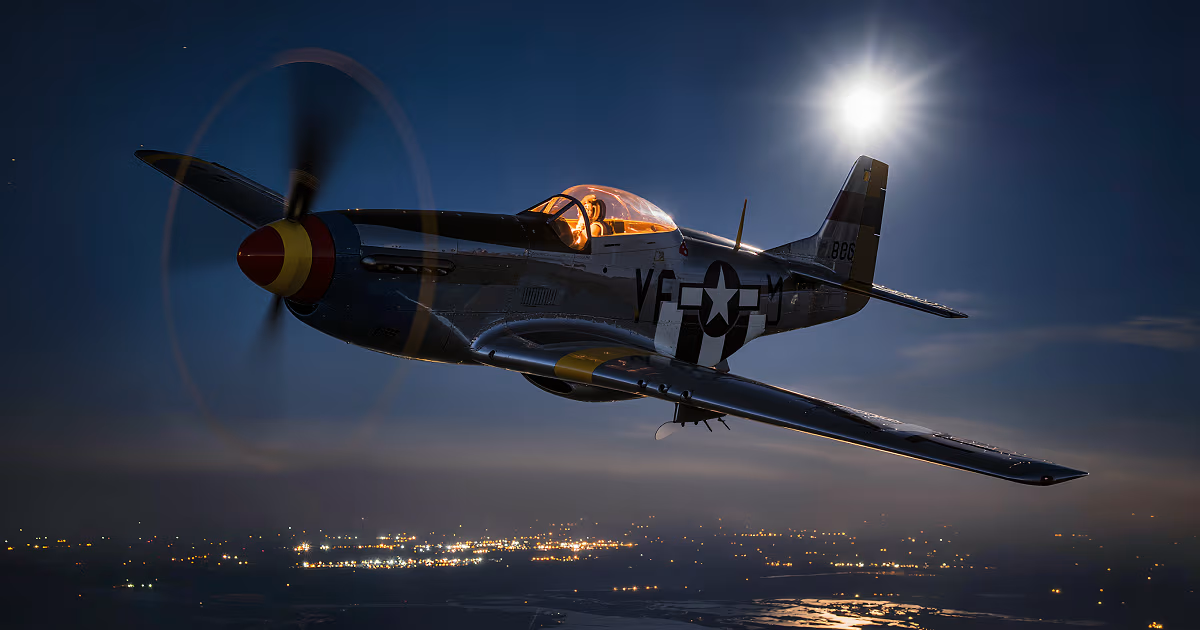
Night P-51 canopy. A light ahead and Fargo dark below.
Illustration, not a period photograph.
Opening
On the evening of 1 October 1948, Second Lieutenant George F. Gorman, a twenty-five-year-old World War II fighter pilot and flight instructor flying a P-51 Mustang for the North Dakota Air National Guard, spent twenty-seven minutes chasing, and being chased by, a small, sharp-edged, blinking white light over Fargo, North Dakota. Two control tower operators watched from the ground. A separate civilian pilot and his passenger, circling nearby in a Piper Cub, watched from the air. All of them, independently, described the same object: round, clean-edged, and capable of speed, turns, and climb rates Gorman's own fighter plane could not match.
Edward Ruppelt, who would later head Project Blue Book, named this case alongside Chiles-Whitted and Mantell as one of three 1948 encounters that most convinced Air Force intelligence analysts UFOs were physically real. It remains one of the few UFO cases with a named military pilot, named ground witnesses, and a named civilian aircrew all independently corroborating the same object's flight behavior in real time.
Timeline
1 October 1948, evening. Gorman returns to Fargo's Hector Airport after a cross-country flight with his squadron and elects to stay airborne to log night-flying hours, circling his F-51 over a lighted football stadium and the city.
Approximately 9 p.m. Preparing to land, Gorman is advised by the control tower of a Piper Cub in the area, which he can see clearly about 500 feet below him. What appears to be a plane's taillight passes him on the right; the tower states it knows of no other aircraft in the vicinity.
Same evening, shortly after. Gorman radios the tower that he will investigate and pulls his F-51 toward the light, closing to roughly 1,000 yards. He describes it as six to eight inches in apparent diameter, clear white, sharply edged with no fuzz or halo, and blinking, before it goes steady and banks sharply left, which he interprets as a pass at the tower.
Same evening. Gorman pursues at increasing power, unable to close the gap as the object climbs and banks again. At roughly 7,000 feet, the object turns sharply toward him; the two close on what he takes to be a collision course before he dives away, the light passing over his canopy at an estimated 500 feet. The object circles roughly 1,000 feet above him and Gorman resumes the chase.
Same evening. A second near head-on pass occurs; the object then climbs steeply straight up and disappears overhead. Gorman's own aircraft stalls at approximately 14,000 feet attempting to follow. He does not see the object again. The encounter ends at 9:27 p.m., twenty-seven minutes after it began.
Same evening, independently. Control tower operators Lloyd D. Jensen and H. E. Johnson watch a light near the field that they separately describe as round, sharply outlined, and moving at a speed clearly exceeding the nearby Piper Cub's; Jensen, using binoculars, notes the object was outdistancing Gorman's pursuing F-51.
Same evening, independently. Piper Cub pilot Dr. A. E. Cannon and passenger Einar Nielson, in radio contact with the tower throughout, separately report a light passing above and to the north of their aircraft moving swiftly westward, distinct from Gorman's fighter, which they could also see and identify separately.
Following days. Gorman gives a formal statement to Major D. C. Jones, commander of the 17th Fighter Squadron, stating his conviction that the object's motion showed evidence of controlled intent, describing its acceleration as rapid but gradual rather than instantaneous, consistent with inertia, and its turns as tight but following a natural curve rather than an impossible, instantaneous direction change. He reports blacking out briefly from the g-forces of his own attempted turn and doubts many pilots could remain conscious matching the object's maneuver.
1949. The U.S. Air Force publicly concludes the object was a lighted weather balloon.
1956. Ruppelt's book The Report on Unidentified Flying Objects notes the balloon explanation runs into a specific problem: a plane would naturally overtake a stationary or slow-moving balloon, which could produce the illusion of head-on passes, but does not account for the object's reported ability to outrun and outclimb Gorman's pursuing fighter.
1970. Physicist James E. McDonald states that the Blue Book file itself contains explicit statements undercutting the balloon explanation the Air Force had officially adopted.
Later. Harvard astronomer Donald H. Menzel, acknowledging the balloon explanation's problems, proposes a two-object solution: Gorman was seeing a lighted balloon at some points and, separately, a mirage of the planet Jupiter at others.
Key figures
Gorman is the case's central witness, an experienced wartime fighter pilot and flight instructor whose own account emphasizes physical detail, no sound, no exhaust trail, no instrument deviation, over sensational claims, and whose formal statement to his squadron commander reads as a careful pilot's technical assessment rather than an embellished story.
Jensen and Johnson are the case's ground-based corroborating witnesses, control tower personnel with a professional stake in accurately distinguishing aircraft from anomalies, whose independent descriptions match Gorman's on the object's shape, edge clarity, and relative speed advantage over both the F-51 and the Piper Cub.
Cannon and Nielson are the case's airborne corroborating witnesses, a civilian pilot and passenger who were simultaneously able to identify Gorman's F-51 as a known, separate object while describing the anomalous light as a third, faster-moving one, a detail that meaningfully rules out simple confusion between the fighter and the object itself.
Ruppelt is the case's most consequential institutional voice, naming it one of the era's three classic cases and later noting in his own book the specific technical problem with the balloon explanation his own former organization had officially adopted.
McDonald and Menzel represent the case's two competing skeptical-adjacent positions: McDonald arguing the Air Force's own file undercuts its official explanation, and Menzel proposing a more elaborate two-cause fix, a lighted balloon plus a Jupiter mirage, to patch the holes the balloon explanation left on its own.
Physical and documentary trail
On the paper, this file has four independent, named witness accounts, Gorman's, the two tower operators', and the civilian aircrew's, all given close in time to the event and largely consistent with one another on the object's appearance and relative speed. It has a formal squadron-level statement from Gorman analyzing the object's flight physics in his own technical terms. It has the Air Force's own officially adopted explanation, and, per Ruppelt's and McDonald's later published accounts, documented internal skepticism within the Blue Book file itself about that same explanation.
There is no photograph, no radar data, and no physical trace, consistent with a nighttime aerial pursuit. The absence of any instrument deviation noted by Gorman, and the total absence of sound, odor, or exhaust reported by every witness, are the details competing explanations have struggled with most consistently.
I am also convinced that the object was governed by the laws of inertia because its acceleration was rapid but not immediate.
Competing explanations
A lighted weather balloon. This became the Air Force's official 1949 explanation and accounts reasonably well for the head-on-pass illusion, a plane overtaking a slow object can appear to be approaching it head-on as their relative positions shift. It accounts poorly for the object's reported ability to actively outrun and outclimb a pursuing fighter at up to 400 mph, a capability no standard weather balloon possesses.
A lighted balloon combined with a mirage of Jupiter. Menzel's later two-part fix directly acknowledges the single-balloon explanation's shortfall by adding a second, unrelated phenomenon to cover the remaining behavior. Ruppelt's own casebook treats this kind of compound, after-the-fact patch skeptically, since it requires two independent misidentifications to have occurred by coincidence within the same twenty-seven-minute window and to have been consistently mistaken for one continuous object by four separate witnesses in two different vantage points.
Vertigo, disorientation, or misjudged relative motion by a startled pilot at night. This reading is weakened specifically by the independent ground and airborne corroboration: Jensen, Johnson, Cannon, and Nielson were not chasing the object and had no comparable disorientation risk, yet described the same shape, edges, and relative speed advantage Gorman did.
A genuine unconventional object exhibiting apparently controlled flight behavior. This remains the reading best supported by the multi-witness consistency and by the specific technical problems, chiefly the sustained speed and climb advantage over a pursuing fighter, that neither official explanation has fully resolved.
Later life of the case
The Gorman Dogfight, alongside Chiles-Whitted and Mantell, helped drive the Air Force's own internal 1948 shift toward taking UFO reports seriously enough to draft the "Estimate of the Situation," and it has remained a fixture of UFO historiography since, featured as the opening case in History Channel's Project Blue Book series in 2019. Gorman himself retired from the Air Force in 1969 as a lieutenant colonel, having given his account only in the immediate aftermath and in formal statements to his own chain of command rather than cultivating a public profile around the case afterward.
Finding
Four independent, named witnesses, an experienced military pilot, two tower operators, and a civilian aircrew who could distinguish the fighter from the object in real time, described the same fast, sharply defined, maneuvering light over Fargo for twenty-seven minutes. The Air Force's own official balloon explanation has been directly challenged by its own later Blue Book chief and by an independent physicist citing the Blue Book file itself, and the compound fix proposed to patch it requires two coincidental misidentifications rather than one.
What still will not resolve: any single conventional explanation that accounts for the object's reported sustained speed and climb advantage over a pursuing P-51 without requiring the kind of stacked, after-the-fact patching that Menzel's Jupiter-and-balloon theory represents. Until one does, Gorman's own squadron statement, that something out there was behaving with apparent intent, remains the most economical reading of what four people independently watched that night.