VALENTICH
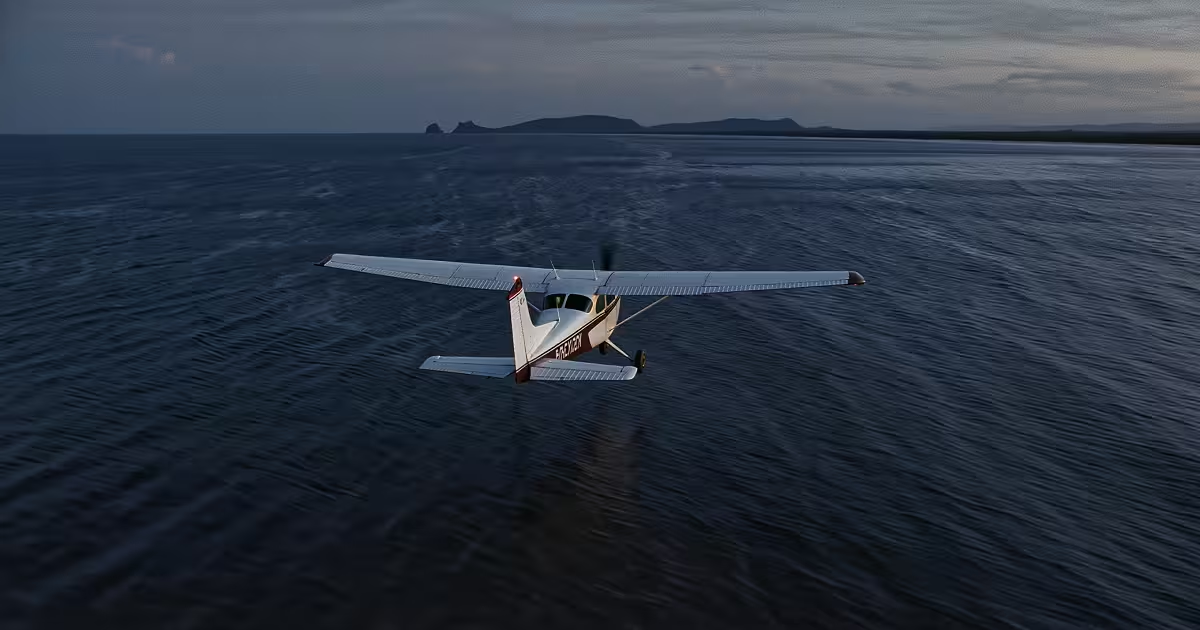
A small single-engine plane flying low over a dark sea.
Illustration, not a period photograph.

Opening
On the evening of 21 October 1978, a 20-year-old pilot named Frederick Valentich took off from Moorabbin, near Melbourne, in a Cessna 182 registered VH-DSJ, heading across Bass Strait to King Island. Over the water he radioed Melbourne Flight Service that a large aircraft with four bright lights was flying above him.
Over the next six minutes he described it orbiting him, hovering, shining with a green light and a metallic surface, while his own engine started to run roughly. His last words were that it was "not an aircraft." Then the microphone stayed open for 17 seconds of metallic, scraping noise, and he was never heard from again. No trace of the pilot was ever found.
Timeline
6:19 p.mValentich takes off from Moorabbin on a night flight to King Island, 125 nautical miles away.
7:06 p.mOver Cape Otway, heading out over the sea, he asks Melbourne whether there is any known traffic below 5,000 feet. There is none. He reports a large aircraft with four bright landing lights about 1,000 feet above him.
7:07 to 7:10 p.mHe says it passed over at high speed, then came back and seems to be "playing some sort of game" with him. It is long and shiny, with a green light. It is orbiting on top of him.
7:12 p.mHe reports his engine is rough-idling and coughing. Then his last words are recorded:
That strange aircraft is hovering on top of me again. It is hovering and it's not an aircraft.
7:12 p.m. onwardsSeventeen seconds of an unexplained metallic noise on the open frequency. Then nothing.
22 to 25 OctoberA sea and air search, with shipping, an RAAF P-3 Orion and eight civilian aircraft, covers more than 1,000 square miles. Oil slicks are spotted, but no wreckage is identified. The search is called off on 25 October.
May 1982The Department of Transport's report says the reason for the disappearance has not been determined, and that the outcome is presumed fatal for the pilot.
Key figures
Frederick Valentich had about 150 hours of flying experience and hoped to become a commercial pilot. He had a strong interest in UFOs, which supporters and sceptics have each used to argue their case. His father, Guido, said for the rest of his life that he hoped his son had been taken, because it meant he might still be alive.
Steve Robey was the Melbourne Flight Service officer who spoke with him during those final minutes. The recording and transcript of their exchange are the core of the case.
Physical and documentary trail
The official record is solid: the flight plan, the transcript of the radio exchange, the search reports and the Department of Transport's final report. Several people on the ground in the Cape Otway area reported seeing a strange green light moving over the sea that evening. A man photographing the sunset at Cape Otway shortly before took pictures that some say show an object, though what they show is disputed. In 1983 an engine cowl flap washed up on Flinders Island. In July that year the Bureau of Air Safety Investigation said it came from a Cessna 182 within a range of serial numbers that included VH-DSJ, which narrows it down but does not prove it. The bureau also asked the Royal Australian Navy Research Laboratory whether a part lost in the search area could have drifted to Flinders Island.
Two other details sit in the record. The aircraft never appeared on radar during the flight. And Mount Stromlo Observatory recorded a meteor stream that night, with 10 to 15 meteors an hour, bright moving lights in the same sky Valentich was describing.
Things you might not know
- Nobody knows why he was going. He told flight officials he was picking up friends on King Island and told others he was collecting crayfish. Investigators found neither was true, and he had not told King Island Airport he was coming, as pilots normally would.
- The RAAF turned him down twice. Both times for not having enough schooling. He had also failed all five commercial pilot exams twice, and failed three more the month before he vanished.
- He had been warned before. He had strayed into controlled airspace near Sydney and twice flown deliberately into cloud, and prosecution had been considered.
- He was only rated for clear nights. His class-four instrument rating let him fly at night only in visual conditions, with a horizon to fly by.
- He had talked about it days before. His father said he was a firm believer in UFOs and worried about being attacked by one. Six days before the flight, he spoke to his girlfriend, Rhonda Rushton, about people being taken.
- The "UFO photo" may be a fly. Plumber Roy Manifold's sunset pictures from Cape Otway that day were said to show something rising from the sea. Sceptics think it is an out-of-focus insect or bird.
- Meteors were falling that night. An observatory near Canberra logged 10 to 15 an hour.
- He had fuel to go a long way. The Cessna carried enough for roughly 800 km, far more than the hop to King Island.
Competing explanations
An encounter with something unknown. The radio exchange describes a large, lit, metallic object the controllers could not identify, and ground witnesses reported a green light over the sea that night.
Disorientation and a crash. One theory is that Valentich became disoriented in the dark over the sea, perhaps flying in a steep bank or even upside down and seeing his own lights reflected or the lights of the coast, before crashing. Scientist Richard Haines examined the case in detail and found the theory hard to fit with how calm and specific the pilot sounds. In 2013 astronomer James McGaha and investigator Joe Nickell proposed a "graveyard spiral": with no horizon over the dark sea, he may have mistaken Venus, Mars, Mercury and the star Antares for the lights of another aircraft while slowly losing control.
A film in his head. The science writer Brian Dunning has pointed out how closely the radio exchange echoes Close Encounters of the Third Kind, and suggested Valentich may have been acting out the film before becoming genuinely disoriented.
A staged disappearance. Some have suggested he faked his own disappearance or took his own life. Those who favour staging point to his fuel, enough for about 800 km, to the fact that the Cessna was never on radar, and to reports police received of a light aircraft landing near Cape Otway at about the same time. The ufologist Keith Basterfield, who interviewed people who knew him, judged suicide very unlikely. Nothing has ever been found to support either idea, and the radio exchange does not sound like a goodbye.
Later life of the case
The Valentich disappearance is still one of the most discussed aviation mysteries in the world, and the radio transcript is often cited as one of the most haunting recordings in UFO history. The aircraft has never been found.
Finding
A young pilot calmly described an unknown object to air traffic control, said plainly that it was not an aircraft, and vanished with his plane. No wreckage or explanation has ever fully accounted for what he described.
What still will not resolve: what was above VH-DSJ that night, and where the Cessna went. The metallic sound at the end of the tape has never been explained.
Evidence signature
6/9 Solid
- Witnesses
- several people
- Instruments
- photo, film or physical traces
- Paper
- formal investigation, court or declassified file
How well documented the case is, not whether it's true. A strong record can still have an ordinary answer, and a thin one can still be real.
You decide · VALENTICH
What do you think happened?
One vote per case, anonymous. You'll see how other readers voted once you've voted.