FALCON LAKE
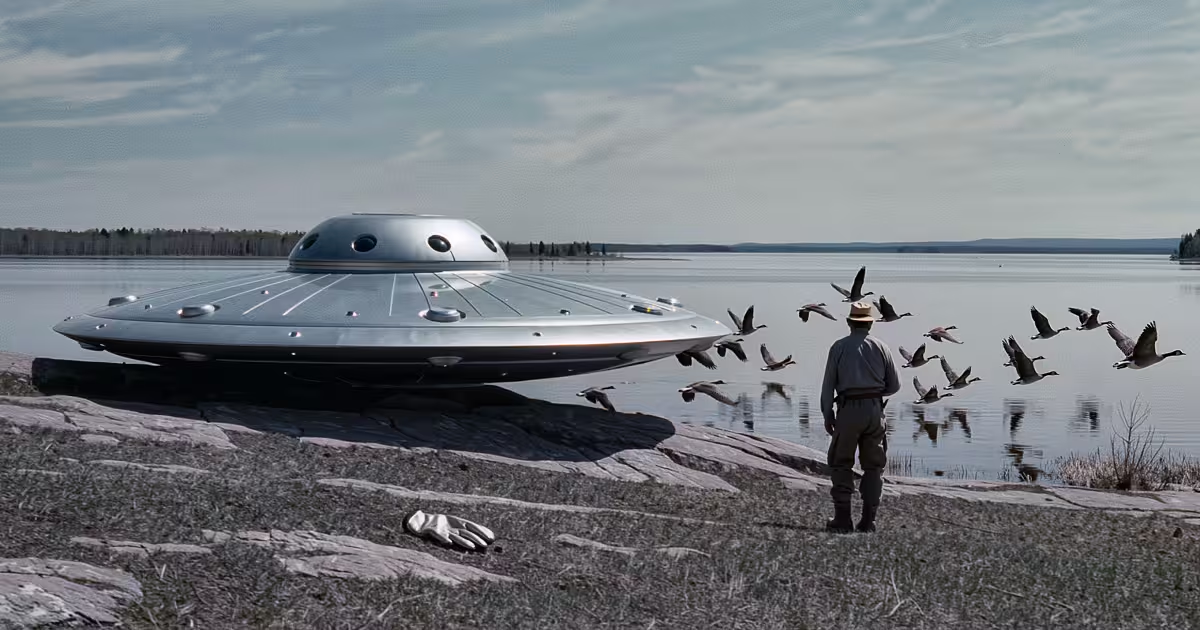
Precambrian rock and a landed disc at midday.
Illustration, not a period photograph.
Opening
At around 12:15 p.m. on 20 May 1967, Stefan Michalak, an industrial mechanic and amateur geologist prospecting for quartz near Falcon Lake in Manitoba's Whiteshell Provincial Park, watched two glowing, cigar-shaped objects descend toward him. One climbed away and vanished into the clouds; the other landed roughly 150 feet off, cooling in color from red through orange to a dull silver-grey as it sat. A door opened in its side and Michalak heard voices from within. He tried English, Russian, and other languages with no response, approached, and touched the hull. As the craft rotated and lifted away, a grid-patterned vent in its side blasted him with hot gas, setting his shirt and undershirt on fire and burning a matching geometric pattern into his abdomen.
What makes this case unusual is not the story itself, plenty of contactee-style accounts from the same decade sound similar, but the sheer weight of subsequent physical documentation: same-day contact with a highway patrolman, same-night hospital treatment, RCMP investigation, a soil sample that tested positive for radioactivity, a formal Condon Committee inquiry, and a Mayo Clinic evaluation, all still not producing a conventional explanation that fully satisfied either side.
Timeline
20 May 1967, approximately 12:15 p.m. Michalak, alerted by agitated geese taking off from a nearby pond, sees the two objects and experiences the landing, contact, and burn as described.
Same day, afternoon. Michalak flags down a passing RCMP highway patrol officer on the Trans-Canada Highway and reports being burned by a "spaceship." This on-duty police contact, filed in writing the same day, is the case's earliest official record.
Same night. Michalak seeks medical treatment in Winnipeg and is diagnosed with first-degree burns in a distinctive pattern.
22 May 1967. Michalak contacts the press. The Winnipeg Tribune runs his account, triggering national coverage and prompting both Canadian and American civilian and official investigations.
23 May 1967. A civilian UFO investigator photographs Michalak's torso, documenting irregularly shaped, unevenly spaced burns consistent with his account rather than with a simple, uniform injury.
26 June 1967. Despite having told authorities he would not disturb the site, Michalak reports he returned to the landing location and collected artifacts, a burnt shirt, a steel measuring tape, and a soil sample. The soil sample subsequently tests positive for elevated radioactivity, and Michalak leads authorities to the actual site afterward.
June 1967. An RCMP report describes Michalak's burns directly: "a large burn that covers an area approximately 1 foot in diameter... blotchy and with unburned areas inside the burned perimeter area," treating the injury itself as physically real even as the cause remained unaddressed.
Following weeks. Michalak undergoes a whole-body radiation count at an Atomic Power Installation to check for internal gamma-emitting isotope contamination, and is separately evaluated at the Mayo Clinic in Minnesota, passing both physical and psychological assessment with no medical explanation found for his injuries or later symptoms of nausea, vomiting, diarrhea, and weight loss.
1968. Physicist Roy Craig investigates the case for the U.S. Air Force-funded Condon Committee (University of Colorado UFO study), accompanied by Life magazine reporters and photographers during his fieldwork.
Late 1970s. Canadian researcher Chris Rutkowski reopens the case after the original investigating team disbands and the files become scattered, re-interviewing Michalak and his family and eventually locating several hundred pages of government documents on the case.
1999. Michalak dies at age 83; Rutkowski's obituary for him notes that despite decades of attention, no skeptical explanation offered up to that point had adequately addressed the case's major physical details.
2010s. The University of Manitoba Archives and Special Collections receives the full Falcon Lake case files, including sketches, photographs, RCMP documents, the burnt shirt and hat, and site debris, consolidating the physical record in one academic repository.
Key figures
Michalak is the case's sole direct witness, a working mechanic with prior prospecting experience in the exact area, no known history of UFO claims before this event, and a documented reluctance about the fame it brought him; by Rutkowski's account he was "beleaguered" by attention he had not sought.
Craig is the case's most consequential skeptical investigator, and his own conclusion, later expanded in his book, was carefully worded: "events during and subsequent to a field search for the landing site cast strong doubt upon the authenticity of the report," a judgment about the physical search rather than a specific alternative explanation for the burns themselves.
Rutkowski is the case's principal long-term chronicler and the person most responsible for the case's modern documentary completeness, having personally tracked down the scattered files and re-interviewed the family after the original 1960s-70s investigative team dissolved.
The RCMP officers and the treating physicians are the case's other direct-observation witnesses, none of whom disputed that Michalak had genuinely been burned in an unusual pattern; their reports document the injury as real while remaining silent on its cause.
Physical and documentary trail
On the paper, this file has an unusually complete chain: a same-day police contact, same-night medical treatment records, photographs of the burn pattern taken within days, a physical soil sample that tested positive for radioactivity, a burnt shirt and hat preserved and later archived, RCMP incident reports, a Condon Committee field investigation, and a Mayo Clinic clearance ruling out self-inflicted or psychiatric explanations for the burns.
What it lacks is any single piece of evidence that independently confirms the craft itself, no photograph of the object, no second witness to the landing or contact, and no conventional source ever confirmed for either the radioactivity reading or the specific grid-pattern burn. Craig's skepticism centered specifically on the physical search for the landing site rather than on the medical evidence, meaning the case's most credentialed skeptical assessment and its most solid physical documentation, the burns themselves, do not actually conflict.
Events during and subsequent to a field search for the landing site cast strong doubt upon the authenticity of the report.
Competing explanations
A hoax. This reading, favored by at least one early skeptic per Rutkowski's own account, has never been supported by a specific mechanism explaining how Michalak could have produced a consistent, medically documented, grid-patterned burn convincing enough to pass Mayo Clinic evaluation, nor any confirmed motive; Rutkowski notes this explanation was offered "without addressing any of the case's major details."
A secret aerospace or military test accident. Raised as an alternative by at least one other published account, this reading would explain a real physical burn from a real technological source without requiring an extraterrestrial craft, but has never been supported by any confirmed classified program, Canadian or American, matching the described object or location.
Craig's doubts about the landing-site search itself. Craig's own careful language leaves room to doubt aspects of Michalak's account of returning to and identifying the site weeks later, an act that itself broke his earlier promise not to disturb the location, without necessarily doubting the burns or the original event's core physical reality.
A genuine unexplained close encounter. This remains the reading best supported by the case's cumulative documentation: real injuries, professionally assessed as real by multiple independent medical examiners across two countries, a radioactivity reading in a collected soil sample, and no confirmed conventional source ever identified for either.
Later life of the case
CBC News has called Falcon Lake "Canada's best-documented UFO case," and it remains one of the few close-encounter reports with physical evidence, the burnt clothing, the soil sample, the medical photographs, preserved and archived at a university rather than existing only as testimony. In 2019, Canada issued a commemorative $20 coin depicting the encounter, reflecting the case's enduring place in Canadian popular culture. Rutkowski's decades of sustained, methodical re-investigation, gathering hundreds of pages of government records after the original file went missing, is itself a notable feature of the case's later life: unusually few UFO cases receive that level of sustained archival effort from a single researcher.
Finding
Stefan Michalak was burned, in a distinctive and medically documented pattern, on a specific afternoon in May 1967, and passed muster with Canadian and American physicians who found no evidence of self-infliction or psychiatric cause. A soil sample he collected from the reported site tested positive for radioactivity. The Condon Committee's own investigator expressed doubt specifically about the landing-site search, not about the medical facts of the burn itself.
What still will not resolve: a confirmed conventional source, technological, natural, or otherwise, for either the burn pattern or the radioactivity reading, and no second witness has ever come forward to corroborate the landing and contact itself. Until one of those changes, Falcon Lake stays exactly what CBC called it: extensively documented, and still unexplained.