COYNE
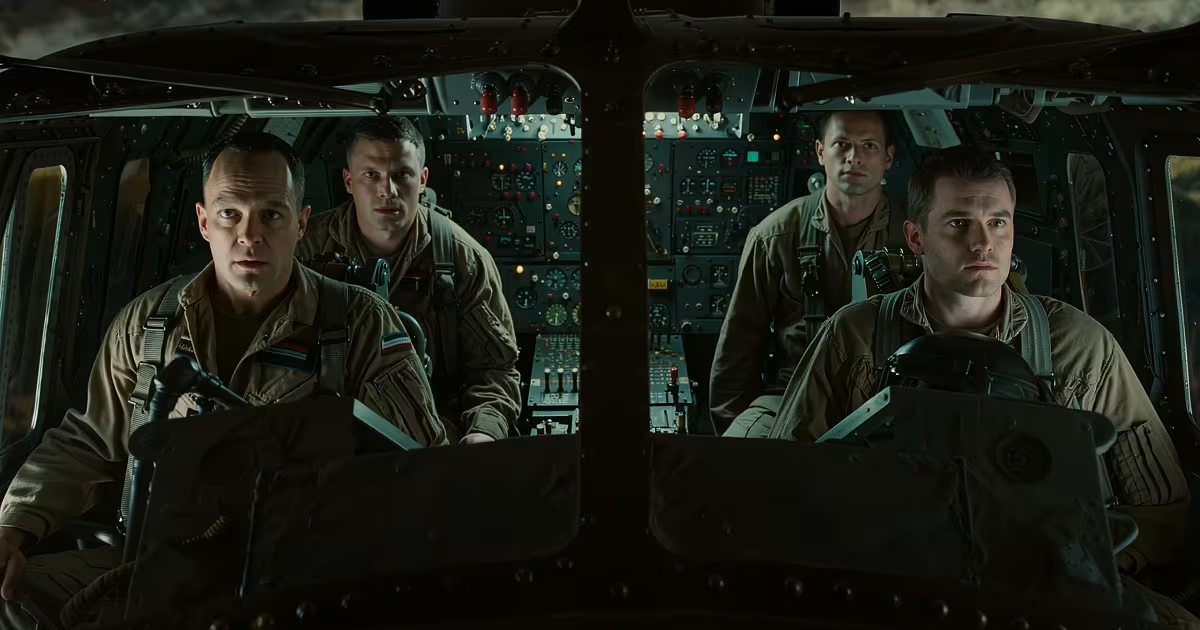
Huey night. Green wash in the cabin glass.
Illustration, not a period photograph.
Opening
On the night of 18 October 1973 an Army Reserve Huey, call sign from the 316th Medical Detachment, was flying from Columbus to Cleveland with four men aboard: Captain Lawrence Coyne, First Lieutenant Arrigo Jezzi, Sergeant John Healey, and Sergeant Robert Yanacsek. Near Mansfield, Ohio, Yanacsek called a red light on the eastern horizon. It came at them. Coyne put the helicopter into a descent. The light became a metallic shape with a red nose, a dome, and a green beam that filled the cabin. The altimeter rose while the stick said down. Then the object left toward the north-west and the Huey was higher than it should have been.
All four men signed the same night. Radio to Mansfield tower went unanswered at the worst minute. Ground witnesses later said they had seen a light and a helicopter together. The Army took statements. Blue Book was already closed. Coyne did not recant.
The spine of the file is a four-man cockpit and a beam that painted the cabin green. Coyne is a Huey that met something over Ohio. It is not a recovered disc in a Mansfield hangar.
Timeline
18 October 1973, about 23:00. Huey at 2,500 feet toward Cleveland, night, ordinary weather for the trip. Yanacsek, rear right, calls the red light. It does not stay on the horizon. Coyne descends, radio call, no useful answer. The object fills the windscreen: grey metal, red forward light, a dome, then a green shaft through the cabin that the men say lit their faces.
The helicopter climbs against command, 3,500 then toward 3,800 in the telling, while Coyne still has the collective where a descent should be. Magnetic compass spins. The object peels off. They fly on to Cleveland and write.
Statements that week. Later ground witnesses from the Mansfield area are collected. A channel of official paper exists without a type. The four men keep the same shape of night for decades, with the ordinary drift of retelling, not a collapse.
Close-encounter lists treat this as a multiple-witness airborne case with a vehicle. That list is later life. The cabin at 23:05 is first.
The Huey was a medical reserve bird on a night hop, not a hunter. Yanacsek's call from the right rear is why four men were looking before the object filled the glass. Coyne's descent and the unanswered radio are in the same minute. The green in the cabin is the detail all four still carry.
Ground people near Mansfield later described a light and a helicopter together. That supporting talk does not have to be perfect to matter. Blue Book was already shut. The Army still took statements because four signatures on one night is not a barracks rumour.
Key figures
Lawrence Coyne is the command pilot. An Army captain on a medical flight is not a club speaker. His descent that became a climb is the exhibit.
Jezzi, Healey and Yanacsek are why this is not a single-seat story. Four men, one cabin, same green.
Mansfield tower owns the radio that did not help at the minute they needed it.
Ground witnesses own a supporting light. They do not own the beam inside the Huey.
Physical and documentary trail
On the paper, 18 October 1973 gives you four hard objects and no airframe.
One: the four-man statement of a closing object, a metal shape, a green cabin light, and an uncommanded climb.
Two: the failed or unanswered radio at the intercept minute.
Three: altimeter and compass behaviour as the crew wrote it.
Four: Army statements and later ground corroboration. U.S. Army statements of the 316th Medical Detachment crew, 18 October 1973, are the originating tray.
There is no gun-camera. There is no radar track everyone accepts as the second object. There is no fragment off the beam.
Four named crew on one airframe is the expensive part. A single-seat story can drift. Four men who still describe the same green have to be talked out one at a time, and that work has not been done on paper that holds.
A green light filled the cockpit.
Competing explanations
An unknown craft that paced a Huey and lit the cabin. This is the four-man night. It has rank on the paper. It has no wreck.
An aircraft or meteor the crew misread, plus a mishandled climb. Possible in night air. Has to carry a green beam four men still describe the same way.
A story grown after landing. Weak once you have four signatures from the same night.
Hybrid caution. A helicopter met a light that became a shape. The cabin went green. Cleveland had no guest on the pan.
Later life of the case
Close-encounter textbooks and anniversary interviews. I keep those on the later-life shelf. The four signatures stay first.
Finding
Four Army men in a Huey over Ohio on 18 October 1973 watched a shaped object come at them, sat in a green cabin light, and found the helicopter higher than the stick said it should be. Believe the crew. A medical detachment does not invent a beam for a report they have to sign.
What still will not resolve: a radar file of that second object, or a photograph from the ground that is the same machine. Either one would pin the green to a craft. The proving object is still what filled the windscreen, held by someone who was not in that Huey.