CARP
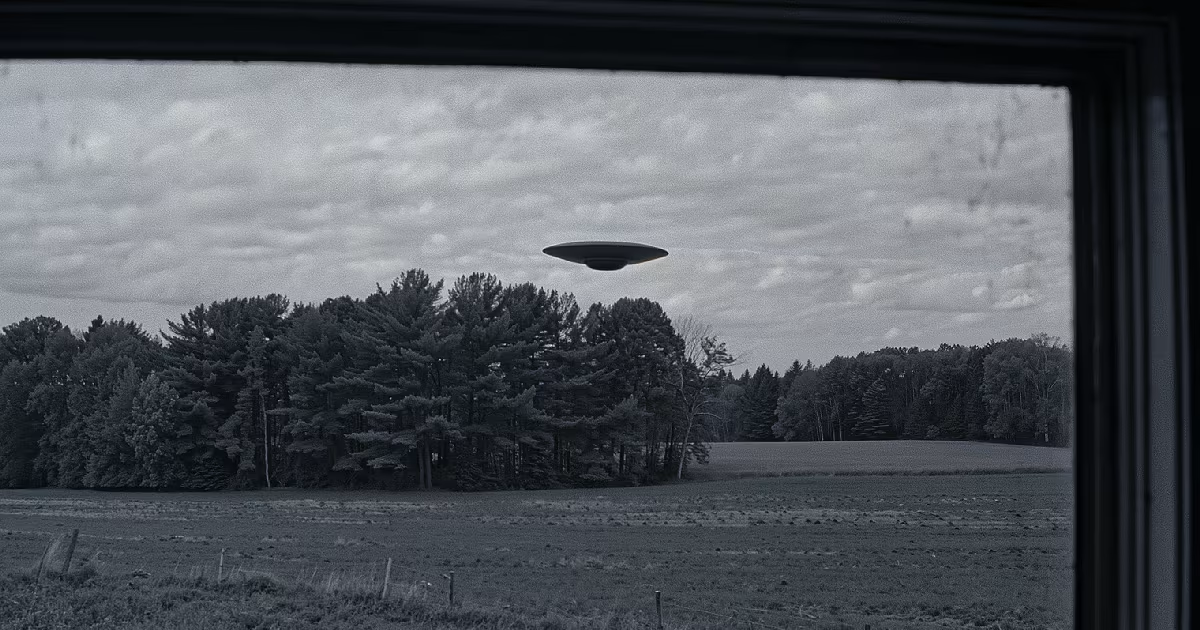
Ontario window view. Treeline, empty sky.
Illustration, not a period photograph.
Opening
In August 1991, a woman named Diane Labenek reported seeing a dark, disc-like object hovering beside a cluster of burning, flare-like flames in a field in West Carleton Township, a rural area near Carp, Ontario, about thirty kilometers west of Ottawa. Six months later, a package with no return address arrived for American UFO researcher Bob Oechsler, containing a VHS tape labeled with a single name, "Guardian," alongside what was presented as a fingerprint. The tape appeared to show exactly the scene Labenek had described, filmed from a position that matched her account in detail she had not disclosed publicly.
What followed was one of the most elaborate UFO document-and-footage packages ever circulated in North America, running for years, escalating in scope with each new mailing, and eventually claiming a crashed craft, alien bodies moved to research facilities at the University of Ottawa, and forged-looking Department of National Defence paperwork. It aired on three American network shows, drew investigators from both countries to a small farming township, and to this day has never been traced to a confirmed author.
Timeline
1989. The first "Guardian" package circulates to UFO investigators in Canada and the United States: a typewritten account of a UFO crash in West Carleton and photographs of an alleged alien body, widely dismissed by researchers at the time as a person in a dark suit and a hockey mask standing in a field.
August 1991. Diane Labenek reports witnessing a dark, saucer-like object beside a group of bright, flare-like flames in a field near Carp.
Early 1992. A second, more elaborate Guardian package reaches Bob Oechsler, an American UFO researcher, containing the VHS tape, a map directing him to West Carleton, and further Guardian-authored material. Oechsler travels to the area with fellow researcher Graham Lightfoot and interviews Labenek, who, according to Oechsler, describes details of the scene matching the tape despite having never seen it.
Early-to-mid 1990s. Later Guardian mailings escalate further, adding purported Department of National Defence documents, diagrams claiming to explain how the craft evaded Canadian radar, and claims that alien remains had been taken to underground research facilities at the University of Ottawa.
1994. Sixteen-year-old Ian Rogers, an Ontario teenager following the case through UFO researcher networks, drives to West Carleton on his own initiative to investigate, later becoming one of the case's most persistent long-term chroniclers.
Mid-1990s. The case is featured on American television programs including Sightings and Encounters, and later on Unsolved Mysteries, dramatically expanding its public profile beyond the UFO research community.
2020-2021. Filmmakers Nick Crowe and Catie Lamer produce the CBC documentary UFO Town, revisiting the case through Rogers, tracking down a local man previously accused on-camera by an American television investigator of being Guardian, and interviewing residents who describe unrelated but similarly unexplained sightings in the same rural district.
Key figures
Labenek is the case's original witness, and her account of the field sighting predates the first VHS package by roughly six months, which is the detail that gave the case whatever traction it had among researchers otherwise primed to dismiss it: an independent witness describing the same scene the tape later showed.
Guardian is the case's central and still unidentified figure, known only through a self-chosen name, an accompanying fingerprint that appears never to have been matched to anyone, and an escalating pattern of mailings over several years that suggests either sustained personal commitment to an elaborate hoax or, in the reading favored by believers, a genuine insider protecting their identity.
Oechsler is the researcher whose credibility lent the case its early seriousness; he described his own initial impression as leaning toward authenticity based on the tape's apparent naturalism, a judgment that was not shared by most of his professional peers, several of whom noted the footage was consistent with staged flares and a vehicle in a field.
Bruce Maccabee, a U.S. Navy physicist and photo analyst with a long history of UFO photographic analysis work, described the tape as one of the clearer examples he had reviewed of an apparently structured object, a technical assessment that stopped short of confirming the object's nature or origin.
Rogers is the case's longest-running independent chronicler, tracing the path of Guardian's packages as a teenager in the 1990s and returning to the story as an adult filmmaker's collaborator in 2020, by which point he had also gathered separate, Guardian-unrelated accounts of strange sightings from area residents.
A local man in his sixties, a churchgoer and self-described believer in dowsing and related phenomena, was accused on-camera of being Guardian by an investigator on the television program Encounters; he denies it, and no public evidence beyond that on-air accusation ties him to the packages.
Physical and documentary trail
On the paper, this file has an unusually large volume of material for a hoax-suspected case, and almost none of it survives independent verification.
One: the VHS tape itself, showing a dark, disc-shaped object with a strobing blue light beside burning flare-like flames in a field, widely available and widely analyzed, with professional opinion split between "consistent with a staged scene involving a vehicle and road flares" and Maccabee's more cautious "clearer than most examples of an apparently structured object."
Two: the purported Department of National Defence documents, never authenticated by the DND and generally treated by researchers on both sides of the case as either forged or, at best, unconfirmed.
Three: the fingerprint attached to the original package, which as far as public reporting shows was never matched against a known individual, leaving Guardian's identity formally unresolved rather than formally protected.
Four: Labenek's original witness account, which predates the tape's circulation and is the one piece of testimony in the file that does not depend on Guardian's own material for its existence, though it also cannot independently confirm anything about the tape's authenticity, only that something unusual was reported in that field before the tape arrived.
There is no confirmed identity for Guardian. There is no DND record acknowledging the events described. There is no crash site, wreckage fragment, or University of Ottawa research record that has ever surfaced publicly.
I kind of had a sense I might be dealing with something that was potentially authentic here.
Competing explanations
An elaborate, sustained hoax. This is the reading favored by most Canadian ufologists who have examined the case closely enough to have an opinion on it, several of whom are notably reluctant to discuss it at all, treating it as an embarrassment to the field rather than an open case. The footage's resemblance to a vehicle and flares in a field, the DND documents' lack of authentication, and the escalating, narrative-driven nature of each new package all point this direction.
Oechsler himself as Guardian, or a close collaborator. Raised explicitly in the CBC documentary as a theory some observers hold, on the reasoning that Oechsler was positioned to benefit professionally from a case he was simultaneously investigating and vouching for. This remains speculative and is not confirmed by any direct evidence tying him to the fingerprint or the original mailings.
A genuine event, obscured by a hoaxer's embellishment. This reading separates Labenek's original sighting, which predates and does not depend on Guardian's material, from everything Guardian subsequently added. It allows for something unexplained having happened in that field in August 1991 without requiring any of the later crashed-craft, alien-body, or DND-cover-up material to be true.
Genuine non-human craft and cover-up, as told. This is Guardian's own narrative, escalating over several mailings, and it is the reading requiring the most independent confirmation that has never arrived: no DND record, no University of Ottawa facility record, no matched fingerprint, no named second source.
Later life of the case
The case's spread through 1990s American television, Sightings, Encounters, and finally Unsolved Mysteries, is itself part of the story: each appearance added viewers and pressure without adding verification, a pattern common to media-amplified UFO cases of that decade. The area's own military connection, used periodically for Canadian Forces exercises, gave skeptics a mundane candidate for unusual lights and activity independent of anything Guardian claimed.
UFO Town, the 2020-2021 documentary, is notable for declining to resolve Guardian's identity while still finding something worth investigating: residents in the same rural district, unconnected to the Guardian material, describing their own unexplained sightings decades apart, which the filmmakers treat as a separate, still-open thread rather than evidence for or against the hoax.
Finding
The Guardian packages, taken as a whole, show the signature of a sustained, escalating fabrication: unauthenticated government documents, footage most professional reviewers read as staged, and an identity protected behind a name and an unmatched fingerprint rather than confirmed by either. Labenek's original 1991 sighting is the one thread in the file that exists independently of Guardian's own material, and it establishes only that something was reported in that field before any tape arrived, not what it was.
What still will not resolve: Guardian's identity, and whether the fingerprint attached to the original package was ever run against anyone at all. Until one of those surfaces, Carp stays a case about the hoax itself as much as about anything that may or may not have happened in a West Carleton field in 1991.