EUPEN 1989
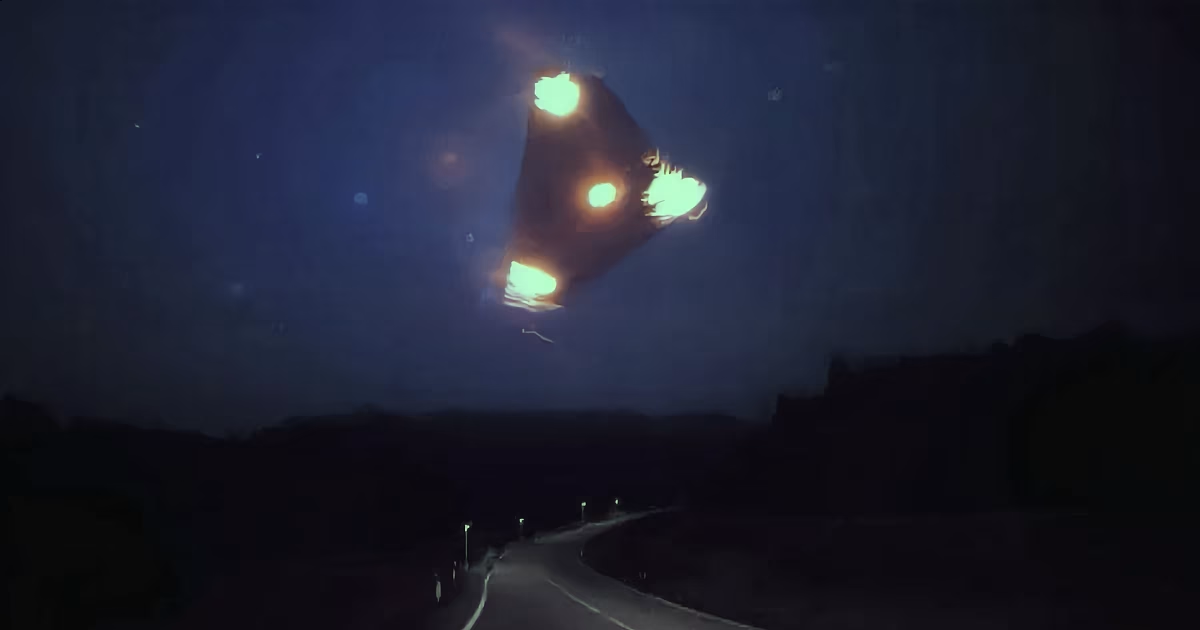
A dark triangle with bright corner lights over a road at night.
Illustration, not a period photograph.

Opening
At about 5:20 pm on 29 November 1989, two Belgian gendarmes, Heinrich Nicoll and Hubert von Montigny, were driving on routine patrol from Eupen to Kettenis, close to the German border, when they saw a bright light over a field beside the road. It was a large, silent, triangular object with bright lights at each corner and a red light in the centre. They followed it for some time as it hovered and moved slowly.
They were not alone. Other patrols and dozens of civilians reported something similar that evening, and once the press picked up the story about 140 people from the area came forward. This report is about that first night. It became the opening of the Belgian UFO wave, told in full in the Belgian Wave report.
Timeline
29 November 1989, about 5:20 pmOn the road from Eupen to Kettenis, Nicoll and von Montigny see a bright light over a field. Close up it is a large triangle, silent, with lights at its corners and a red light in the middle. It moves off slowly, and they follow it. They radio their base.
That eveningThe object is later reported over the Gileppe reservoir. Other gendarmes and civilians across the area report lights and triangles.
The following daysThe civilian UFO group SOBEPS begins collecting witness statements from the night, and later press coverage brings the number of people reporting it to about 140. The defence minister rules out military aircraft.
Winter 1989 to 1991Reports spread across eastern Belgium and the wave runs for more than a year, including the F-16 scramble of 30 to 31 March 1990 and the Petit-Rechain photograph, later confessed as a hoax. See the Belgian Wave for that story.
September 1991NBC's Unsolved Mysteries films a reconstruction of the Eupen night using computer-generated imagery.
Key figures
Heinrich Nicoll and Hubert von Montigny, the Eupen gendarmes, are the first and most-cited witnesses: two police officers on duty, following an object for an extended time.
SOBEPS, the Belgian Society for the Study of Space Phenomena, gathered the night's witness statements and published them in its two-volume report on the wave. Defence minister Guy Coëme ruled out Belgian and allied military aircraft.
Physical and documentary trail
The record for the first night: the gendarmerie reports, the witness statements collected by SOBEPS, the defence minister's statement, and press coverage from the following days. There is no photograph of the Eupen object and no radar record of it from that evening.
The rest of the wave has its own problems, a faked photograph and disputed radar data from the F-16 night, but those belong to later months. The gendarmes' account of 29 November stands on its own.
Things you might not know
- It hovered over a reservoir for an hour. The object was reported hanging motionless over the watch-tower at the Gileppe lake for about an hour.
- Six gendarmes were among the witnesses. SOBEPS counted 41 witnesses that evening, six of them gendarmes. Other counts of the night differ.
- The defence minister ruled out military aircraft. Guy Coëme said all hypotheses involving military aircraft in Belgian airspace were "definitely to be ruled out".
- Reuters had another answer. A Reuters report put the lights over Eupen down to a Soviet satellite breaking up.
- American television reconstructed it. NBC's Unsolved Mysteries filmed a reconstruction in September 1991, using computer-generated imagery.
Competing explanations
Unknown craft. The gendarmes' long, close observation and the number of witnesses that night are the core of the case.
Helicopters or aircraft. Some later sightings in the wave match military helicopters or aircraft with bright landing lights, and the first Eupen report has itself been compared to a helicopter. The descriptions of a slow, silent, large triangle don't fit easily, and the minister ruled out military aircraft.
A secret aircraft. Some suggested a US stealth aircraft. The US denied flying over Belgium, and the F-117's shape and behaviour don't match what was reported.
A re-entering satellite. The Reuters suggestion. A satellite breaking up would cross the sky in seconds or minutes, not hover for an hour.
Later life of the case
The Eupen night is the founding sighting of one of the best-known UFO waves of the late twentieth century. The later Petit-Rechain confession damaged the wave's image, but it doesn't touch what the two gendarmes reported on 29 November.
Finding
Two police officers on duty watched a large triangle for an extended time on 29 November 1989, and dozens of others saw something similar that evening. No photograph or radar record supports them, and no explanation offered so far fits what they described.
What still will not resolve: what the Eupen gendarmes followed.
Evidence signature
6/9 Solid
- Witnesses
- trained, independent witnesses
- Instruments
- photo, film or physical traces
- Paper
- official records at the time
How well documented the case is, not whether it's true. A strong record can still have an ordinary answer, and a thin one can still be real.
You decide · EUPEN 1989
What do you think happened?
One vote per case, anonymous. You'll see how other readers voted once you've voted.