TITAN II
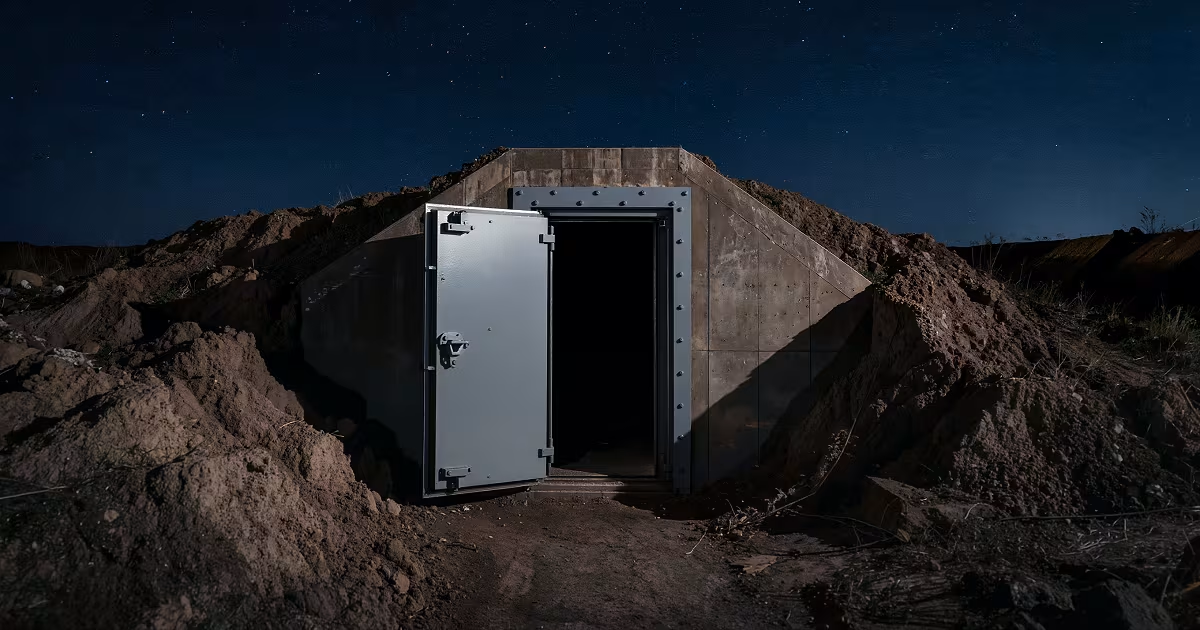
The heavy steel door of a Titan II silo standing open at night.
Illustration, not a period photograph.

Opening
On the evening of 18 September 1980, an airman doing routine maintenance in a Titan II missile silo near Damascus, Arkansas, dropped a heavy socket from a wrench. It fell about seventy feet, bounced, and punctured the missile's first-stage fuel tank.
Over the next eight hours fuel vapour filled the silo. At about 3 a.m. on 19 September it exploded, blowing off the silo door, killing Senior Airman David Livingston and injuring others, and throwing the missile's nuclear warhead into a nearby field. The warhead didn't detonate. The Damascus accident is the most serious nuclear weapons accident on American soil that has been made public.
Timeline
1963Titan II, the largest US intercontinental missile, enters service in silos in Arizona, Kansas, and Arkansas. It uses storable liquid fuels that are toxic and ignite on contact.
9 August 1965A fire at a Titan II site near Searcy, Arkansas, kills 53 civilian workers during modification work.
18 September 1980, about 18:30At Launch Complex 374-7 near Damascus, an airman's socket falls and pierces the fuel tank. Fuel starts leaking.
Overnight. Crews and commanders debate what to do. The area is evacuated. Two airmen go into the complex to check vapour levels.
19 September 1980, about 03:00The fuel vapour explodes. The 740-ton silo door is blown off. The W53 warhead is thrown clear and later found intact. Livingston dies of his injuries, and more than twenty people are hurt.
1987The last Titan II missiles are retired.
2013Eric Schlosser's book Command and Control reconstructs the accident in detail.
Key figures
The airman who dropped the socket was doing a routine task with the wrong tool, according to later accounts.
Senior Airman David Livingston was killed after going into the complex that night.
Eric Schlosser made the accident widely known, and set it inside a history of near-misses with US nuclear weapons.
Physical and documentary trail
The sources: Air Force accident investigation records, congressional reports, press coverage, the documentary based on Schlosser's book, and survivor accounts.
This site files it under UFOs because Titan II silos also appear in stories of lights seen over missile bases in the 1960s and 70s. Those stories are thin. The Damascus accident is the part of the Titan II record with evidence.
Things you might not know
- The socket weighed 8 pounds. It fell about 80 feet, bounced off a thrust mount and punched through the first-stage fuel tank.
- The wrong tool was used. The airman carried a 3-foot, 25-pound ratchet wrench into the silo instead of a torque wrench.
- The warhead was 9 megatons. The W53 was the most powerful warhead ever carried by an American intercontinental missile.
- It landed by the gate. The warhead came down about 100 feet from the complex's entry gate.
- The governor was Bill Clinton. He said Air Force officials told him a nuclear explosion could not have happened inside the silo.
- A hero was reprimanded. Sergeant Jeff Kennedy was first praised, then reprimanded for going into the complex against orders, and suffered lasting breathing problems from the oxidiser.
- It was filmed twice. The TV film Disaster at Silo 7 followed in 1988, and the documentary Command and Control in 2017.
Competing explanations
An accident. A dropped socket, an old missile design, and slow decisions. Every official and independent account agrees.
Anything else. No investigation has found evidence of sabotage, an unexplained object, or any other cause.
Later life of the case
Damascus is central to the history of nuclear safety, and a warning about ageing weapons and procedures. The site is now private land. A Titan II silo near Tucson, Arizona, survives as a museum.
Finding
Not a UFO case. A dropped tool caused an explosion that killed one airman and threw a nuclear warhead out of its silo, and it didn't detonate. The mystery here is how close it came, not what was in the sky.
What still will not resolve: whether other near-misses from the Titan II era are still unpublished.
Evidence signature
5/9 Solid
- Witnesses
- several people
- Instruments
- nothing on record
- Paper
- formal investigation, court or declassified file
How well documented the case is, not whether it's true. A strong record can still have an ordinary answer, and a thin one can still be real.
You decide · TITAN II
What do you think happened?
One vote per case, anonymous. You'll see how other readers voted once you've voted.