LA JOYA 1980
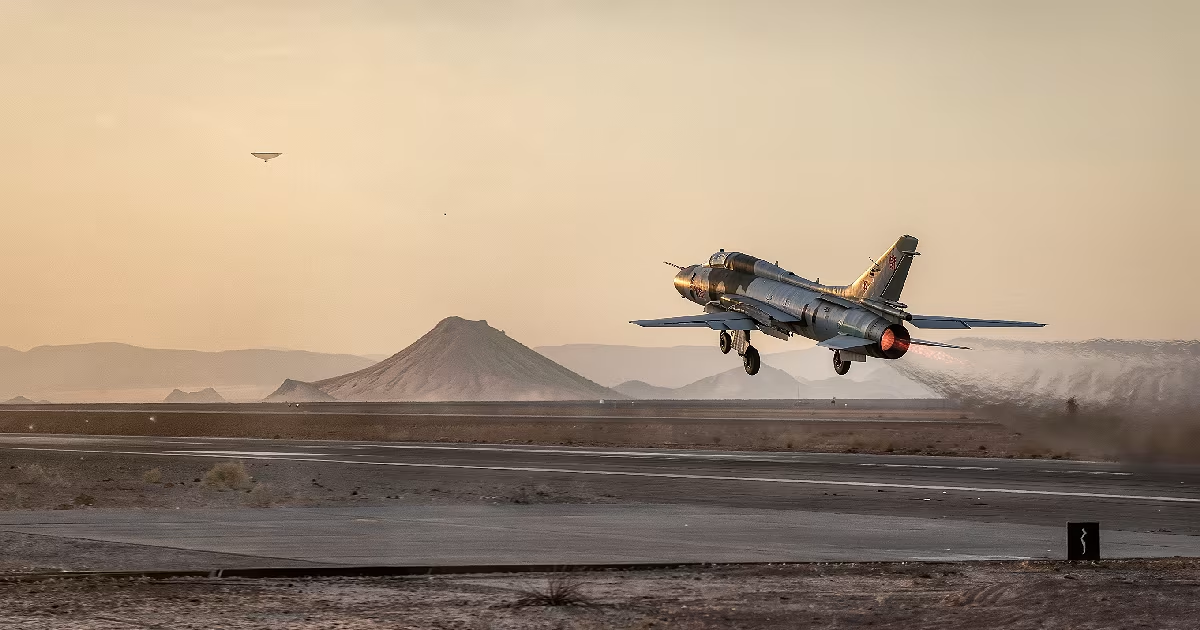
An Su-22 takes off from a desert runway, a small pale shape above.
Illustration, not a photograph.

Opening
On the morning of 11 April 1980, a Peruvian Air Force pilot, Oscar Santa María Huertas, was ordered up from La Joya air base near Arequipa in southern Peru to intercept an object hovering near the runway. He says he fired about sixty 30mm rounds into it from his Sukhoi Su-22 at close range, saw no effect, chased it to around 63,000 feet, and finally pulled alongside a smooth domed object about 30 feet across before low fuel sent him home.
The case is unusual because it involves a military jet that fired on its target, a base full of witnesses, and a declassified US Defense Department report. It is also a case where the object's behaviour, for most of the encounter, matches a high-altitude balloon. The pilot rejects that reading, and he is the only witness to the close approach.
Timeline
11 April 1980, about 7:15 amPersonnel at La Joya, a fighter base in the desert east of Arequipa, report an object hovering about 1,800 feet above the ground and roughly three miles from the base. The commander orders an Su-22 on standby to intercept it, with permission to bring it down.
The attack runSanta María closes to firing range and fires around sixty rounds of 30mm cannon. He later says the shells "seemed to absorb" into the object, or had "no effect at all". The object begins to rise.
The climbHe follows it upward and outward, trying several times to line up another firing pass. Each time, he says, it stopped abruptly as he closed, and he overshot. The chase covers roughly 50 miles and ends at about 63,000 feet, near the aircraft's ceiling.
The close lookWith the object stationary, he flies close and describes a cream-coloured dome on a wide, shining metallic base, with no wings, windows, exhaust or visible propulsion. Low on fuel, he returns to La Joya. The whole encounter, by his account, lasts 22 minutes.
June 1980A US Defense Department intelligence message from the defence attaché in Lima, later declassified, describes a La Joya intercept of a UFO by an Su-22, the firing of cannon rounds and the object's apparent indifference. It dates the incident to 9 May 1980, not 11 April. The source of the discrepancy has never been settled.
2007Santa María, now a retired colonel, takes part in a Washington press conference organised by the journalist Leslie Kean and the filmmaker James Fox.
2010His first-person account appears in Kean's book UFOs: Generals, Pilots, and Government Officials Go on the Record.
2013He testifies at the Citizen Hearing on Disclosure at the National Press Club in Washington.
Key figures
Oscar Santa María Huertas is the central witness and the only person to see the object at close range. He served about 25 years as a fighter pilot. The base commander gave the intercept order, but the sources I found do not name him. The US defence attaché in Lima wrote the American report, which relies on Peruvian sources rather than first-hand observation. Leslie Kean brought the account to an English-speaking audience.
Physical and documentary trail
The declassified US message of June 1980 is the key outside document. It confirms that the Peruvian Air Force reported an intercept at La Joya in which an Su-22 fired on an unidentified object, and it records the Peruvian view that the object's origin was unknown. It does not settle the date, it gives no radar data, and it is second-hand. The Peruvian Air Force's own records, the gun camera film if any, and the pilot's debriefing have not been published. The 30mm rounds would have fallen somewhere in the desert, and no recovery of spent rounds or debris has been reported.
It had no effect at all.
Things you might not know
- He thought it was a balloon at first. In his own retelling he describes firing at "the balloon", which is what the base expected to find.
- The two governments disagree on the date. The pilot says 11 April, and the US report says 9 May.
- Peru opened an official UFO office decades later. In 2001 the Peruvian Air Force set up OIFAA, an office for investigating anomalous aerial phenomena, which was later revived in 2013.
- 63,000 feet is close to the Su-22's ceiling. The chase ended about as high as the aircraft could go.
- He was one of the first fighter pilots to describe firing on a UFO in public. Similar accounts exist, but few come with a matching foreign government document.
Competing explanations
A balloon. A large research or surveillance balloon hovering low, then rising steadily to over 60,000 feet, fits the object's general behaviour well. Balloons rise when lightened and drift with altitude winds, and a fighter overshooting a near-stationary target would see it "stop" in front of it. Cannon shells can pass through a thin balloon envelope with no visible effect. This is the most common sceptical reading.
The pilot's objection. Santa María says the object stopped dead in front of him several times and then moved away, and that up close it was a solid dome on a metallic base, not an envelope. He is a trained fighter pilot who knew balloons were what the base was looking for. If his account of the close approach is accurate, a balloon does not fit it.
An unknown craft. On the pilot's account, the object survived cannon fire, climbed faster than expected and held position at altitude. The supporters of this reading point to the US report as confirmation that something was there and that the Peruvians could not identify it.
Later life of the case
La Joya is now one of the cases most often cited in discussions of military encounters with UAP, largely because of the US document and Santa María's public appearances. The date discrepancy and the lack of Peruvian records keep it from moving further.
Finding
Something was over La Joya, a fighter fired on it, and both the Peruvian Air Force and a US attaché reported it as unidentified. For most of the encounter, a large balloon is the strongest ordinary explanation. The pilot's description of the close approach does not fit a balloon, and it is the part of the record that only he can speak to.
What still will not resolve: the Peruvian Air Force's own report, radar data and any gun camera film from La Joya, and which of the two dates is right.
Evidence signature
6/9 Solid
- Witnesses
- trained, independent witnesses
- Instruments
- nothing on record
- Paper
- formal investigation, court or declassified file
How well documented the case is, not whether it's true. A strong record can still have an ordinary answer, and a thin one can still be real.
You decide · LA JOYA 1980
What do you think happened?
One vote per case, anonymous. You'll see how other readers voted once you've voted.