EISENHOWER AT MUROC
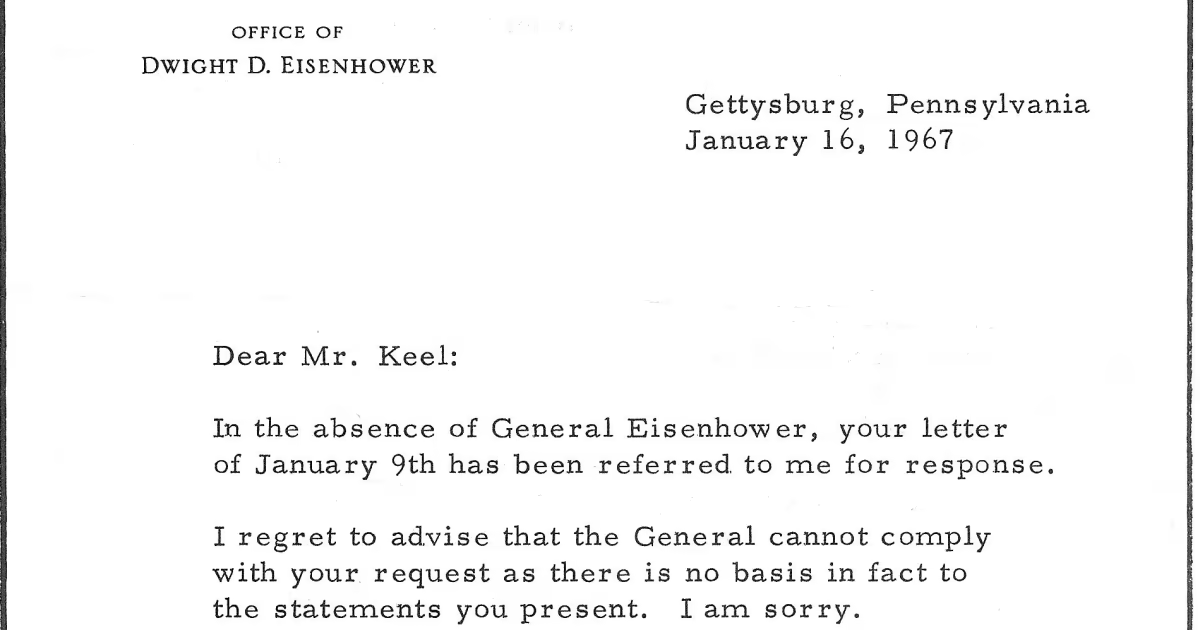
The reply from Eisenhower's office to John Keel, 16 January 1967.
Scan from John Keel's ANOMALY no. 1, May 1969.

Opening
On the evening of Saturday 20 February 1954, President Dwight D. Eisenhower went missing from public view for several hours during a golfing holiday in Palm Springs, California. Reporters could not find him, and for about two minutes the Associated Press wire carried a bulletin saying he had died of a heart attack. The next morning his press secretary, James Hagerty, said the president had chipped the cap on a front tooth while eating and had been taken to a local dentist.
Two months later a Los Angeles lecturer named Gerald Light wrote to a friend that Eisenhower had really been "spirited over to Muroc", the desert air base now called Edwards, to see visiting craft. That letter is where the story of Eisenhower meeting aliens begins. In January 1967 John Keel wrote to Eisenhower and asked about it. The reply, from the general's office, is in Keel's files.
Timeline
17 February 1954Eisenhower arrives in Palm Springs and stays at the home of his friend Paul Helms at Smoke Tree Ranch. Over the next two days he plays golf, including a round with Ben Hogan.
20 February 1954, eveningAround 8 p.m. the president leaves for a location the press is not told about. The AP bulletin of his death goes out and is withdrawn about two minutes later.
21 February 1954, morningHagerty introduces Dr Francis A. Purcell as the dentist who treated the president the night before. Eisenhower and his wife attend the Palm Springs Community Church.
April 1954Gerald Light writes to Meade Layne of Borderland Sciences Research Associates in San Diego. The copy that survives is undated, with a note that it was received on 16 April. Light says he spent two days at Muroc, saw five kinds of craft being studied "with the assistance and permission of the Etherians", and that Eisenhower had been taken there one night from Palm Springs.
July 1954Eisenhower's own dentist, Col. James M. Fairchild, replaces the crown on the same tooth.
9 January 1967Keel, then in the middle of his West Virginia investigations, writes to Eisenhower about the rumoured Muroc landing.
16 January 1967Brig. Gen. Robert L. Schulz, Eisenhower's executive assistant, replies from Gettysburg that there is "no basis in fact" to Keel's statements.
28 March 1969Eisenhower dies.
May 1969Keel prints the reply on page 16 of the first issue of his newsletter ANOMALY.
Late 1980s onwardBooks and lectures add a second meeting at Holloman Air Force Base and a treaty with grey aliens. None cites a document.
Key figures
Dwight D. Eisenhower was president and on holiday. He never spoke about the night in public, and he did not answer Keel himself.
Gerald Light was a writer and lecturer in the circle around Meade Layne, whose group mixed UFOs with spiritualism. His letter is the only early source for the Muroc story, and it describes the visitors as "Etherians", beings that could appear and disappear at will. Light named three men who he said went with him: Franklin Allen "of the Hearst papers", Edwin Nourse of the Brookings Institution, once President Truman's chief economic adviser, and "Bishop MacIntyre of L.A.". None of them is on record confirming the trip.
James Hagerty gave the dentist explanation. Dr Francis Purcell was the dentist he named.
John Keel asked the question directly while Eisenhower was still alive, and published the answer.
Physical and documentary trail
What exists: the AP bulletin and its withdrawal, the next-day press briefing, and the church service are all in the newspapers of the time. Light's letter survives as a copy in Borderland Sciences material. The reply to Keel survives in ANOMALY.
The dental side is thinner than the official story suggests. In a 1995 history of Eisenhower's teeth, the dental historian James Mixson found that the crown on that front tooth had been fitted in July 1952, chipped and repaired that December, and replaced in July 1954, which fits a weak cap breaking again. But no record of the February treatment was found in Purcell's office, and in a 1979 interview his widow said she did not remember her husband treating the president.
Nothing on the Muroc side has surfaced at all: no flight log for a night trip from Palm Springs, no base record, and no statement from any of Light's three companions.
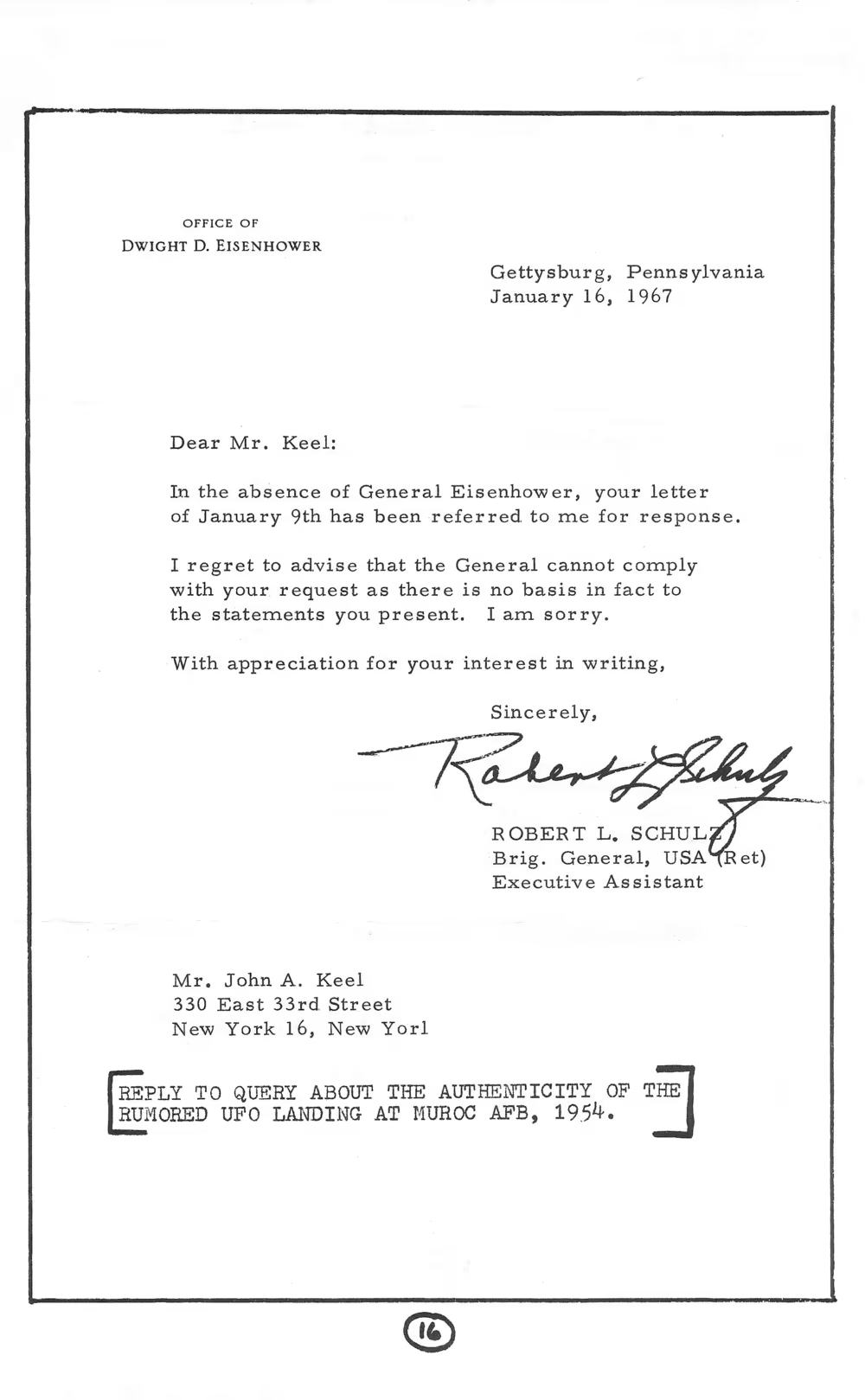
I regret to advise that the General cannot comply with your request as there is no basis in fact to the statements you present. I am sorry.
Things you might not know
- The base had already changed its name. Muroc Air Force Base had been renamed Edwards in 1949, five years before Light still called it Muroc.
- The bishop was already a cardinal. James Francis McIntyre, the Archbishop of Los Angeles, had been made a cardinal in January 1953, more than a year before Light's letter called him Bishop MacIntyre.
- Light never says he saw Eisenhower. The president's visit is something Light reports hearing about, and even in Layne's circle the claim was treated as guesswork.
- Keel printed the reply after Eisenhower died. The answer reached Keel in January 1967, but he held it until the first ANOMALY in May 1969, two months after Eisenhower's death.
- The Eisenhower Library has been asked many times. An archivist there has said nothing in the archives indicates such a meeting.
- The Washington Post marked the 50th anniversary. Its February 2004 feature on the legend ran under the headline "Ike and the Alien Ambassadors".
Competing explanations
A broken tooth and a jumpy press corps. Eisenhower's crown had a history of failing, the dentist was named the next morning, and the death bulletin was a wire-service error during a few hours without news. This is the documented reading.
A secret night trip to Muroc. The base is about 100 miles from Palm Springs, close enough for a fast flight. This rests entirely on Light's letter, written two months later by a man who says he heard it, inside a group that described the visitors as spirit beings.
A private evening the White House covered with a dental story. The missing office record and Mrs Purcell's memory leave room for the president having been somewhere else, for an ordinary reason. Nothing names where.
Later life of the case
Over the next decades the story lost its spiritualist framing and grew. Writers in the late 1980s and early 1990s, William Cooper among them, added a second meeting at Holloman Air Force Base and a treaty, none of it traced to a document. The original source is still one letter from a Los Angeles lecturer, and the only response from Eisenhower's own office is the one Keel received.
Finding
Eisenhower was out of sight for a few hours on 20 February 1954, and the White House said he was at the dentist. His dental records support a crown that kept breaking, though the dentist's own office kept no trace of that night. The Muroc meeting comes from a single letter written two months later by someone who did not claim to see it, and when John Keel asked Eisenhower's office in 1967, the answer was that there was "no basis in fact".
What still will not resolve: where exactly the president was between 8 p.m. and the next morning, and whether any record of the dental visit survives outside the press briefing.
Evidence signature
3/9 Thin
- Witnesses
- one person, or a tradition
- Instruments
- nothing on record
- Paper
- official records at the time
How well documented the case is, not whether it's true. A strong record can still have an ordinary answer, and a thin one can still be real.
You decide · EISENHOWER AT MUROC
What do you think happened?
One vote per case, anonymous. You'll see how other readers voted once you've voted.