LOCH RAVEN DAM
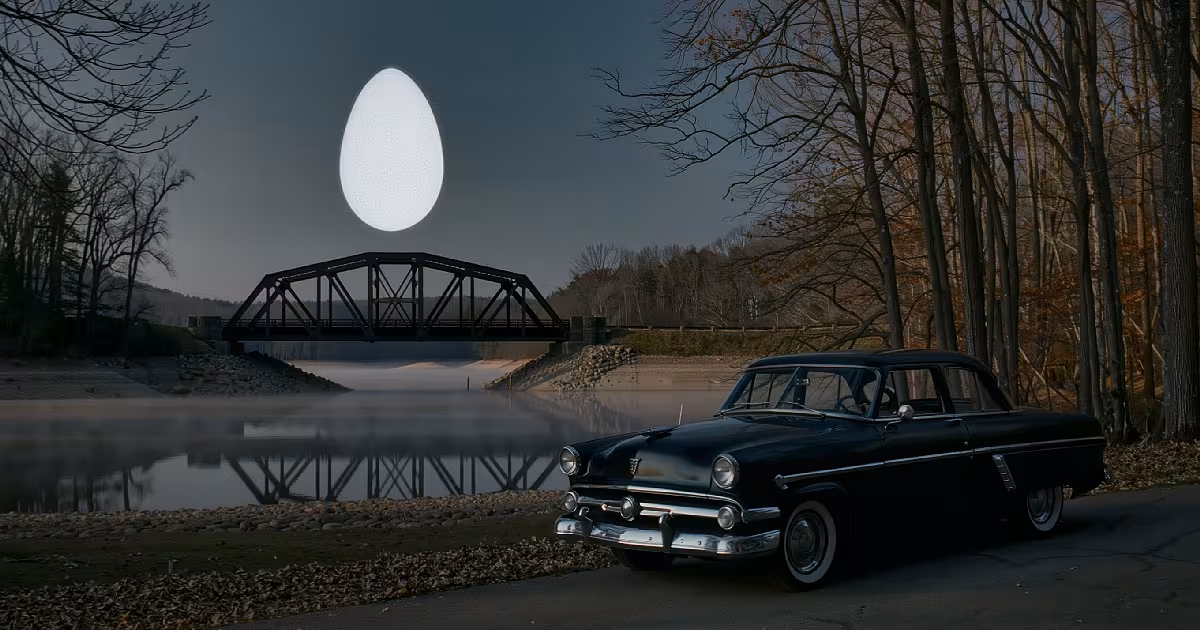
A dark 1950s car sits below a glowing egg over a truss bridge.
Illustration, not a photograph.

Opening
On the night of Sunday 26 October 1958, Phillip Small and Alvin Cohen were driving on Maryland Route 146 near the Loch Raven Dam, north of Baltimore, when they saw a large, flat, egg-shaped object hanging over the bridge ahead of them. As they got closer, Small's car lost its headlights, its dash lights and its engine all at once.
The two men got out and sheltered behind the car. The object flashed, they felt heat on their faces, a loud bang followed, and it rose straight up and was gone. They drove to Towson, called the authorities, and went to hospital to be checked for burns. Project Blue Book investigated and left the case as unidentified.
Timeline
26 October 1958, about 10:30 p.mSmall, 27, and Cohen, 24, approach a bridge over the Loch Raven Reservoir. From about 200 to 250 yards away they see a glowing, egg-shaped object, about 100 feet long, hovering 100 to 150 feet above the bridge. Blue Book's summary gives the time as 10:30 p.m.; other accounts say 11:30 or close to midnight.
Seconds laterAbout 75 to 80 feet from the bridge, and 200 to 300 feet from the object, the car goes dead: engine, headlights and dashboard lights. Turning the key produces no sound from the starter.
The next minuteThe men leave the car and watch from behind it for 30 to 45 seconds. The object gives off a brilliant white flash, they feel heat on their faces, and they hear a loud, dull noise that Small later compared to a tremendous thunderclap. The object rises vertically, without turning, and disappears within 5 to 10 seconds. Blue Book recorded the whole sighting as lasting about a minute.
AfterwardsThe car's electrics come back and it starts. The men drive into Towson and call the Ground Observer Corps from a phone booth at Loch Raven Boulevard and Joppa Road. Small said the man who answered told them "Aww, come on now" and hung up. They then call the Towson police, who send Corporal Kenneth Hartmann and Patrolman Richard Fink to the booth.
The same nightAfraid of radiation burns, the men are examined at St. Joseph's Hospital, then on East Caroline Street in Baltimore. They are not treated. Later their skin is reddened on the side that faced the object, like sunburn.
Following weeksAn Air Force second lieutenant investigating for Project Blue Book interviews several witnesses. The Air Force indexes the case under 27 October and files it as unidentified. On 14 or 15 December the Baltimore Evening Sun runs "Baltimore's Flying Saucer".
Key figures
Phillip Small, 27, a collection manager for a finance company, was driving. Alvin Cohen, 24, was a supervisor at Sears, Roebuck and Co. Both told the same story to the police, the hospital and the Air Force.
Corporal Kenneth Hartmann and Patrolman Richard Fink of the Towson police took their first account at the phone booth.
The Blue Book investigator, a second lieutenant whose name is not in the accounts I've found, interviewed the witnesses and could not explain it.
J. Allen Hynek and Jacques Vallée later put the case into their books, and the physicist James McDonald cited it to Congress in 1968.
Physical and documentary trail
The record is better than most car-stop cases: a Blue Book file with a record card, a summary and interview notes, now online through the Black Vault; the police call to a named corporal and patrolman; the hospital visit; and a newspaper feature within weeks. Blue Book's own summary describes one large, flat, egg-shaped object that affected the car's electrical system and caused a burning sensation, with later physiological effects on both men.
What is missing is anything measured. No one tested the car, recorded the reddened skin in a surviving medical note, or took a reading at the bridge. Accounts say others in the area saw an object or heard the bang, but none of those people is named in the sources I've found. The bridge itself has since been demolished.
I am not saying that it was a flying saucer. I don't know. I do know there are at least such things now as UFOs.
Things you might not know
- The spotters hung up. Their first call went to the Ground Observer Corps, the volunteer network that watched the skies for Soviet bombers. Small said the man who answered did not believe them and put the phone down.
- Blue Book believed them. The Air Force's case notes say "it can be assumed that the sighting did actually occur as related" and that no conclusion could be reached about what the object was.
- The date moved a day. The sighting happened on the evening of the 26th, but Blue Book's index lists it as 27 October 1958.
- They feared radiation, not aliens. The men went to hospital because they were afraid the heat had given them radioactive burns, a real worry in 1958.
- It still draws stories out. When a volunteer for the Historical Society of Baltimore County included the case in a talk, audience members came up afterwards to say they had seen UFOs too.
Competing explanations
An unknown craft with a powerful field. The reading most researchers have taken. It accounts for everything together: the object, the car failing near it and recovering after it left, the flash, the heat and the reddened skin. It has no physical object and no measurement behind it.
Ball lightning or another plasma. A glowing body, a flash, heat and a thunder-like bang all fit some reports of ball lightning. It struggles with the size, a 100-foot object hanging steadily for most of a minute, and no account I've found mentions a storm that night. There is also no confirmed case of ball lightning stopping a car.
A car fault and an excited reading of something ordinary. Cars do stall and lose their lights. A fault that started and ended exactly with the object, and a light bright enough to redden skin, are hard to fit into this. Nothing in the record suggests the two men invented the story: they called the police and went to hospital, and Blue Book accepted their account.
Later life of the case
Loch Raven became one of the classic "electromagnetic effects" cases, alongside Levelland a year earlier. Jacques and Janine Vallée included it in Challenge to Science (1966), McDonald cited it in his 1968 statement to the House Committee on Science and Astronautics, and Hynek discussed it in The UFO Experience (1972). It stays on Blue Book's list of unknowns. For the project that filed it, see Project Blue Book.
Finding
Two men on a Maryland road saw a large glowing object over a bridge, lost their car's power, felt heat from a flash, and reported it to the police, a hospital and the Air Force the same night. The Air Force accepted that the sighting happened as described and could not say what the object was. Nothing in the record has explained it since.
What still will not resolve: a measured trace, whether a test of the car or a medical note on the reddened skin, that would show what came off that object.
Evidence signature
4/9 Solid
- Witnesses
- several people
- Instruments
- nothing on record
- Paper
- official records at the time
How well documented the case is, not whether it's true. A strong record can still have an ordinary answer, and a thin one can still be real.
You decide · LOCH RAVEN DAM
What do you think happened?
One vote per case, anonymous. You'll see how other readers voted once you've voted.