LINDA NAPOLITANO
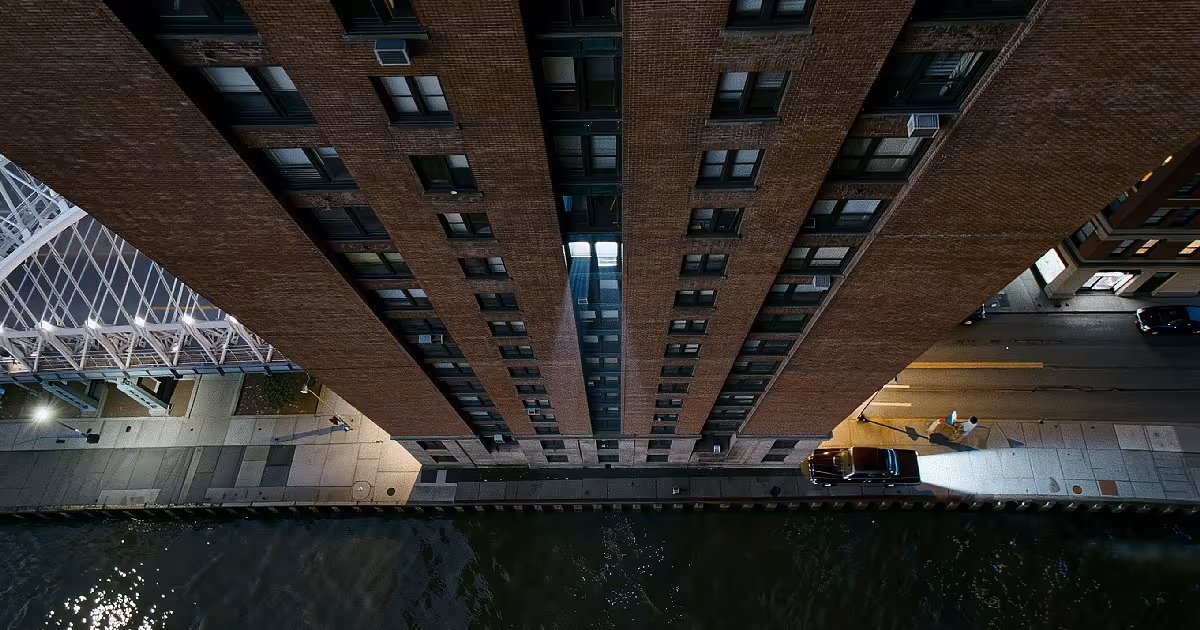
Manhattan apartment block at 3 a.m. Bridge lights, one window lit.
Illustration, not a period photograph.
Opening
At about 3 a.m. on 30 November 1989, Linda Napolitano, a mother living on the 12th floor of an apartment building in Lower Manhattan, said three small grey beings took her through her closed bedroom window into a hovering craft, examined her, and returned her. On its own, it would be one of thousands of abduction accounts. What made it famous was what came later. Two men, calling themselves Richard and Dan, wrote to the researcher Budd Hopkins, saying they had watched a woman float out of a window in a beam of light that night, from a car below. They said they were security officers guarding a world leader, who saw it too. That leader was later named as the UN Secretary-General, Javier Pérez de Cuéllar.
Timeline
April 1989. Napolitano contacts Budd Hopkins about earlier experiences.
30 November 1989, about 03:00. The alleged abduction takes place. Napolitano recalls fragments. Hopkins later hypnotises her.
February 1991. Hopkins receives a letter from "Richard" and "Dan" describing what they saw from their car near the Brooklyn Bridge.
1991 to 1993. More letters arrive, and other people come forward saying they saw a craft or light over the area that night. Hopkins says a total of about two dozen witnesses. Richard and Dan never meet Hopkins in person.
1993. Researchers Joseph Stefula, Richard Butler, and George Hansen publish a critique, questioning the case's evidence and the identities of the witnesses.
1996. Hopkins publishes Witnessed: The True Story of the Brooklyn Bridge UFO Abductions.
Later. Pérez de Cuéllar denies having had any such experience.
2024. Netflix releases a three-part documentary, The Manhattan Alien Abduction, presenting conflicting accounts. Napolitano tries and fails to stop its release.
Key figures
Linda Napolitano, originally known publicly as Linda Cortile, is the central witness.
Budd Hopkins, an artist and one of the best-known abduction researchers, investigated and championed the case.
Richard and Dan are the claimed security officers. They've never been identified.
Javier Pérez de Cuéllar, UN Secretary-General from 1982 to 1991, is named as the third witness, and denied it.
Carol Rainey, Hopkins's former wife, later wrote that she believed the case was a hoax and that Hopkins ignored problems with it.
Physical and documentary trail
On the paper: Hopkins's investigation and book, the letters from Richard and Dan, other witness statements, hypnosis records, and the critics' published analysis. There's also a claimed nasal implant seen on an X-ray, which Hopkins called a smoking gun. It hasn't been independently verified.
What would settle it, the identities of Richard and Dan, has never been established.
I cannot but strongly deny the claim that I have had an abduction experience at any time.
Competing explanations
A real abduction with independent witnesses. If Richard, Dan, and the others saw what they described, this is the best-witnessed abduction on record.
A hoax. Critics argue the witness letters and other evidence were created by one or more people, with Hopkins too committed to the case to see it. Carol Rainey's account supports this view.
A real experience, embroidered. Napolitano may sincerely believe what she remembers, while other parts of the case were added later by others.
Later life of the case
Hopkins presented it as one of the most important abduction cases ever recorded. The Netflix series brought it to a new generation, and the arguments about it are as heated as ever.
Finding
If the witnesses are real, this is the most important abduction case ever recorded. If they're not, it's one of the most elaborate hoaxes. The whole case turns on two men who have never been identified, and a world leader who denies it. Nothing public has settled which it is.
What still will not resolve: who Richard and Dan are.