MAJESTIC 12
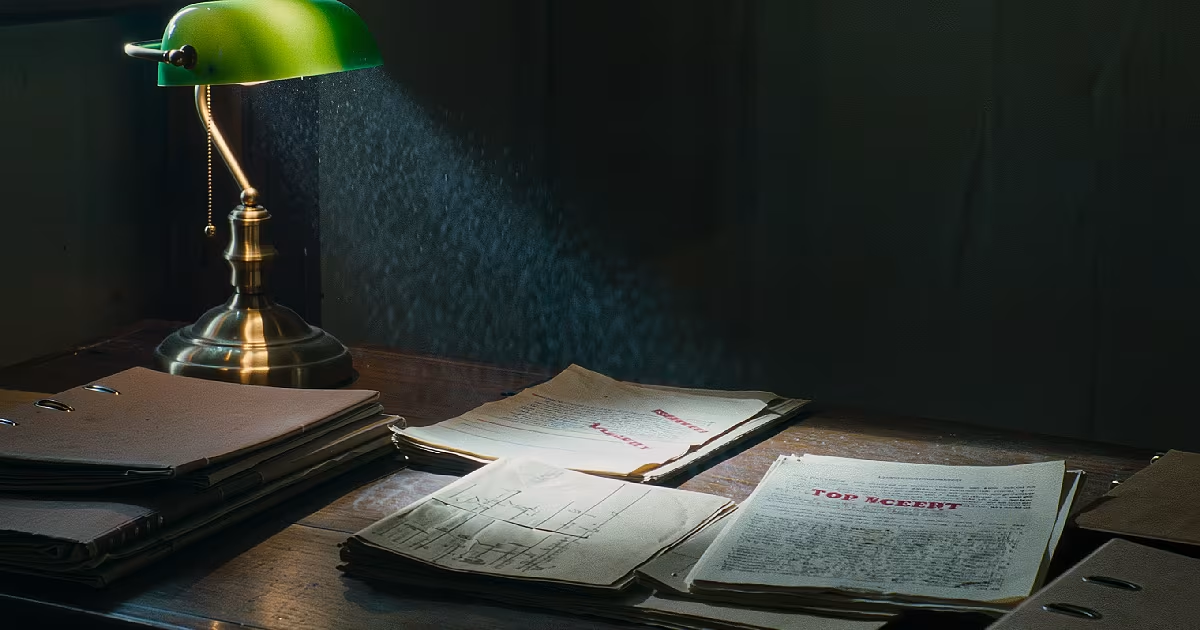
Majestic 12 document imagery.
Illustration, not a period photograph.
Opening
Majestic 12 enters the archive as paper, not as a recovered committee room. In December 1984 a roll of undeveloped 35 mm film arrives, by Jaime Shandera's later account, in a package with a New Mexico postmark and no useful return address. When the film is processed it shows pages that claim to be a November 1952 briefing for President-elect Eisenhower and a September 1947 Truman memorandum authorizing a recovery committee after a crash in New Mexico.
The names on the list are real men in real 1947 offices: Forrestal, Bush, Hillenkoetter, Twining, Vandenberg, and the rest. That is why the packet travels. Real letterheads make a forged committee easier to believe and a real committee harder to dismiss. In 1988 the FBI asks the Air Force whether such a body was ever authorized. The Air Force Office of Special Investigations says no such committee was formed and that the documents are bogus. The Bureau adopts that line in its file.
Provenance is the spine of this card. The film does not come from a named vault with a withdrawal slip. It comes from a mailbox. Everything after that sentence is argument about typewriter dates, a Truman signature that looks transplanted, a Cutler-Twining sheet later claimed from National Archives stacks, and a policy committee that no surviving White House finding aid will own.
Timeline
The story the pages tell begins in July 1947 with a New Mexico recovery and a 24 September 1947 Truman-Forrestal authorization for Operation Majestic-12. It then jumps to 18 November 1952 and a supposed Eyes Only briefing for Eisenhower that lists twelve men and describes crashed craft and bodies. That is the internal chronology of the document. It is not a chronology the National Archives can staff with original folders from 1947 or 1952.
Mid-December 1984. The external chronology starts here, with the film in Shandera's mail. William L. Moore and Stanton T. Friedman work the packet with him.
July 1985. Moore and Shandera say they found a Cutler-Twining memorandum in declassified National Archives boxes, a short note that mentions MJ-12 in an Eisenhower-era staffing context.
May 1987. The group releases the papers into the press and conference circuit. White House and National Security Council spokesmen deny the organization that summer.
September 1988. An AFOSI agent contacts the FBI after a version of the memo reaches a field office from a school that received it in the mail. On 30 November 1988 AFOSI tells the Bureau that no such committee was authorized. The FBI file later released through the Vault carries the word bogus.
The 1990s bring later waves of MJ-12 paper, including alleged manuals under other titles, through different hands. Those waves are not this card's first object. The first object is the 1984 film and the 1954 Cutler sheet claimed from the Archives. Mixing the waves is how the argument stays permanently unstuck.
Key figures
Jaime Shandera is the mailbox. He is a Los Angeles producer, not an archivist. His account of nested wrapping and an unprocessed canister is the chain of custody. There is no second named recipient for that first roll.
William L. Moore brings the packet into ufology as a researcher who has already published on Roswell. He presents the papers as appearing genuine while stopping short of a final authentication. His role is release and framing, not a government stamp.
Stanton T. Friedman treats the membership list as a research problem and spends years checking whether those twelve men could have sat on such a body. He argues the content is consistent with a real committee. Consistency of names is not provenance of film.
Philip J. Klass and later document examiners, including typewriter and linguistics work, treat date commas, classification lines, and the Truman signature as marks of manufacture. Air Force OSI and the FBI are the official actors who decline to own the committee. They do not produce a missing 1947 folder. They produce a rejection.
Physical and documentary trail
On the paper, the first wave gives you four hard objects and no vault copy.
One: the 1984 35 mm film images of the Eisenhower Briefing Document and the attached Truman-Forrestal memorandum. No original ribbon-copy on Agency bond has been produced from a government vault. The public object is a photograph of a page.
Two: the Cutler-Twining memorandum of 14 July 1954 as later exhibited with a National Archives copy stamp. The sheet is the only item in the first wave that researchers claimed to have pulled from a declassified box rather than from a mailbox. Its critics call it a plant. The Archives has not treated it as proof that MJ-12 existed as described in the briefing.
Three: the FBI file. FBI Vault file, Majestic 12, includes the 1988 field intake and the AFOSI advice that the committee had not been authorized and the documents were not authentic. This is the government's paper on the packet, not the packet's paper on the government.
Four: the membership list as a historical checklist. The twelve names held the jobs the briefing assigns. That checklist is real biography. It is also the easiest part of a hoax to get right. It does not move the film from a mailbox into a 1952 White House file.
There is no withdrawal slip. There is no 1952 briefing distribution list on White House paper that a researcher can pull from a named box. There is no 1947 executive order in the numbered series the Truman memo claims.
An Air Force investigation determined the document to be a fake.
Competing explanations
Authentic committee, leaked film. This reading says a recovery in 1947 forced Truman to create a closed board, that Eisenhower was briefed in 1952, and that the 1984 film is a leak of that board's paper. It leans on the right names in the right jobs and on later crash-retrieval testimony. It has no withdrawal slip.
Fabrication. This is the official reading. AFOSI and the FBI call the documents bogus. Date format, markings, and a Truman signature that matches another document too closely are the usual exhibits. A committee that large leaves paper in more than one attic. That paper has not surfaced in the places where 1947 and 1952 national security files do surface.
Real program, bad attachment. This reading splits the difference without mercy. There may have been tightly held recovery work after 1947. That possibility does not authenticate this film. A real program can still be stapled to a manufactured briefing. The file has to keep those two sentences from collapsing into each other.
Hybrid caution. The names are real. The mailbox is real. The committee as described on the film is not established.
Later life of the case
Once released, MJ-12 becomes a franchise. Later documents, television, and conference circuits multiply the initials until the mailbox origin recedes. Researchers who still defend the first wave now have to carry the later waves as well, including sheets that even some early advocates would not sign.
The FBI Vault scan keeps the official rejection available without requiring a researcher to take Moore's word for the wrapping. Academic treatments treat the episode as a study in how an anonymous film can occupy a field that already wanted a committee.
The names on the list remain useful as a roster of 1947 power. I keep the later manuals and the conference enlargements on the later-life shelf. I do not treat them as incoming 1952 field notes.
Finding
Someone sat down and made a Truman-era committee on paper. The film that reached Jaime Shandera in 1984 carries a 1952 Eisenhower briefing and a 1947 Truman memo naming Majestic 12, and the pages have been treated as scripture and as a plant ever since. The hunger they feed is real. The committee room they describe has never been walked into with a pass.
What still will not resolve: provenance. A typed original in a named archive, with a reception stamp and a chain from 1947 or 1952 that does not run through an anonymous envelope, would end the argument. Ink tests and typewriter fights will not. The folder needs a birth certificate, not another photocopy.