PROJECT MKULTRA
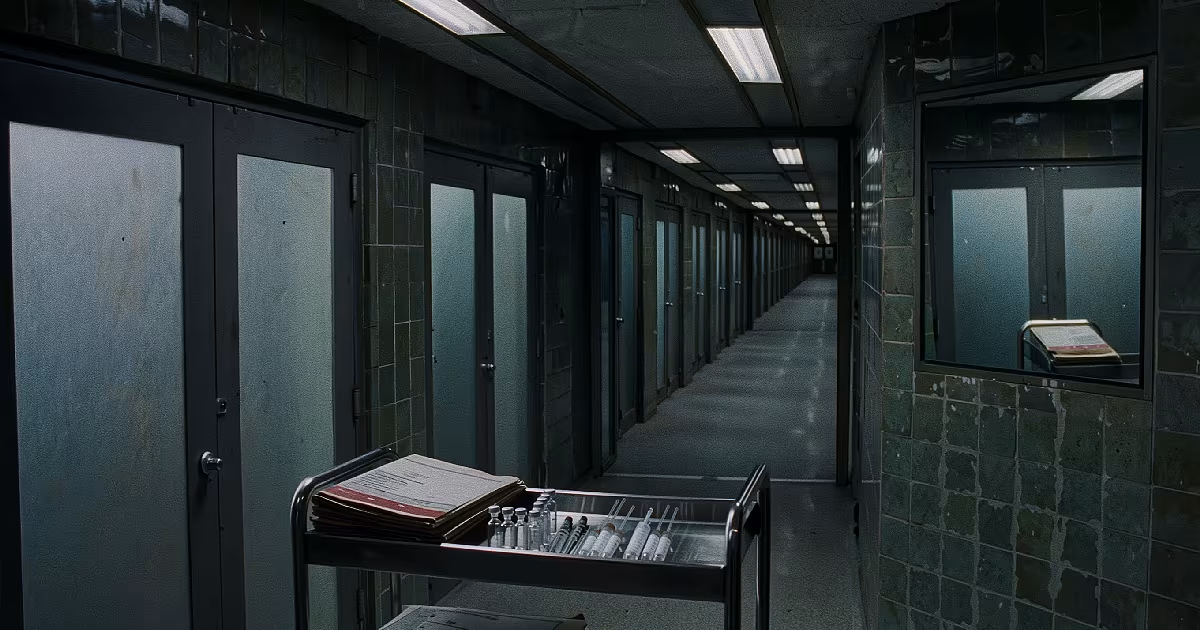
MKUltra era materials.
Illustration, not a period photograph.
Opening
From 1953 to 1973, the CIA ran a program codenamed MKUltra, an umbrella covering at least 149 subprojects at universities, hospitals, prisons, and CIA-run safe houses across the United States and Canada, aimed at developing drugs and psychological techniques for interrogation, behavior modification, and mind control. Some subjects were informed volunteers. Many were not. Under Director Richard Helms's order, the CIA destroyed most of the program's records in 1973, before any formal investigation began, which is the single fact that has shaped every account of MKUltra written since: what is known is not the full program, but whatever survived one man's decision to burn it.
What did survive is not nothing. It includes a director's own sworn testimony, a discovered cache of financial records, a documented death, an exhumation, and, as recently as July 2026, fresh congressional testimony still arguing over how much of the story remains untold.
Timeline
1950, prior to formal authorization. A memorandum to CIA Director Roscoe Hillenkoetter outlines plans for interrogation teams trained in the use of drugs and hypnosis for "personality control purposes," an early planning document predating the program's formal 1953 authorization.
1953. Director Allen Dulles formally approves MKUltra under chemist and poison specialist Sidney Gottlieb, tasked with developing techniques usable against Soviet bloc adversaries. The CIA's own 1963 Inspector General report later notes that "present practice is to maintain no records of the planning and approval of test programs," meaning the project's documentation was incomplete even before any deliberate destruction occurred.
19 November 1953. At a retreat, Gottlieb secretly doses U.S. Army biochemist Frank Olson and several colleagues with LSD without their knowledge, as part of the program's ongoing testing. Olson suffers a severe psychological crisis over the following days.
28 November 1953. Nine days later, Olson falls from the window of Room 1018A at the Statler Hotel in New York City and is pronounced dead on arrival. The CIA rules it a suicide at the time.
1953-1964, ongoing. Subprojects proliferate under the MKUltra umbrella: Operation Midnight Climax runs CIA-operated safe houses in San Francisco and New York, where unwitting men are dosed with LSD by prostitutes working for the agency while officers observe through two-way mirrors, with agent George White later writing to Gottlieb that he found the work "fun, fun, fun." At McGill University in Montreal, psychiatrist Ewen Cameron subjects patients seeking treatment for depression and anxiety to drug-induced comas and weeks of electroshock under a CIA-funded subproject, with some patients never fully recovering. Research also touches Stanford, where volunteer subject Ken Kesey's own experience with CIA-supplied psychedelics later feeds directly into the countercultural movement he helped launch with the Merry Pranksters.
1973. Helms, departing as CIA Director, orders the destruction of MKUltra's files. Most program documentation is destroyed before any external investigation begins.
1975. Journalist Seymour Hersh, already reporting on separate illegal CIA domestic surveillance, identifies Olson as the man who fell from the Statler Hotel window in 1953 and informs the Olson family. The Rockefeller Commission, convened by President Ford to review CIA abuses, issues a report in June concluding the agency had conducted "plainly unlawful" activities including drug testing on unsuspecting citizens, but reaches a limited conclusion overall, noting that relevant records had been destroyed and that involved individuals were unavailable or deceased. The Olson family holds a press conference announcing intent to sue; the family receives a $750,000 settlement and a personal apology from President Ford at the White House.
1975-1976. The Senate's Church Committee, chaired by Senator Frank Church, investigates more deeply, and Gottlieb's name surfaces repeatedly in the heavily redacted surviving files as the program's chemical division director; by this point Gottlieb has retired to India. Separately, Senator Edward Kennedy chairs joint hearings on biomedical and behavioral research addressing related Defense Department and CIA human experimentation.
15 July 1977. CIA Director Stansfield Turner reports to Congress the discovery of seven boxes of MKUltra financial records that had escaped the 1973 destruction, found during an unrelated Freedom of Information Act search by an employee of the Office of Technical Services. Turner's later testimony explains the boxes survived because they had, in a departure from normal filing procedure, been sent to Retired Records in 1970 by the Budget and Fiscal Section rather than kept under the project file itself, meaning they were not searched or retrieved when other MKUltra material was destroyed three years later.
3 August 1977. Turner testifies before a joint hearing of the Senate Select Committee on Intelligence and the Subcommittee on Health and Scientific Research, detailing the newly found material: fragmentary financial data covering 149 subprojects, revealing the names of roughly 115 researchers and 80 institutions, some of it provided to the committee on a classified basis given ongoing concerns about improper CIA contributions to private institutions. Further hearings follow in September 1977.
1994. Frank Olson's body is exhumed at his family's request. A forensic pathologist finds a previously undetected cranial injury the family's investigators argue is consistent with a blow to the head predating the fall, rather than injuries from the fall alone. The New York District Attorney's office opens a homicide investigation; no charges are ever filed, and Olson's son Eric spends decades afterward arguing his father was killed because he had developed moral objections to the program and was seen as a security risk, a claim the government has never confirmed.
2001. The CIA's own reading-room disclosure of Turner's 1977 testimony becomes part of the searchable public FOIA record, allowing later researchers direct access to the discovery narrative in the agency's own words.
July 2026. A congressional hearing revisits MKUltra with new testimony, including from researcher Tom O'Neill, who argues CIA officials misled the Church Committee in the 1970s by characterizing the program as an overall failure, and separately raises a disputed claim connecting MKUltra research to Charles Manson, a claim other MKUltra-focused researchers and academics treat with significant skepticism given the thinness of its sourcing. The same period brings testimony from a former CIA officer that roughly forty boxes of JFK- and MKUltra-related files being processed for declassification were pulled back from release by the agency, prompting a bipartisan congressional preservation letter; as of this writing, that specific dispute remains open and unresolved rather than settled in either direction.
Key figures
Gottlieb is the program's central architect, a chemist whose personal role spanned the Olson dosing, the Midnight Climax brothels, and broader subproject oversight, and who retired without prosecution, later reportedly spending his later years writing poetry in rural Virginia.
Helms is the figure most directly responsible for the historical record's central gap: his 1973 order to destroy MKUltra's files is the single decision that determined how much of this program the public would ever be able to examine. He was later fined $2,000 for lying to Congress about an unrelated matter and retained his government pension until his death, with no prosecution connected to the destruction of federal records itself.
Olson is the program's most consequential named casualty, and his case is the closest thing MKUltra history has to a genuinely unresolved individual mystery: dosed without consent, dead nine days later, officially ruled a suicide for over two decades, then reopened as a homicide investigation following a 1994 exhumation that found evidence the family argues points to a very different story, one that has never been formally confirmed or closed.
Cameron is the program's most direct link to documented, severe, non-consensual patient harm, using genuine medical patients seeking ordinary psychiatric treatment as unwitting subjects for CIA-funded experimentation with lasting effects on some of them.
Turner is the figure responsible for the program's single largest post-destruction disclosure, and his own detailed 1977 congressional testimony, explaining precisely how and why the surviving financial boxes escaped the 1973 purge, remains one of the more remarkably candid pieces of institutional self-accounting in the entire CIA declassification record.
Physical and documentary trail
On the paper, this file has real, substantial documentation despite the 1973 destruction: the surviving 1963 Inspector General report, the Church Committee's and Rockefeller Commission's 1975 findings, Turner's own detailed sworn 1977 testimony describing the discovered financial boxes, the 1994 forensic exhumation report on Olson, and decades of subsequent FOIA-driven disclosure through outlets including the National Security Archive.
What remains permanently missing is any comprehensive account of the program's full human scope, since the deliberately destroyed records, not merely lost or classified but affirmatively burned on direct order, mean no complete subject count, consent record, or outcome tracking for the great majority of MKUltra's 149 subprojects will likely ever be recoverable.
Present practice is to maintain no records of the planning and approval of test programs.
Competing explanations
A program of genuine, if often ineffective, Cold War-era mind control research, ended and substantially covered up rather than continued. This is the mainstream historical consensus, resting on the extensive documented record that does survive, and it does not require positing continuation beyond the program's own 1973 termination to account for the scale of harm already established.
A program whose reported "failure" was itself a misdirection, with more capable or more consequential outcomes never disclosed. This reading, advanced most prominently in 2026 testimony by researcher Tom O'Neill, remains contested by other MKUltra-focused academics specifically because its most dramatic claims (including the Manson connection) rest on sourcing those researchers consider thin, a genuine live dispute within the field rather than a settled finding.
A closed historical matter with no ongoing relevance. This reading sits awkwardly against the 2026 dispute over withdrawn declassification files, which, whatever its ultimate resolution, indicates the documentary record is still actively being negotiated rather than fully settled even fifty years after the Church Committee's original investigation.
Later life of the case
MKUltra has become one of the most widely cited real-world examples in broader American conspiracy culture, its genuine, documented history frequently blurred in popular retelling with considerably less-supported extensions (continued secret programs, mind-control assassination claims) that go well beyond what the surviving record actually establishes. The persistent, recurring rediscovery of the story, 1975's initial revelations, 1977's accidental document find, 1994's exhumation, and 2026's fresh congressional testimony, reflects a program whose deliberate incompleteness keeps generating new partial answers rather than ever producing one final, comprehensive account.
Finding
MKUltra's core facts are not in dispute and have not been for decades: a real CIA program conducted non-consensual drug and psychological experimentation on American and Canadian citizens for two decades, at least one participant died under circumstances his own family still contests, and the program's director ordered the deliberate destruction of its records specifically to limit what investigators could later learn. What remains genuinely open is not whether this happened, but how much of it never reached even the accidental 1977 discovery, and whether the most consequential subprojects are among the parts that burned.
What still will not resolve: a full accounting of MKUltra's human subjects and outcomes, permanently constrained by Helms's 1973 order, and the specific, currently disputed status of the roughly forty boxes of related files reportedly pulled back from declassification in 2026. Until that dispute resolves one way or another, this file's most honest status is not closed but actively still being written.