KNIGHTS TEMPLAR
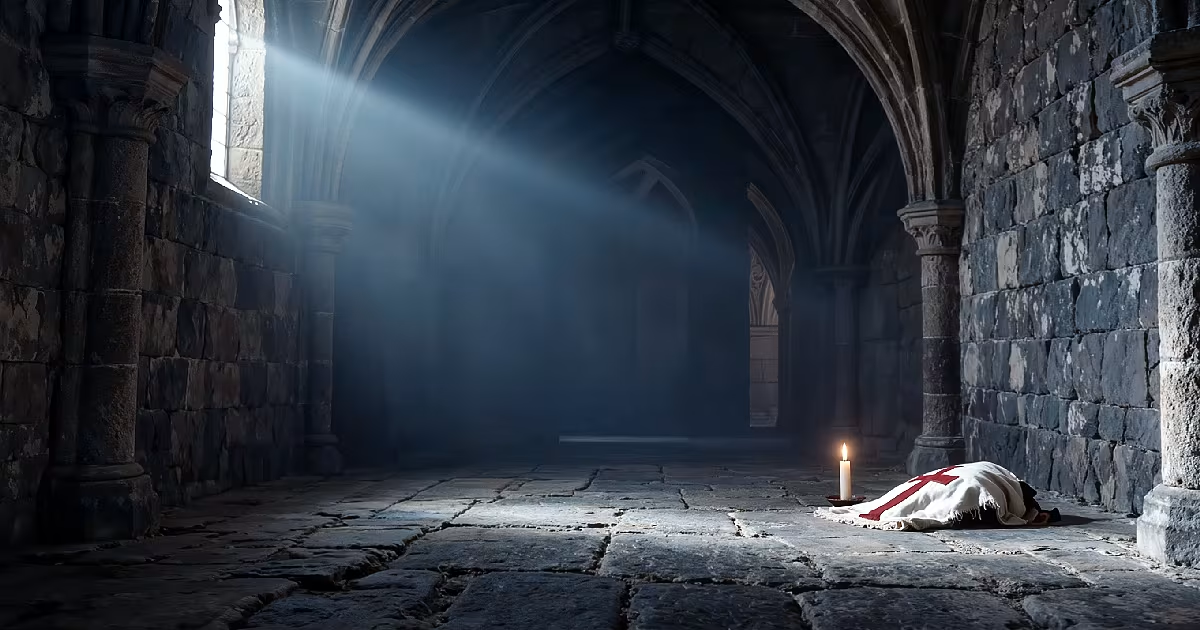
A white mantle with a red cross lying on a candlelit stone floor.
Illustration, not a photograph.

Archive / Conspiracy / BOT313-0541
CON-130713 OCT 1307ConspiracyCHARGES UNPROVEN
THE ORIGINAL FRIDAY THE 13TH
Fig. 01 A white mantle with a red cross lying on a candlelit stone floor. Illustration, not a photograph.
Opening
At dawn on Friday 13 October 1307, on the orders of King Philip IV of France, officers across the kingdom arrested every Knight Templar they could find. The Templars were the richest and best-known military order in Christendom: warrior monks who had guarded pilgrims to Jerusalem for nearly two centuries and lent money to kings. Within days they stood accused of spitting on the cross, denying Christ, worshipping an idol and obscene initiation rites.
Under torture, many confessed. Five years later the pope dissolved the order. Seven years later its last Grand Master, Jacques de Molay, was burned alive in Paris, having taken his confession back. The record of their fall is one of the best documented of the Middle Ages. Everything that has been added to it since, from lost treasure to the Holy Grail, is not.
Timeline
1119 to 1120A French knight, Hugues de Payens, proposes a religious order of knights to protect pilgrims in the Holy Land. King Baldwin II of Jerusalem gives them quarters on the Temple Mount, in the captured Al-Aqsa Mosque, believed to stand on the site of Solomon's Temple. They become the Poor Fellow-Soldiers of Christ and of the Temple of Solomon: the Templars. There are about nine of them.
1129The Council of Troyes gives the order official church approval, championed by the abbot Bernard of Clairvaux, who writes In Praise of the New Knighthood for them.
1139Pope Innocent II's bull Omne Datum Optimum frees the order from local laws and taxes. The Templars answer only to the pope.
From about 1150The order issues letters of credit, so pilgrims can deposit money at home and draw it in the Holy Land. It becomes, in effect, an international bank.
1177At the Battle of Montgisard, around 500 Templar knights help defeat a far larger army led by Saladin.
1187 and 1291Jerusalem falls to Saladin. A century later Acre, the last major Christian stronghold, falls too, and the Templars move their headquarters to Cyprus. Their original purpose is gone; their wealth and privileges are not.
Friday 13 October 1307Philip IV, deep in debt to the order after his wars with England, has de Molay and the French Templars arrested in a coordinated dawn raid.
22 November 1307Pope Clement V, under pressure from Philip, orders the rulers of Christendom to arrest the Templars and seize their property.
17 to 20 August 1308At Chinon, papal envoys question de Molay and other leaders and record that the pope absolves them of heresy. The document recording this is later lost in the Vatican archives.
1310Dozens of Templars who had retracted their confessions are burned at the stake outside Paris.
22 March 1312At the Council of Vienne, Clement V suppresses the order with the bull Vox in excelso, without ever declaring it guilty. Its property goes to the rival Knights Hospitaller.
18 March 1314Jacques de Molay and Geoffroi de Charney publicly retract their confessions and are burned on a small island in the Seine in Paris. Clement V dies about a month later. Philip IV dies that November.
1319In Portugal, where King Denis had protected the Templars, their assets pass to a new Order of Christ, based at the old Templar castle of Tomar.
September 2001The Vatican historian Barbara Frale finds the Chinon Parchment, apparently misfiled since 1628. It shows the pope absolved the Templar leaders four years before he dissolved the order.
Key figures
Jacques de Molay was the last Grand Master, an old soldier who confessed under pressure in 1307, recanted, and died for it. Philip IV, called the Fair, was the king who ordered the arrests and drove the prosecution. Clement V was the pope caught between them, who absolved the Templars in private and suppressed them in public.
Hugues de Payens founded the order, Bernard of Clairvaux gave it its spiritual charter, and Barbara Frale found the document that changed how historians read its end.
Physical and documentary trail
The record is unusually rich for the fourteenth century: the papal bulls that founded, protected and dissolved the order; the royal arrest orders; hundreds of pages of interrogation records from France and elsewhere; the Chinon Parchment; and contemporary chronicles of the executions. Templar churches, castles and seals survive across Europe, among them the Temple Church in London and the Convent of Christ at Tomar.
The weak point is the confessions. Most were obtained under torture or the threat of it, many were withdrawn, and outside France, where torture was used less, the order was mostly found innocent. Historians today generally regard the charges as politically driven, with no real evidence behind them.
Things you might not know
- Their seal showed two knights on one horse. It stood for their vow of poverty.
- They started with about nine men. At their height they had perhaps 15,000 to 20,000 members, of whom only about a tenth were knights.
- The pope cleared them first. The Chinon Parchment shows Clement V absolved the leaders in 1308. It sat misfiled in the Vatican for nearly four centuries.
- The curse comes from a chronicle. The story that de Molay summoned the king and pope to face God traces to a verse chronicle attributed to Geoffrey of Paris, which the historian Malcolm Barber thought was by an eyewitness. Both men did die within the year.
- The Grail link began in a poem. Wolfram von Eschenbach's Parzival, written in the early 1200s, has the Grail guarded by knights he calls templeisen. Historians find no link between the real Templars and any Grail.
- Friday the 13th probably isn't their fault. The date of the arrests is real, but historians find no sign of Friday the 13th as an unlucky day until centuries later. The Templar origin story is a modern one.
Competing explanations
A king's money problem. The view most historians hold. Philip IV owed the order heavily, had already moved against the Jews and Italian bankers of France for money, and used charges of heresy, the one accusation the Church could not ignore, to destroy a rich creditor.
A guilty order. The view of the prosecution. Some initiation rites may have included crude tests or humiliations, and a few confessions are detailed. But the evidence was extracted under torture, the confessions were widely withdrawn, and the pope himself absolved the leaders.
A secret that survived. The view of the legends: that the Templars found something under the Temple Mount (the Ark, the Grail, secret knowledge), escaped with their treasure, and lived on through Scotland, the Freemasons or Oak Island. None of this appears in any record from the time. Groups claiming Templar descent appear only in the eighteenth century.
Later life of the case
From the 1700s Freemasons and others began claiming Templar roots, and the legends grew into novels, films and games, from Ivanhoe to The Da Vinci Code and Assassin's Creed. The most influential modern myth about them was invented in the 1960s; see the Priory of Sion. For the most famous treasure-hunt said to involve them, see Oak Island.
Finding
The fall of the Templars is documented history: a powerful order destroyed by a debt-ridden king, on charges that rested on torture and that the pope himself had quietly set aside. That part is settled. The treasure, the Grail and the secret survival belong to later centuries, and nothing from the Templars' own time supports them.
What still will not resolve: what happened to the order's moveable wealth in France after the arrests, since no full account of it survives.
Evidence signature
6/9 Solid
- Witnesses
- several people
- Instruments
- photo, film or physical traces
- Paper
- formal investigation, court or declassified file
How well documented the case is, not whether it's true. A strong record can still have an ordinary answer, and a thin one can still be real.
You decide · KNIGHTS TEMPLAR
What do you think happened?
One vote per case, anonymous. You'll see how other readers voted once you've voted.