EWEN CAMERON
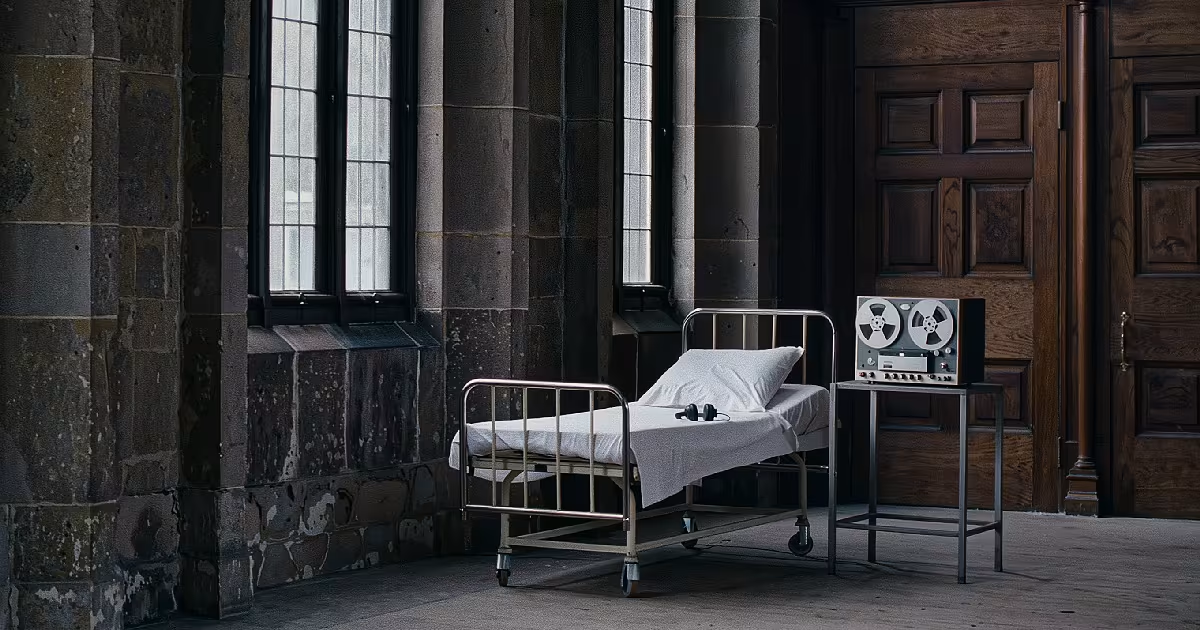
A hospital bed and a reel-to-reel tape recorder in a stone hall.
Illustration, not a photograph.

Archive / Conspiracy / BOT313-0483
CON-1957ConspiracyCIA FUNDED
THE SLEEP ROOM AT THE ALLAN MEMORIAL INSTITUTE
Fig. 01 A hospital bed and a reel-to-reel tape recorder in a stone hall. Illustration, not a photograph.
Opening
Between the late 1950s and the early 1960s, a Scottish-born psychiatrist, Dr Donald Ewen Cameron, ran a programme of experiments on his patients at the Allan Memorial Institute, a psychiatric hospital attached to McGill University in Montreal. Many of them had come in with anxiety or postnatal depression. They were put into drug-induced sleep for days or weeks, given electroconvulsive therapy at many times the usual strength, and played tape loops of recorded messages, in an attempt to wipe out their existing personalities and rebuild them. Cameron called it depatterning and psychic driving.
Part of the work was paid for by the CIA. This is not a legend or a leak: it is established by declassified records, by a lawsuit the CIA settled, and by compensation later paid by the Canadian government. It is one of the clearest documented cases of the MKUltra programme reaching real patients, many of whom had no idea.
Timeline
1943Cameron becomes the first director of the Allan Memorial Institute, newly founded with funding from the Rockefeller Foundation and others, and the first chairman of McGill's department of psychiatry.
1945He is one of three psychiatrists who examine Rudolf Hess at Nuremberg.
1957 to 1964He receives about $69,000 under an MKUltra subproject for what became known as the Montreal experiments. Money passes through a cover organisation, the Society for the Investigation of Human Ecology.
1961 to 1966Cameron serves as president of the World Psychiatric Association. He had been president of the American Psychiatric Association in 1952 to 1953.
8 September 1967Cameron dies of a heart attack while hiking in the Adirondacks, aged 65.
1980The CBC programme The Fifth Estate interviews former patients, who are suing the CIA.
1988The CIA settles with a group of former patients led by Velma Orlikow, whose husband David was a Canadian MP. Anne Collins's book In the Sleep Room is published.
1992The Canadian government announces compensation for surviving patients.
Key figures
Ewen Cameron was a leading figure in world psychiatry. His research was meant to treat serious mental illness, by his own standards. He commuted weekly between Lake Placid, New York, and Montreal.
Velma "Val" Orlikow was a patient who became the lead plaintiff in the suit against the CIA.
Sidney Gottlieb ran MKUltra for the CIA, and the money reached Cameron through the Society for the Investigation of Human Ecology.
Anne Collins, a Canadian journalist, wrote the first book on the affair.
Physical and documentary trail
The record: CIA records of MKUltra, including grant documents; the lawsuit and its settlement; Cameron's own published papers on depatterning and psychic driving; and the Canadian compensation scheme. Patients, described in the later reporting, were kept asleep with drugs for weeks, in one case up to three months, while tapes repeated short statements. Electroconvulsive therapy was given at thirty to forty times the normal power, according to accounts of the treatment.
What I have not found is a complete public list of the patients treated this way, or of their outcomes. It is also unclear whether Cameron knew that the CIA was the source of his money.
Things you might not know
- He was a leader of his profession. At the time, Cameron held presidencies of the American, Canadian and World psychiatric associations in turn.
- He examined Rudolf Hess. In 1945 he was one of three psychiatrists who evaluated Hess, who later admitted faking the amnesia.
- The money was laundered. The CIA used a front, the Society for the Investigation of Human Ecology, so that Cameron would receive grants without the source being named.
- The tapes used simple statements. Patients heard short messages played over and over, which was the psychic driving.
- He died on a hike. Cameron collapsed in the Adirondacks with his son, in 1967, before the programme became public.
- A documentary followed. A 2020 film, Eminent Monsters, covers his career.
Competing explanations
A rogue doctor. The argument that Cameron acted on his own theories, that he would have done the same work without the CIA, and that the agency's role was to pay for it. The fact that he continued after the funding began suggests this, though the funding did make the work possible.
A deliberate CIA programme. MKUltra aimed at control and interrogation techniques, and Cameron's methods were of interest to it. Writers including Naomi Klein argue that his work shaped later interrogation methods. That link is argued, not proved by a single document.
Medicine of its time. Some of the treatments, such as electroconvulsive therapy and sleep therapy, were then standard. What marked this work out was the scale and the intent to erase personality.
Later life of the case
New legal actions were filed in Quebec in the 2010s by the families of former patients, including a class action. Some claims have been settled by the federal government and others refused. The case is now often taught as a lesson in research ethics and informed consent.
Finding
The facts are documented: patients at the Allan Memorial were subjected to depatterning and psychic driving, the CIA paid for part of it, the CIA settled a suit, and Canada paid compensation. The strongest reading is a prominent psychiatrist whose experimental treatment of patients was funded in part by an intelligence programme.
What still will not resolve: how many patients were treated this way, and how much Cameron knew about where the money came from.
See also the wider programme in Project MKUltra.
Evidence signature
6/9 Solid
- Witnesses
- trained, independent witnesses
- Instruments
- nothing on record
- Paper
- formal investigation, court or declassified file
How well documented the case is, not whether it's true. A strong record can still have an ordinary answer, and a thin one can still be real.
You decide · EWEN CAMERON
What do you think happened?
One vote per case, anonymous. You'll see how other readers voted once you've voted.