GLADIO
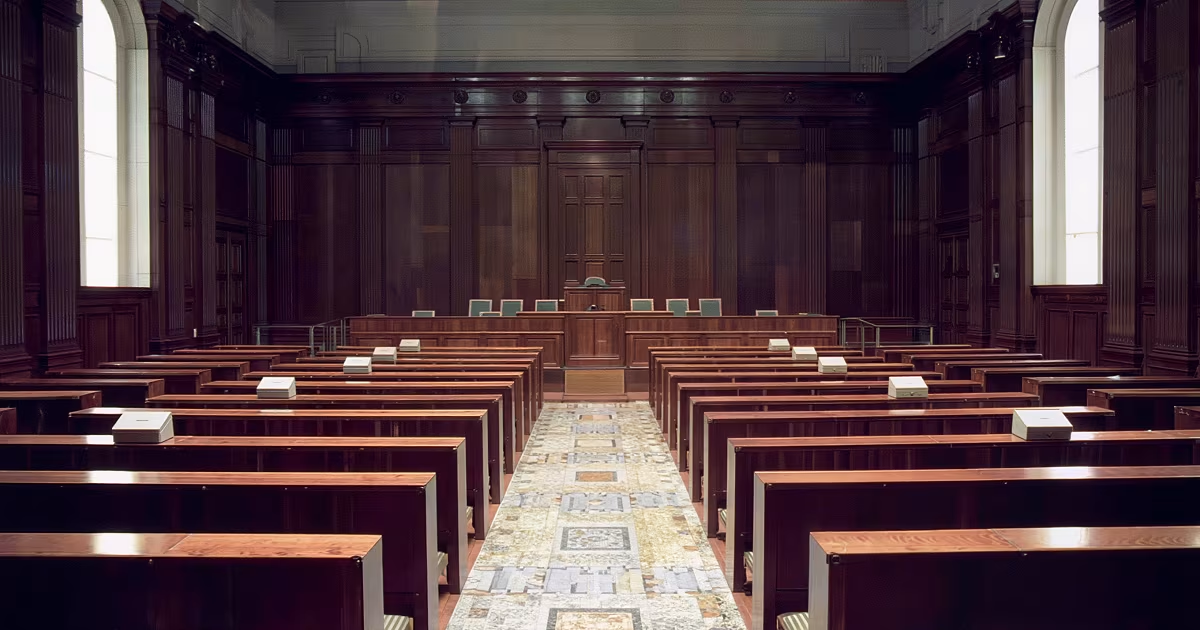
1990 Italian chamber benches. No readable papers.
Illustration, not a period photograph.
Opening
On 24 October 1990 Giulio Andreotti stood in the Italian Chamber and read a paper. A stay-behind structure existed. Gladio. Sword. About 622 names, 40 cells, born under SIFAR in the 1950s after an American approach he dated to 1951. Caches in the north-east. NATO coordination through the Clandestine Planning Committee and the Allied Clandestine Committee. Mandate, in his telling: a Soviet crossing. Not internal work. He wanted it wound down.
The word had come up because Judge Felice Casson, on the 1972 Peteano bombing, had asked for personnel files Vinciguerra had named. Other capitals then admitted cousins: SDRA 8, Absalon, Counter-Guerrilla, P-26. Washington said any Italian remnant was Italy's. Strategy-of-tension charges, that the net touched domestic bombs, remain the fight around the file. Andreotti denied the internal brief. Casson had not been looking for folklore. He had been looking for a name in a bombing case.
The spine of the file is a prime minister naming a stay-behind in parliament. Gladio is an admitted structure. It is not a proven fuse on every Italian bomb of those years.
Timeline
1951 approach in Andreotti's dating. 1950s SIFAR cells and caches.
1972 Peteano. Casson later, asking for names Vinciguerra had given.
August 1990 a Senate order. 24 October 1990 Andreotti reads Gladio into the Chamber.
Other capitals admit cousins. The tension-strategy fight continues in books. That fight is later life unless a court ties a cell to a charge sheet.
Andreotti dated an American approach to 1951 and a SIFAR birth in the 1950s. Caches in the north-east are why this is not only a committee name. Casson reached the word through Peteano and Vinciguerra, which is why the tension fight will not leave the file even when the speech denies an internal brief.
Cousin admissions in other capitals after 24 October show the structure was not an Italian folk tale. Washington pointing at Italy for any remnant is a diplomatic sentence, not a denial that stay-behinds existed.
Key figures
Giulio Andreotti owns the 24 October sentence.
Felice Casson owns the Peteano question that forced the word out.
SIFAR and later Italian services own the cells as admitted.
Vinciguerra owns a name that pointed Casson at files. NATO committees own coordination in Andreotti's telling.
Physical and documentary trail
On the paper, 1990 gives you four hard objects and no single bomb verdict.
One: Andreotti's Chamber statement of 24 October 1990.
Two: the counts he gave, names and cells and caches.
Three: Casson's Peteano file request.
Four: cousin admissions in other capitals. Andreotti statement to the Italian Chamber on Gladio, 24 October 1990, is the originating public tray.
There is no public roster of all 622 in one binder. There is no court that this card will treat as closing the tension argument. There is no denial that he named the structure.
A Chamber speech that counts cells and caches is already a file. A court page tying a named cell to a named bomb would move the tension argument. Until then the speech and Casson's question stand together without a verdict this card will stamp.
A parallel and occult structure which is said to have operated within our secret service.
Competing explanations
A stay-behind for a Soviet crossing only. This is Andreotti. It has a speech. It has Casson still asking about Peteano.
A net that also touched domestic bombs. This is the tension reading. It has questions. It has no single verdict this card will stamp.
A paper army that never cached a useful thing. Weak against the cells he counted.
Hybrid caution. A prime minister named Gladio. A judge had asked because of a bombing. Those two sentences stand together.
Later life of the case
European stay-behind lists and tension books. I keep those on the later-life shelf. The Chamber page stays first.
Finding
Giulio Andreotti told the Italian Chamber on 24 October 1990 that a stay-behind called Gladio existed, with cells and caches, and he did it because a judge on Peteano had asked for names. Believe the speech. A prime minister does not invent a structure for a folklore file.
What still will not resolve: a full public roster, or a court page that ties a named cell to a named bomb. Either one would finish the fight. The proving object is still that tie, written as a verdict, not as a chapter heading.