MKNAOMI
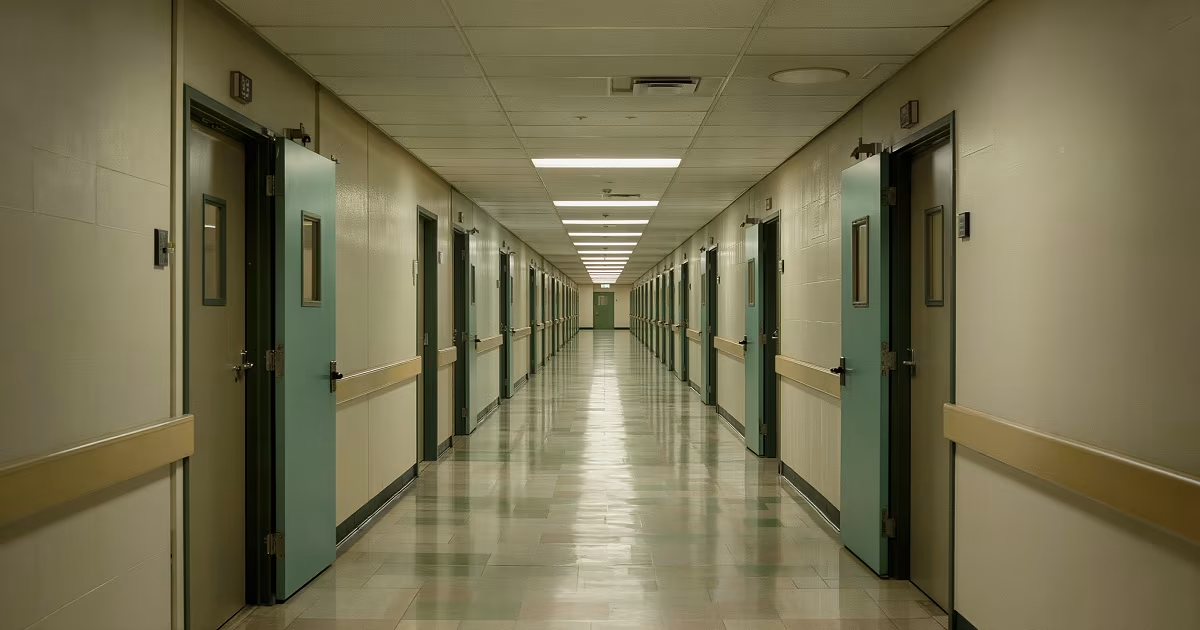
Fort Detrick lab corridor. Closed doors, no labels readable.
Illustration, not a period photograph.
Opening
MKNAOMI was the Special Operations partnership that put Fort Detrick's biological work in contact with CIA needs. Church Committee staff later wrote that the project ran from the early 1950s into 1970, when Nixon's orders against offensive biological weapons forced a close. The stay-behind that made the file famous was a stockpile the Agency still held after the order: among other materials, about eleven grams of shellfish toxin in a building the committee could name. Sidney Gottlieb's shop sat in the paper. Detrick men sat in the other chair.
The point of the caption was a capability, not a public health program. Church treated the retained toxin as a violation of the spirit of the 1969-70 orders. The Agency's line was incomplete destruction and forgotten cans. Both sentences are in the hearing record. No battlefield use is required for the stockpile to have existed.
The spine of the file is a Detrick partnership and toxin that outlived an order. MKNAOMI is a stockpile on a list. It is not a rumour that no gram was found.
Timeline
Early 1950s the partnership is captioned. Detrick and CIA Special Operations share a shop.
1969 Nixon announces an end to offensive biological work. 1970 the project is to close. Destruction is ordered.
Mid-1970s Church finds retained material, including the shellfish toxin figure that stuck in public.
Later dumps add captions. The hearing is first for the eleven grams. The 1950s caption is first for the shop.
Detrick's partnership with CIA Special Operations is older than the 1975 headline about grams. The grams are how the public met the cupboard. The caption is how the cupboard was built. Nixon's order is why leftover toxin became a committee sentence instead of an inventory line nobody read.
Key figures
Fort Detrick specialists own the technical end.
CIA Special Operations and Gottlieb's office own the requirement.
Church staff own the public count of what remained.
The Nixon orders own the close that the cans did not fully obey.
Physical and documentary trail
On the paper, 1950s-75 give you four hard objects and no empty cupboard.
One: MKNAOMI as a named Detrick-CIA project.
Two: the 1969-70 presidential close of offensive work.
Three: Church's finding of retained toxin, including the eleven-gram figure.
Four: testimony on incomplete destruction. Church Committee record on MKNAOMI and retained toxin, 1975, is the public tray.
There is no full public inventory of every can. There is no page that makes the eleven grams a newspaper invention. There is no battlefield after-action this card will stamp.
Church's count is the stay-behind. A complete destruction certificate from 1970 would have ended the leftover story. It was not on the table.
Approximately eleven grams of shellfish toxin remained in Agency storage.
Competing explanations
A secret weapons shop that ignored a president. This is the shocked reading. It has cans. It has a close order.
Bureaucratic leftover, forgotten inventory. The Agency door. Has to carry why a partnership existed for two decades.
A capability never meant for use. Possible. Church still counted grams.
Hybrid caution. A project was captioned. An order said destroy. Grams were still there when staff opened the cupboard.
Later life of the case
Later toxin lists and Gottlieb biographies. I keep those on the later-life shelf. The Church count stays first.
Finding
MKNAOMI tied Detrick to CIA Special Operations for years, a presidential order said that work should end, and Church still found shellfish toxin in Agency storage. Believe the cupboard. A committee does not invent eleven grams for a chapter heading.
What still will not resolve: a full inventory of every can, or a page that shows complete destruction in 1970. Either one would finish the leftover. The proving object is still that inventory, unredacted, not a rounded public figure.