OPERATION AJAX
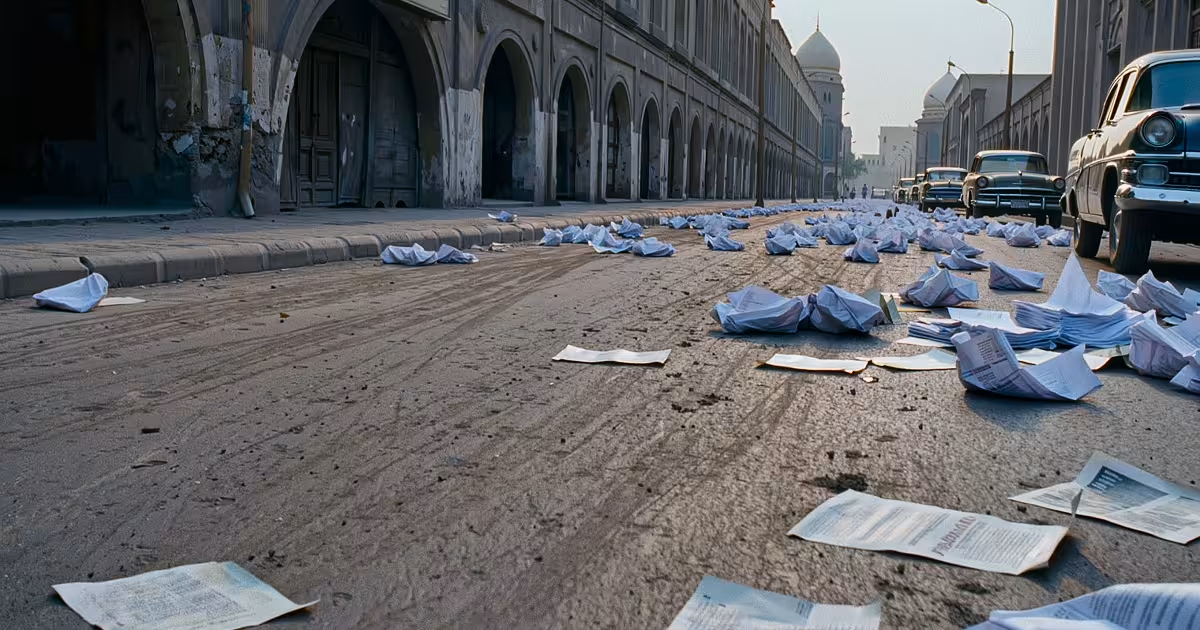
Leaflets scattered along a Tehran street lined with 1950s cars.
Illustration, not a period photograph.

Archive / Conspiracy / BOT313-0136
CON-195319 AUG 1953ConspiracyADMITTED
THE CIA COUP IN IRAN
Fig. 01 Leaflets scattered along a Tehran street lined with 1950s cars. Illustration, not a period photograph.
Opening
In August 1953, the CIA and Britain's MI6 overthrew Mohammad Mosaddegh, the elected prime minister of Iran, who had nationalised the British-owned Anglo-Iranian Oil Company two years earlier. The American side was codenamed TPAJAX. The first attempt, on the night of 15 to 16 August, collapsed within hours, and the Shah fled the country.
On 18 August, CIA headquarters told its Tehran station that operations against Mosaddegh should be discontinued. The station, led by Kermit Roosevelt Jr., kept going. The next day crowds and army units took the streets, and Mosaddegh fell. The Agency did not formally acknowledge its role until 2013.
Timeline
1951Iran's parliament votes to nationalise the oil industry, and Mosaddegh becomes prime minister. Britain responds with a blockade of Iranian oil and plans of its own, under the MI6 name Operation Boot.
Early 1953Winston Churchill's government seeks American help. Under President Eisenhower, Washington agrees to a joint operation.
April 1953The CIA allocates $1 million to the Tehran station, to be used in any way that would bring about Mosaddegh's fall.
August 1953After resisting, the Shah signs decrees dismissing Mosaddegh and naming General Fazlollah Zahedi prime minister.
About 1am, 16 AugustColonel Nematollah Nassiri delivers the dismissal decree. Mosaddegh rejects it and has Nassiri arrested. By dawn the Shah has flown to Baghdad, and from there to Rome.
18 AugustCIA headquarters cables the station that operations against Mosaddegh should be discontinued. Roosevelt does not stand down. Station assets spread copies of the Shah's decree and stir fears of a communist takeover.
19 AugustPro-Shah crowds, some paid and some not, march in Tehran. Army units loyal to Zahedi seize government buildings and attack Mosaddegh's house. Estimates of the dead for the coup run from 200 to 300.
22 AugustThe Shah returns to Tehran.
21 December 1953A military court convicts Mosaddegh of treason. He serves three years in prison and spends the rest of his life under house arrest at Ahmadabad, where he dies on 5 March 1967.
Key figures
Mohammad Mosaddegh was the nationalist prime minister whose oil policy started the crisis and whose fall became a founding grievance of modern Iranian politics.
Kermit Roosevelt Jr., grandson of Theodore Roosevelt, ran the operation on the ground and later told his version in the memoir Countercoup.
Mohammad Reza Shah Pahlavi signed the decrees, fled when the first attempt failed, and returned to rule until the 1979 revolution.
General Fazlollah Zahedi was the officer the plotters chose as Mosaddegh's replacement. After the coup the CIA gave his government $5 million.
Donald Wilber, a CIA planner and Persian scholar, wrote the Agency's internal history of the coup in 1954.
Physical and documentary trail
What survives: Wilber's Clandestine Service History, obtained by The New York Times and published in 2000; documents released by the CIA in August 2013 stating the coup was carried out under CIA direction; and the State Department's revised Foreign Relations of the United States volume of June 2017, around 1,000 pages long. In 1997 the CIA said it had destroyed or lost almost all its own operational files from 1953, so the internal ledger of who was paid, and how much, is incomplete.
Things you might not know
- Headquarters tried to call it off. The 18 August cable said operations against Mosaddegh should be discontinued. The coup succeeded the next day.
- Mosaddegh was Time's Man of the Year. The magazine gave him the title for 1951.
- The memoir was pulled. In 1979 McGraw-Hill recalled nearly all 7,500 copies of Countercoup after British Petroleum threatened to sue over its account of the oil company's role.
- The CIA called the memoir fiction. Roosevelt cut every mention of MI6 and made over 150 other changes for clearance, and internal files describe the result as essentially a work of fiction.
- The cost is still argued. Estimates of the total run from $100,000 to $20 million, depending on what is counted.
- A senior cleric asked for money. Documents released in 2017 show Ayatollah Kashani, once Mosaddegh's ally, in contact with the Americans and apparently asking for funds. No record shows he received any.
Competing explanations
An Anglo-American coup. This is the reading of the CIA's own history and its 2013 statement. Without the money, the propaganda and the station's refusal to stand down on 18 August, there is little reason to think 19 August happens.
An Iranian event the CIA helped along. Some historians argue that the clergy, the army and parts of the public had already turned against Mosaddegh, and that the crowds of 19 August were partly spontaneous. Wilber's history itself calls the demonstrations partly spontaneous.
Oil as the sole motive. Oil explains why London wanted Mosaddegh gone. Washington's documents put more weight on fear of the Tudeh communist party and a Soviet foothold, though the 1954 consortium deal gave American companies a share of Iranian oil.
Later life of the case
The coup shaped how Iranians saw the United States for decades and was a grievance behind the 1979 revolution and the hostage crisis. American officials began acknowledging it openly in the 2000s, culminating in the 2013 release and the 2017 State Department volume.
Finding
The CIA and MI6 planned and paid for the overthrow of Iran's elected prime minister, and the United States has admitted it. The open question is how much of 19 August was bought and how much was Iranian. The record shows a failed first attempt, a headquarters ready to quit, and a second day that mixed paid crowds with genuine anger at Mosaddegh.
What still will not resolve: the full payment record, much of which the CIA says it destroyed or lost, and the British files on Operation Boot, which have never been released in full.
Evidence signature
4/9 Solid
- Witnesses
- several people
- Instruments
- nothing on record
- Paper
- official records at the time
How well documented the case is, not whether it's true. A strong record can still have an ordinary answer, and a thin one can still be real.
You decide · OPERATION AJAX
What do you think happened?
One vote per case, anonymous. You'll see how other readers voted once you've voted.