OPERATION CHAOS
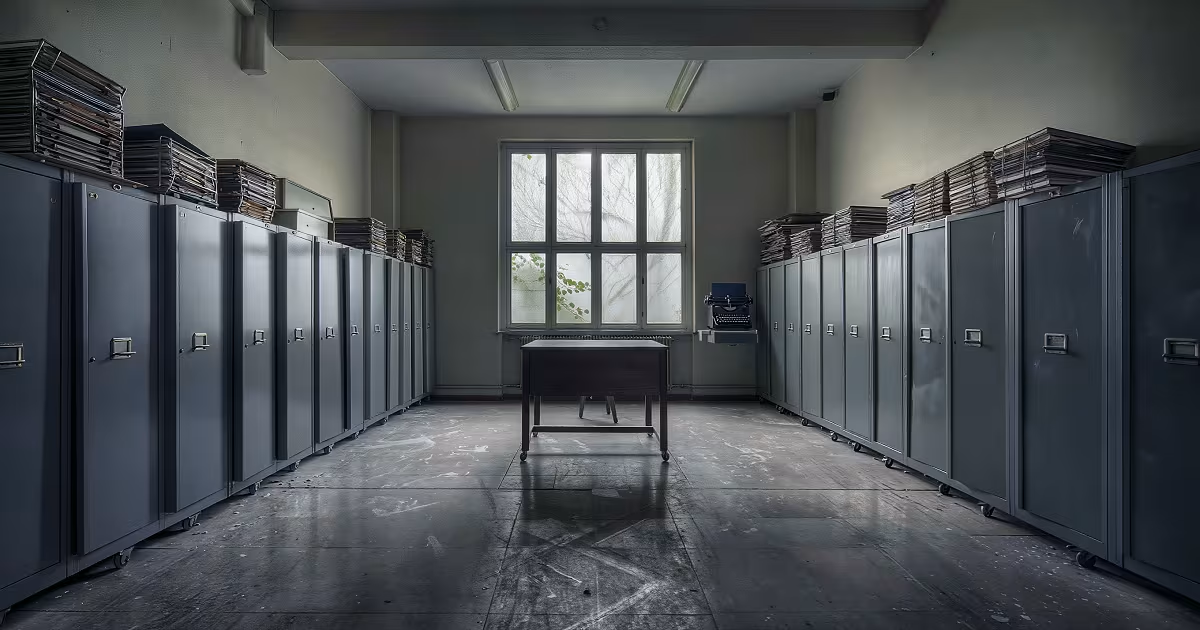
A long records room of grey cabinets and files, a table by the window.
Illustration, not a period photograph.

Archive / Conspiracy / BOT313-0146
CON-1967ConspiracyADMITTED
MHCHAOS INDEX OF THREE HUNDRED THOUSAND NAMES
Fig. 01 A long records room of grey cabinets and files, a table by the window. Illustration, not a period photograph.
Opening
Operation CHAOS, cryptonym MHCHAOS, was the CIA's program for watching the American antiwar movement and the radical left. It began in August 1967, when Director Richard Helms, under pressure from President Lyndon Johnson to find foreign hands behind the protests, had a Special Operations Group set up inside James Angleton's Counterintelligence Staff. Helms chose Richard Ober to run it. The stated question was foreign: were foreign governments funding or steering American dissent?
The answer the Agency kept giving was no. The files kept growing anyway. By the end CHAOS held a computer index of more than 300,000 names and organisations, about 7,200 personality files on American citizens and nearly 1,000 files on organisations. The CIA restricted it in 1973 and ended it in March 1974. Seymour Hersh exposed it in the New York Times that December.
Timeline
15 August 1967Deputy Director for Plans Thomas Karamessines relays Helms's instructions to set up the unit. Ober, already working on the Ramparts magazine affair, has begun a computer index on the "New Left".
15 November 1967Helms delivers "International Connections of the U.S. Peace Movement" to Johnson. It finds little evidence of foreign control or funding.
4 September 1968A second study, "Restless Youth", goes to Johnson. A version with a section on American students goes to Henry Kissinger on 18 February 1969.
Mid-1968The cryptonym CHAOS is assigned. In July 1968 all CIA stations are cabled to send material on dissidents "Eyes Only" to the unit.
20 June 1969White House aide Tom Charles Huston writes to the CIA asking for more on foreign support for the movement. The pressure now comes from the Nixon White House.
6 September 1969Helms orders every CIA directorate to support the operation, assuring them it is within the Agency's statutory authority.
October 1969 to July 1972The unit contacts about 40 agents for reporting abroad on American dissidents.
November 1972The CIA's own Inspector General staff are barred from reviewing CHAOS files during a field survey.
Late August 1973The new Director, William Colby, orders CHAOS "restricted to the collection abroad of information on foreign activities related to domestic matters."
15 March 1974CHAOS is terminated.
22 December 1974Hersh's front-page story, "Huge C.I.A. Operation Reported in U.S. Against Antiwar Forces, Other Dissidents in Nixon Years", reports files on at least 10,000 Americans.
June 1975The Rockefeller Commission reports that some CHAOS activities "unlawfully exceeded" the CIA's statutory authority.
Key figures
Richard Helms, Director of Central Intelligence 1966 to 1973, who ordered the unit created and kept it going.
Richard Ober, the counterintelligence officer who ran it from start to finish.
James Angleton, Chief of Counterintelligence, under whose staff it sat.
Thomas Karamessines, who passed down the original directive.
William Colby, who as Director narrowed it in 1973 and closed it in 1974.
Seymour Hersh, the Times reporter who made it public.
Physical and documentary trail
The core record is chapter 11 of the Rockefeller Commission report (June 1975) and the CHAOS section of the Church Committee's Book III (April 1976). The commission counted 13,000 files in all, including the 7,200 personality ("201") files. The unit wrote 3,500 internal memoranda, sent more than 3,000 to the FBI and 37 to the White House and other senior officials. It received more than 11,000 FBI items and more than 12,000 cables. Nearly 65 percent of its files were opened to serve FBI requests.
Inputs came from everywhere. CHAOS put names on the watch list for the CIA's mail-opening program in New York and passed a watch list to another agency, the NSA, which sent back about 1,100 pages of material. Organisations with files included Students for a Democratic Society, the Black Panther Party and Women's Strike for Peace. The program's broader place in the 1975 to 1976 inquiries is told in the Church Committee report.
This is an area not within the charter of this Agency, so I need not emphasize how extremely sensitive this makes the paper. Should anyone learn of its existence it would prove most embarrassing for all concerned.
Corrections to the earlier version of this report. Helms did not end CHAOS in 1973. Colby restricted it in August 1973 and it was terminated on 15 March 1974. The quotation previously attributed to the Church Committee about the index could not be found in that wording and has been replaced. The index of more than 300,000 names is in both the Rockefeller and Church reports.
Things you might not know
- The index had a monster's name. Access ran in password-protected streams by sensitivity, so staff called the computer system "Hydra".
- It lived in a vaulted basement. The unit, which peaked at 52 staff in 1971, was physically separated from the rest of Counterintelligence.
- CHAOS clipped film reviews. Grove Press got a file because it had published Kim Philby. Grove also distributed the film "I Am Curious Yellow", so analysts clipped and filmed the critics' reviews.
- Some agents were "sheepdipped". Recruits were run through radical circles at home to build credentials before going abroad. On three occasions agents reported on domestic matters, including the May Day 1971 demonstrations in Washington.
- The budget office was kept in the dark. An Office of Management and Budget inspection team was deliberately not told of CHAOS during a survey of CIA field operations.
- Helms overruled his own doubters. A memorandum for the record of 5 December 1972 said CHAOS "cannot be stopped simply because some members of the organization do not like this activity."
Competing explanations
A legitimate counterintelligence mission that drifted. The Rockefeller Commission accepted that gathering intelligence abroad on foreign links to dissent was proper. Its finding was that CHAOS became a repository for domestic material, largely because it served the FBI.
Domestic political surveillance under a foreign label. Two presidents demanded proof of foreign control. Each study said it was not there, and the files kept growing. On this reading the foreign question was the licence, not the purpose.
Bureaucratic momentum. Once the index existed, every FBI report and press clipping had somewhere to go. The Grove Press file is the commission's own example of collection without a target.
Later life of the case
The Rockefeller findings, CHAOS among them, fed into President Ford's Executive Order 11905 of February 1976, which tightened limits on CIA activity inside the United States. Congress went further and set up permanent intelligence committees, the Senate's in 1976 and the House's in 1977. The CHAOS index itself has never been published.
Finding
CHAOS is documented and admitted. The CIA ran a unit from 1967 to 1974 that indexed more than 300,000 names and kept files on about 7,200 Americans, while its own studies found no meaningful foreign control of the movement it was watching. A presidential commission called parts of it unlawful.
What still will not resolve: who was in the index. No list of the 300,000 names has ever been released, so most people in it have no way of knowing.
Evidence signature
5/9 Solid
- Witnesses
- several people
- Instruments
- nothing on record
- Paper
- formal investigation, court or declassified file
How well documented the case is, not whether it's true. A strong record can still have an ordinary answer, and a thin one can still be real.
You decide · OPERATION CHAOS
What do you think happened?
One vote per case, anonymous. You'll see how other readers voted once you've voted.