OPERATION MENU
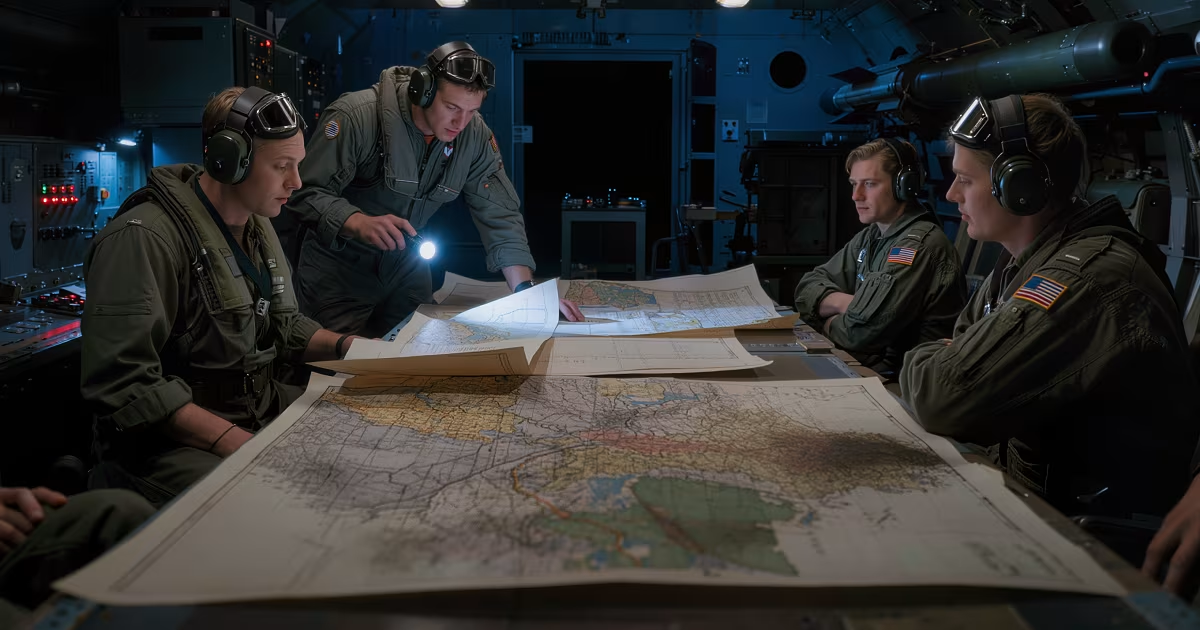
American aircrew studying maps by torchlight inside a bomber.
Illustration, not a period photograph.

Archive / Conspiracy / BOT313-0209
CON-1969ConspiracyDOCUMENTED
SECRET B-52 BOMBING OF CAMBODIA
Fig. 01 American aircrew studying maps by torchlight inside a bomber. Illustration, not a period photograph.
Opening
From 18 March 1969 to 26 May 1970, American B-52 bombers struck North Vietnamese and Viet Cong base areas inside Cambodia, a country that was officially neutral. The campaign was called Operation Menu, after the codenames of its target areas: Breakfast, Lunch, Snack, Dinner, Supper and Dessert. It ran to about 3,800 sorties and 108,823 tons of bombs.
The bombing was kept secret by a dual reporting system. Routine records showed the missions as strikes in South Vietnam, while the real targets travelled by back channel and the paperwork was destroyed. Congress as a whole did not learn the truth until 1973.
Timeline
18 March 1969Breakfast, the first strike, hits Base Area 353, believed to hold COSVN, the communist headquarters for the south.
9 May 1969William Beecher of The New York Times reports the Cambodia raids. The White House responds by wiretapping officials and journalists, including Morton Halperin, whose phone is tapped for 21 months.
Summer 1969Five members of Congress have been privately briefed.
26 May 1970Menu ends, a month after American and South Vietnamese troops cross into Cambodia.
1970 to August 1973Operation Freedom Deal extends B-52 bombing to at least half of Cambodia.
December 1972Major Hal Knight, who had destroyed Menu paperwork after each mission, writes to Senator William Proxmire.
1973The Senate Armed Services Committee holds eight days of hearings, and the dual reporting becomes public.
30 July 1974The House Judiciary Committee rejects a proposed article of impeachment over the secret bombing and the falsified records.
Key figures
President Richard Nixon and his national security adviser Henry Kissinger ordered the bombing and the secrecy around it.
Major Hal Knight handled the false reports at a radar site, burned the real ones, and became the whistleblower. He later received poor efficiency reports and was discharged.
William Beecher broke the story in 1969, two months after it began.
Senator William Proxmire received Knight's letter and pushed for the hearings.
Physical and documentary trail
What exists: the Senate hearing record of 1973, Knight's testimony, the Defense Department's later figures, Beecher's 1969 report, and the House Judiciary Committee's votes. The original target paperwork for many missions was deliberately destroyed, and there is no confirmed count of Cambodian casualties. The Defense Department put the civilian population of the six target areas at 4,247, and one estimate has Base Area 353 alone receiving nearly 25,000 bombs.
Things you might not know
- The menu had six courses. Breakfast, Lunch, Snack, Dinner, Supper and Dessert each named a target area.
- The evidence was burned on purpose. After each mission Knight destroyed the paperwork and computer tapes that showed the real target.
- It was in the paper within eight weeks. The New York Times reported the raids in May 1969, but the story drew little reaction.
- The leak led to wiretaps. Thirteen officials and four journalists had their phones tapped, one of the threads later pulled in Watergate.
- The headquarters was never found. The bombing failed to destroy COSVN, the target that had justified the first strike.
- Kissinger defended it plainly. He later said the United States was bombing North Vietnamese troops that had invaded Cambodia.
Competing explanations
A secret war against a neutral country. On this reading, the bombing and the falsified records deceived Congress and the public about the scope of the war, and killed Cambodian civilians whose numbers will never be known.
A legitimate strike on enemy sanctuaries. Nixon and Kissinger argued the base areas were occupied by North Vietnamese forces, that Cambodia's ruler Prince Sihanouk tolerated the raids, and that secrecy protected him. The deception of Congress remains the weak point of this reading.
A military failure. The bombing did not stop North Vietnamese offensives or destroy COSVN. Supporters say it disrupted the base areas; critics say it widened the war.
Later life of the case
Menu became a central example in arguments about executive war powers and contributed to the War Powers Resolution of 1973. The wider bombing of Cambodia that followed is often linked to the rise of the Khmer Rouge, a connection historians still argue over.
Finding
The United States bombed Cambodia in secret for fourteen months and falsified its own records to hide it, and this was confirmed in Senate hearings. Nixon and Kissinger's case that the targets were enemy bases is part of the record too. What is missing is the human cost on the ground.
What still will not resolve: how many Cambodians were killed by Menu, and what the destroyed target records would show.
Evidence signature
4/9 Solid
- Witnesses
- nothing on record
- Instruments
- photo, film or physical traces
- Paper
- formal investigation, court or declassified file
How well documented the case is, not whether it's true. A strong record can still have an ordinary answer, and a thin one can still be real.
You decide · OPERATION MENU
What do you think happened?
One vote per case, anonymous. You'll see how other readers voted once you've voted.