OPERATION SEA-SPRAY
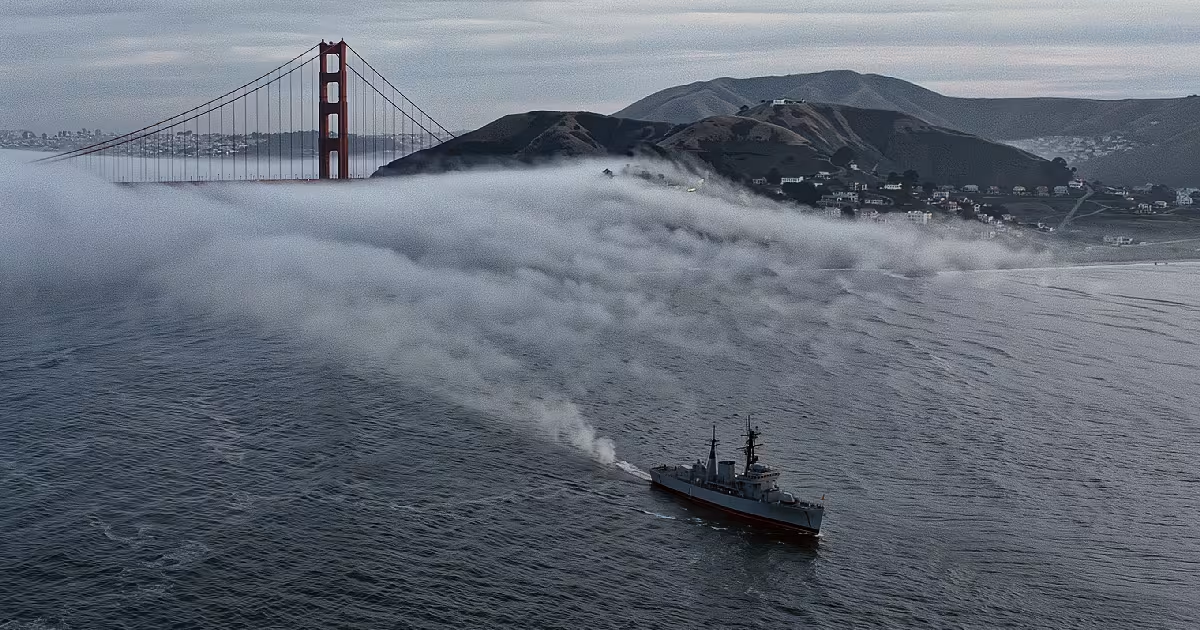
A grey Navy ship trailing mist in the fog below the Golden Gate Bridge.
Illustration, not a period photograph.
Opening
Between 20 and 27 September 1950, a US Navy vessel off San Francisco sprayed clouds of bacteria into the sea fog and let the wind carry them over the city. It was a test of how an enemy might attack a coastal city with germ weapons. Nobody living in the Bay Area was told. The public learned of it twenty-six years later.
Timeline
1949 to April 1950. Earlier trials include bacteria released into the Pentagon’s air handling system in August 1949 and clouds sprayed from Navy ships off Norfolk, Virginia, in April 1950.
1950. The Army’s Chemical Corps plans a series of open-air tests to measure how an aerosol spreads over a city. Gen. Anthony McAuliffe, as Chief Chemical Officer, approves San Francisco as a site and signs off on the organisms.
20 to 27 September 1950. The Navy releases Serratia marcescens and Bacillus globigii offshore. Samplers at 43 sites pick up the bacteria across the city and as far as 23 miles away in the East Bay.
Late September to October 1950. Stanford Hospital, then in San Francisco, sees eleven patients with urinary infections caused by Serratia, a species almost never seen there before.
Autumn 1950. One of the eleven, Edward J. Nevin, aged 75 and recovering from prostate surgery, dies about three weeks after admission when the infection reaches his heart valves.
January 1951. The Chemical Corps writes up the results as Special Report No. 142: Biological Warfare Trials at San Francisco, California, 20-27 September 1950.
1951. Stanford doctors publish the cluster in the Archives of Internal Medicine as a medical curiosity, without knowing about the test.
December 1976. Newspaper reports, including the San Francisco Chronicle on 22 December, reveal the San Francisco test.
1977. Senate hearings chaired by Edward Kennedy take the Army’s testimony. The Army lists 239 open-air tests between 1949 and 1969, among them bacteria dropped in light bulbs onto New York subway tracks in 1966. Retired Gen. William Creasy, who had run the Chemical Corps, defends the San Francisco test and the choice of organism.
1981 to 1983. Sixty-seven of Nevin’s relatives, including his grandson Edward J. Nevin III, sue. The trial draws so much attention that the judge lets reporters sit in the empty jury box. The court finds the government immune and that the test did not cause his death. The Ninth Circuit affirms in January 1983, and the Supreme Court declines to hear the case.
Key figures
Edward J. Nevin, born in County Kilkenny, Ireland, who came to San Francisco in 1903, raised seven children in the Mission District and worked as a pipefitter. He is the only death ever linked to the test. His grandson Edward J. Nevin III, who took the family’s case to court. Gen. Anthony McAuliffe, famous for “Nuts!” at Bastogne, who approved the test. The Stanford physicians who noticed the cluster without knowing why.
Physical and documentary trail
On the paper: Special Report No. 142 and the Army’s later testimony. The 1951 medical paper records the infections. The court record sets out the chain of approvals. The report itself put the exposure in plain numbers. What is missing is proof either way that the hospital’s Serratia came from the Navy’s spray. Nobody in 1950 compared the hospital strain with the test strain, and it can’t be done now.
Every one of the 800,000 people in San Francisco exposed to the cloud at normal breathing rate (10 liters per minute) inhaled 5,000 or more fluorescent particles.
Competing explanations
The spray caused the infections. The timing is close, the organism was rare in the hospital, and one of the released strains was Serratia. The family’s case rested on this.
Coincidence and hospital spread. The Army argued the Stanford cluster came from catheters and instruments on the ward, a known route for Serratia, and that the test strain was not shown to be the same. The court accepted this.
Both. The test may have seeded the city and the ward spread it. Nothing on record can separate the two.
Later life of the case
Open-air testing of this kind ended when President Nixon shut down the US offensive biological weapons programme in 1969. Sea-Spray became the example cited in almost every later account of US biological testing on its own citizens. It fed the 1977 hearings and helped change how Serratia marcescens was seen: once treated as a harmless marker, it is now a known cause of hospital infections.
Finding
The test itself is not in doubt. The Army admitted it, documented it and defended it: a city of about 800,000 people was used as a test chamber without its consent. The question the courts could not settle is narrower, and it concerns one man. The data leaves it open whether Edward Nevin died because of the spray.
What still will not resolve: whether the eleven Stanford patients were the only people the test made ill, since nobody was looking.