OPERATION LAC
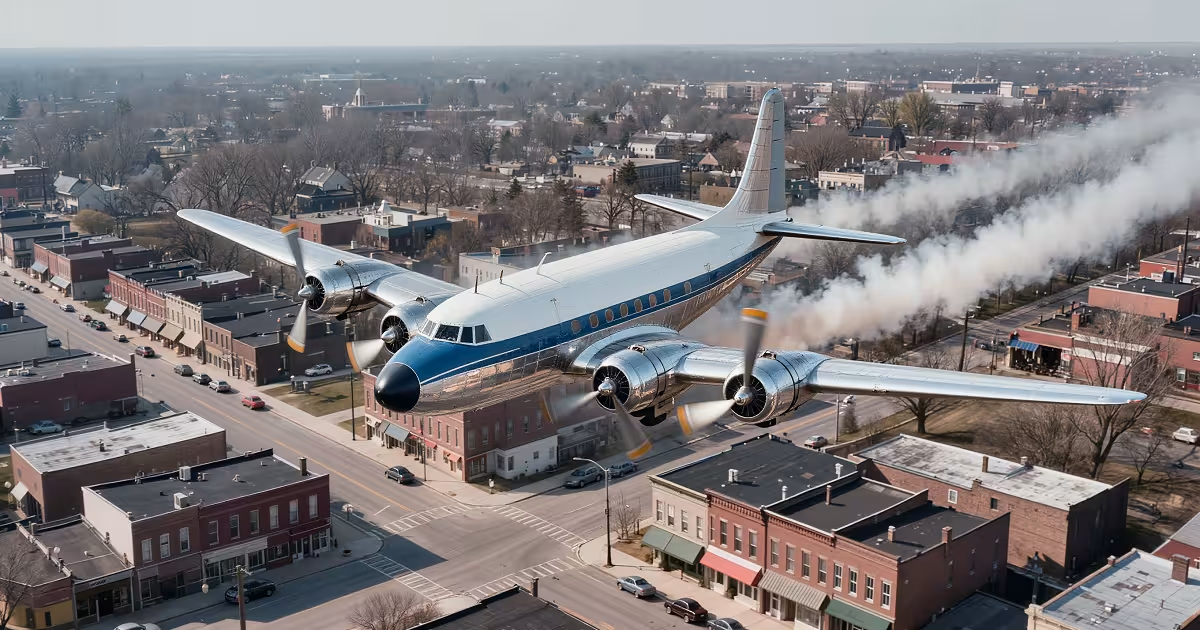
A four-engine plane spraying a white trail over a small town.
Illustration, not a period photograph.

Archive / Conspiracy / BOT313-0229
CON-1957ConspiracyADMITTED
THE ARMY SPRAYS THE MIDWEST
Fig. 01 A four-engine plane spraying a white trail over a small town. Illustration, not a period photograph.
Opening
Operation LAC, for Large Area Coverage, was a US Army Chemical Corps test series in 1957 and 1958. A C-119 "Flying Boxcar" loaned by the Air Force released zinc cadmium sulfide, a fine fluorescent powder, along flight lines hundreds of miles long. Ground stations tracked the particles under ultraviolet light to see how far a biological weapon dropped from the air might spread. On the first run they turned up 1,200 miles away.
LAC was one part of a wider programme. In separate tests in the 1950s and 1960s the Army released the same compound from rooftops and vehicles in cities including St. Louis and Minneapolis. In all, it was released in 33 urban and rural areas. The people who lived there were not told what it was. A 1997 National Research Council review found no evidence it made anyone sick, and the argument has not ended there.
Timeline
1953 to 1954The Army sprays zinc cadmium sulfide in St. Louis, including from rooftops in poor, largely Black neighbourhoods. City officials are told it is a smoke screen test meant to shield the city.
2 December 1957The first LAC run flies from South Dakota to International Falls, Minnesota. A cold air mass carries most of the powder into Canada, but particles reach a station in New York State, 1,200 miles away.
February 1958A test at Dugway Proving Ground ends similarly, with the particles swept towards the Gulf of Mexico.
Fiscal year 1958About 100 flight hours are logged for LAC, including a run of 1,400 miles. Other lines run from Toledo, Ohio, to Abilene, Texas, and from Detroit to Springfield, Illinois, to Goodland, Kansas.
1963 to 1965A second round of spraying takes place in St. Louis, with blowers on the Pruitt-Igoe housing towers, schools and station wagons.
1977The tests become public through Senate hearings on Army biological testing.
1994The Army confirms that the city tests were part of its biological warfare programme and that cities were picked for their resemblance to Soviet cities.
14 May 1997The National Research Council reports that exposures were far below harmful levels, while noting that some data were lost.
September 2012Sociologist Lisa Martino-Taylor, whose 2011 dissertation examined the St. Louis tests, publicly raises the possibility that a radioactive additive was used, while saying she has no direct proof. Senators Roy Blunt and Claire McCaskill write to the Army.
November 2012Assistant Secretary of the Army Katherine Hammack replies that the tests posed no health risk.
Key figures
The Army Chemical Corps, which designed and ran the tests.
Rogene Henderson of the Lovelace Respiratory Research Institute, who chaired the 1997 National Research Council subcommittee.
Leonard Cole, whose book The Eleventh Plague reconstructed the LAC flights from Army records.
Lisa Martino-Taylor, author of Behind the Fog, who revived the St. Louis story.
Roy Blunt and Claire McCaskill, the Missouri senators who pressed the Army in 2012.
The residents of the sprayed areas, who were never asked for consent.
Physical and documentary trail
Cole cites an Army Chemical Corps document, "Summary of Major Events and Problems" for 1958, which called LAC the largest test the Corps had ever undertaken, covering an area from the Rocky Mountains to the Atlantic and from Canada to the Gulf of Mexico. A typical line of 400 miles released about 5,000 pounds of powder. Canadian defence files also record the country's part in the tests.
The 1997 report, Toxicologic Assessment of the Army's Zinc Cadmium Sulfide Dispersion Tests, estimated the maximum combined cadmium doses at 24.4 micrograms in St. Louis, 14.5 in Winnipeg and 6.8 in Minneapolis. On Biltmore Beach in Florida, then an unpopulated island, it may have reached 390. The committee put a safe inhaled amount for an average man at around 500 micrograms over a few days.
After an exhaustive, independent review requested by Congress we have found no evidence that exposure to zinc cadmium sulfide at these levels could cause people to become sick.
Corrections to the earlier version of this report. LAC itself was the 1957 to 1958 aircraft series. The rooftop and vehicle releases in St. Louis and other cities were separate city tests, not part of LAC, and are now described that way. The earlier version also said members of Congress asked for health studies of residents. What is on record is that Senators Blunt and McCaskill asked the Army for information on health effects in 2012.
Things you might not know
- The cover story was a smoke screen. St. Louis officials were told the spraying tested a screen that could shield the city, not a germ warfare tracer.
- The weather ran the first test. On 2 December 1957 a Canadian air mass took most of the powder north, and the Army still counted the run a partial success because of the New York detection.
- Cities were cast as Soviet stand-ins. Minneapolis, St. Louis and Winnipeg were chosen partly because they resembled Soviet cities.
- Ordinary life beat the tests. The 1997 committee said residents took in 12 to 84 micrograms of cadmium from soil, water, food and air in normal daily life, more than the tests added.
- No follow-up study was possible. The committee judged an epidemiological study unworkable: 30 to 40 years on, those exposed could not be identified and there were no health data on them.
- Ethics were outside the brief. The National Research Council said it was not asked to address the ethical and social issues raised by the testing.
Competing explanations
Necessary defence testing at low risk. The Army needed to know how an aerial attack would spread, zinc cadmium sulfide was not thought toxic at the time, and the 1997 review supports the view that doses were small.
Unethical testing on civilians. People were exposed without knowledge or consent, and in St. Louis the spraying concentrated on poor, largely Black neighbourhoods. The 1997 committee itself recommended that the Army study whether inhaled zinc cadmium sulfide breaks down into more toxic cadmium compounds in the lungs, an open question at the time.
A hidden radioactive component. Martino-Taylor argues the St. Louis tests may have included a radiological additive. She has said she lacks direct proof, and the Army has denied it.
Later life of the case
LAC and the city tests are now regularly cited alongside other Cold War programmes that tested on people without consent. The 2012 congressional letters and the Army's reply were the last major official exchange. Martino-Taylor expanded her research into the book Behind the Fog, which keeps the St. Louis questions in print.
Finding
Admitted. The Army released zinc cadmium sulfide over much of the United States and parts of Canada from aircraft, and over cities from rooftops and vehicles, without telling the people underneath. The best available assessment, from 1997, found doses too low to cause illness, while noting gaps in the data.
What still will not resolve: the long-term effect on the people exposed. No follow-up study of residents was done, and the 1997 committee judged one unworkable, so the question it could not settle on human data is still settled only by estimate.
Evidence signature
5/9 Solid
- Witnesses
- several people
- Instruments
- nothing on record
- Paper
- formal investigation, court or declassified file
How well documented the case is, not whether it's true. A strong record can still have an ordinary answer, and a thin one can still be real.
You decide · OPERATION LAC
What do you think happened?
One vote per case, anonymous. You'll see how other readers voted once you've voted.