PROJECT ICEWORM
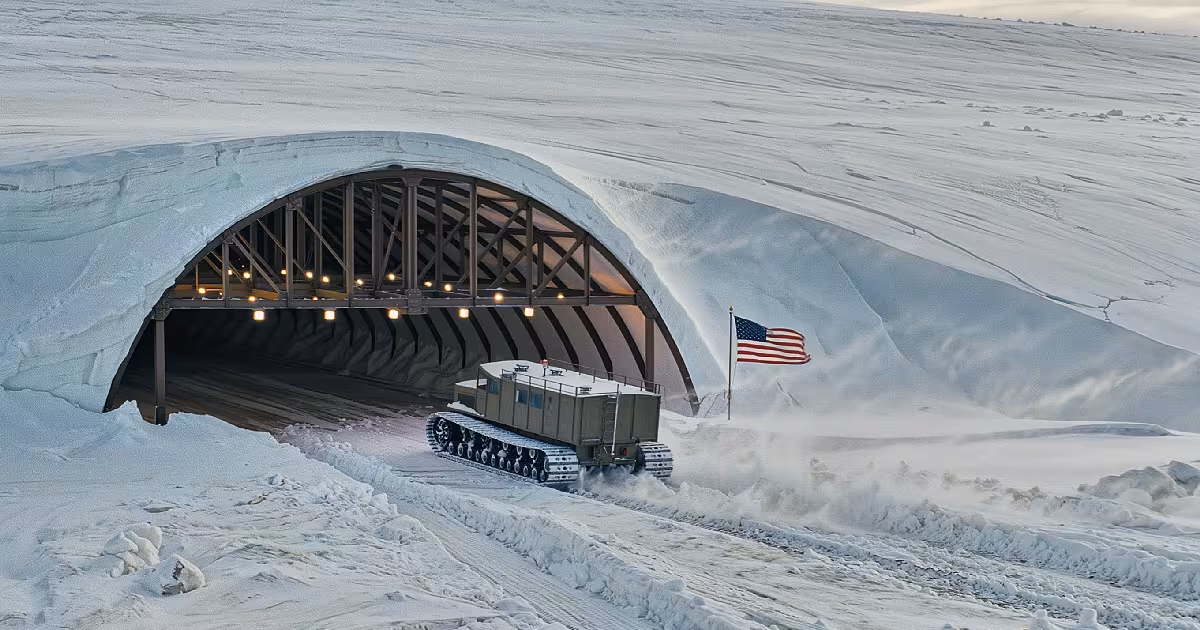
A tracked vehicle driving out of an arched trench entrance cut into the Greenland ice sheet, with a US flag in the snow beside it.
Illustration, not a period photograph.
Opening
In 1959 the US Army began cutting trenches into the Greenland ice sheet about 150 miles east of Thule Air Base and roofing them over with arched steel. The result, Camp Century, was presented to the world as a polar research station powered by a portable nuclear reactor. Behind it sat a plan the public was not told about: Project Iceworm, a network of tunnels under the ice that could hide and move hundreds of nuclear missiles within range of the Soviet Union.
Timeline
1959. Construction of Camp Century begins at about 6,600 feet on the ice sheet in northwest Greenland. Twenty-one trenches, some 3 kilometres in all, house labs, bunks, a chapel and a theatre for around 200 men.
1960. The Army’s report Strategic Value of the Greenland Icecap sets out Iceworm: up to 600 shortened Minuteman missiles, nicknamed Iceman, moved by rail through 4,000 kilometres of tunnels across an area about three times the size of Denmark, with launch points four miles apart.
October 1960. The PM-2A reactor goes critical. It is the Army’s first portable nuclear power plant, flown in pieces and assembled under the ice.
1962. The ice proves less solid than planned. It flows and squeezes the trenches, and the reactor room ceiling drops about five feet. Crews spend much of their time trimming the walls back.
1963 to 1964. The reactor is shut down and removed. The camp runs on diesel.
1966. Scientists finish drilling a 1,390-metre ice core to the bedrock, the first ever through the Greenland ice sheet. The camp closes that year and is abandoned in 1967. Iceworm never gets a missile.
January 1968. A B-52 carrying four hydrogen bombs crashes on the sea ice near Thule.
1995 to 1997. A Danish inquiry into the Thule crash, by the Danish Foreign Policy Institute, brings Iceworm to public attention in Denmark. The government publishes declassified documents in 1997.
2016. A study led by William Colgan warns that climate change could one day expose the waste left in the ice.
Key figures
The US Army Corps of Engineers and its Polar Research and Development Center, which built the camp. The Army planners behind the 1960 report. The scientists who used the base for real research, including the ice core team. The Danish government, which had tacitly allowed US nuclear weapons at Thule and later said it had never agreed to missiles under the ice.
Physical and documentary trail
On the paper: the 1960 Army report, Army films and press material that showed Camp Century as a triumph of science, the 1997 Danish documents, and the ice core, which is still in storage. What is missing is any sign the missile plan went beyond paper. No Iceman missile was built and no missile tunnel was dug. What is still there is the camp itself, now buried under decades of snow, with what the 2016 study estimated at around 9,200 tonnes of physical waste, about 200,000 litres of diesel, wastewater, PCBs and low-level radioactive coolant from the reactor.
Competing explanations
A real plan, stopped by the ice. The documents show Iceworm was studied seriously, and Camp Century was the test of whether soldiers could live and build under the ice. The moving ice answered the question.
A plan that was never going to happen. Some historians see Iceworm as an Army bid for a nuclear role at a time when the Air Force and Navy held the missiles. On that reading Camp Century was the real goal and Iceworm was the pitch.
A cover story built on a real one. Camp Century’s public science was genuine, and so was the secret purpose. Both can be true at once, and the record suggests they were.
Later life of the case
The science outlived the soldiers. In 2017, staff at the University of Copenhagen found soil from the bottom of the 1966 core in forgotten storage. Researchers from the University of Vermont found fossil leaves and moss in it. Later dating showed Greenland had been largely free of ice about 400,000 years ago, a warning about how much the sheet can melt.
A 2021 follow-up found the waste should stay buried at least to the end of this century, because snowfall still outpaces melting at the site. In 2024 a NASA radar flight mapped the remains of the camp deep in the ice.
The US military never left northwest Greenland. Thule, now Pituffik Space Base, is still in use. On 22 September 2026 the United States, Denmark and Greenland signed a new Arctic security agreement that lets the US expand at Pituffik and set up new bases at Narsarsuaq and Mestersvig.
Finding
Iceworm is documented. The US Army planned to hide hundreds of nuclear missiles under the Greenland ice, built a nuclear-powered base to test the idea, and abandoned it when the ice would not stay still. Denmark’s public was not told for three decades. What the record doesn’t show is any missile ever being placed there.
What still will not resolve: exactly how much Danish officials knew in 1960, and when the ice will give back what was left inside it.