GOLDSBORO 1961
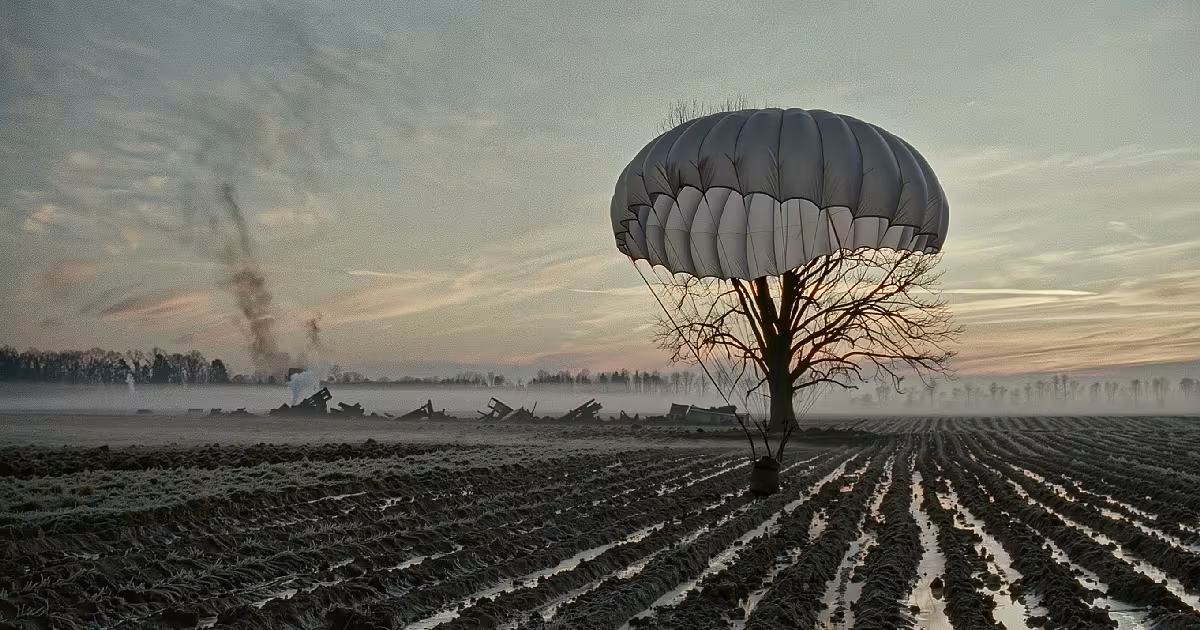
A white parachute caught in a bare tree above a frosty ploughed field at dawn, with smoke rising from wreckage in the distance.
Illustration, not a period photograph.
Opening
Just after midnight on 24 January 1961, a B-52G bomber carrying two hydrogen bombs broke up in the air over Faro, a farming community about 12 miles north of Goldsboro, North Carolina. Both bombs fell. Each was a Mark 39 with a yield of about 3.8 megatons, more than 250 times the Hiroshima bomb. Neither exploded. For decades the Air Force said there had never been any danger that one would. Its own records say something different.
Timeline
23 January 1961. B-52G serial 58-0187 of the Strategic Air Command takes off from Seymour Johnson Air Force Base on a 24-hour airborne alert mission, carrying two Mark 39 bombs. The aircraft belongs to the 4241st Strategic Wing and is commanded by Maj. Walter S. Tulloch.
Late evening. During refuelling, the tanker crew sees fuel pouring from the bomber’s right wing. The leak worsens fast: later accounts put the loss at more than 5,400 gallons in under three minutes. The B-52 is told to hold offshore and burn off fuel before landing.
24 January, about 12:35 a.m. As it descends toward the base, the wing fails and the aircraft breaks apart at about 10,000 feet. Five of the eight crew get out and survive. The third pilot, 1st Lt. Adam Mattocks, has no ejection seat and climbs out through the top hatch, the only man believed ever to have escaped a B-52 that way. Maj. Eugene Shelton, Maj. Eugene Richards and T/Sgt. Francis Barnish die.
Bomb one. It falls away with its parachute open and lands upright in a field, caught in a tree by its parachute. Its timer runs through. The Arm/Safe switch is still set to Safe, and the bomb doesn’t fire.
Bomb two. Its parachute doesn’t open. It hits a muddy field at high speed and breaks apart. Its Arm/Safe switch is found set to Armed, but the impact had cut the power it needed.
Following weeks. Army and Air Force teams dig for the second bomb in waterlogged ground. By 29 January they have recovered the primary, including its plutonium core. The uranium secondary has buried itself deeper, and water floods the pit faster than pumps can clear it. The dig is abandoned, and the secondary is estimated to lie as much as 180 feet down.
1962. The government pays the landowner for a permanent easement over a 200-foot circle around the spot, banning digging deeper than five feet.
1969. Parker F. Jones, a safety supervisor at Sandia National Laboratories, writes a memo reviewing the accident, Goldsboro Revisited.
2012. North Carolina puts up a roadside marker in nearby Eureka titled “Nuclear Mishap”.
2013. The Jones memo is released in full through a Freedom of Information request by the writer Eric Schlosser and published by The Guardian.
Key figures
Maj. Walter Tulloch, the aircraft commander, and his crew of seven, three of whom died. Lt. Adam Mattocks, who went out through the hatch. Lt. Jack ReVelle, the bomb disposal officer who dug for the second bomb and later described finding its switch. Parker F. Jones of Sandia, who later reviewed how close it came. Secretary of Defense Robert McNamara, who spoke of the accident privately two years later. Eric Schlosser, whose research brought the memo out.
Physical and documentary trail
On the paper: the Air Force accident reports, the 1969 Jones memo, the easement, and interviews with those who were there. The physical trail is still in a Wayne County field: part of bomb two, including its uranium secondary, lies deep in the mud under land the government still controls. It is not armed and cannot explode, and the government says it poses no hazard. What is missing is the full account that was withheld for decades.
One simple, dynamo-technology, low voltage switch stood between the United States and a major catastrophe.
ReVelle later recalled the moment his team found bomb two’s switch. His sergeant told him they had found the arm/safe switch. ReVelle said “Great”, and the sergeant replied, “Not great. It’s on arm.”
Competing explanations
A near-detonation. The Jones memo’s reading: in bomb one, most of the arming sequence ran as it would in a real drop, and only the last safety switch held. That switch was a type known to fail under an electrical short.
A system that worked. The Air Force position for decades: the safety design did its job, several safeguards had to fail, and a nuclear explosion was never likely. The bomb did not go off.
Both. The safety systems held, but by a smaller margin than the public was told, and with a switch the engineers themselves did not trust.
Later life of the case
Goldsboro changed how nuclear weapons were designed. It fed into a push through the 1960s for safer switches and later for weapons that would not arm without a coded signal. McNamara, in a classified meeting in January 1963, cited accidents in which “by the slightest margin of chance, literally the failure of two wires to cross”, a nuclear explosion had been averted.
Finding
The accident is fully documented, and so is the danger. Two multi-megaton bombs fell on North Carolina. One went most of the way through its arming sequence and was stopped by a single switch, and the other lost its core in the mud where it remains. The Air Force was right that no explosion happened, and wrong to say for so long that one could not have.
What still will not resolve: exactly where in the mud under Faro the second bomb’s secondary lies, and how many other close calls are still classified.