HAVANA SYNDROME
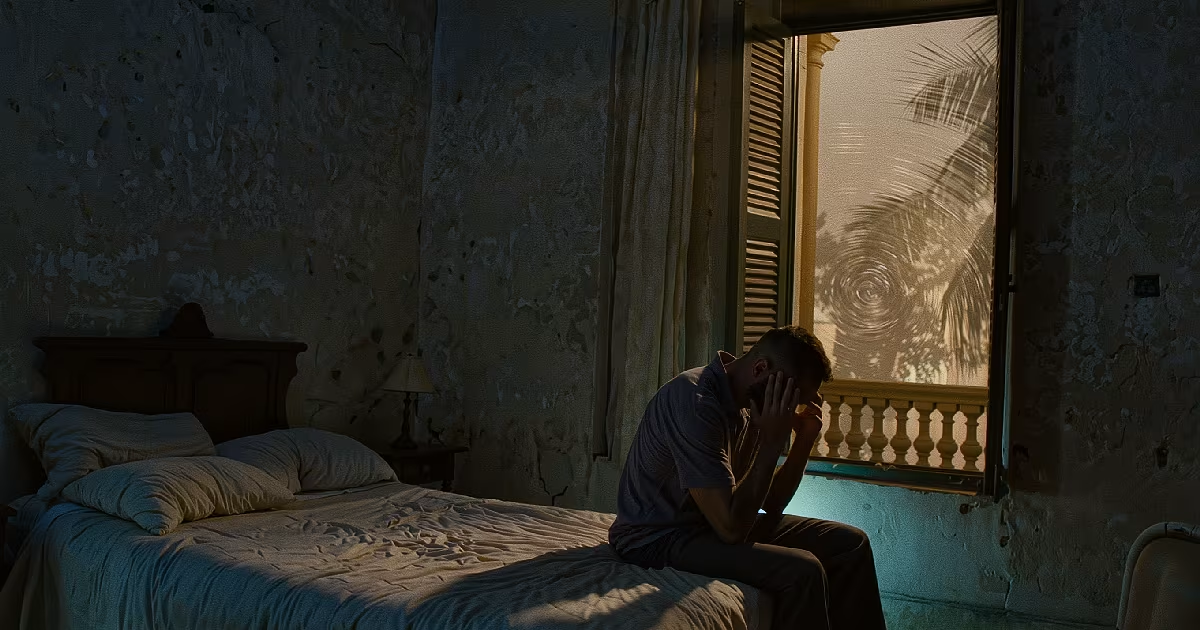
A man sits on the edge of a bed with his head in his hands as rings ripple across the window behind him.
Illustration, not a photograph.
Opening
In late 2016, US diplomats and intelligence officers at the embassy in Havana, Cuba, began reporting a sudden, piercing sound or pressure in their homes and hotel rooms, followed by headaches, dizziness, hearing loss, and trouble with memory and concentration. Similar reports later came from China, Austria, Vietnam, Washington DC and elsewhere, eventually more than a thousand in total. The US government calls them Anomalous Health Incidents. Whether a foreign weapon caused any of them is still argued over inside the intelligence community itself.
Timeline
Late 2016. The first cases at the Havana embassy, mostly among CIA officers posted there. Several describe a loud, directional noise that stops when they move to another room.
September to October 2017. The State Department withdraws more than half its Havana staff and expels 15 Cuban diplomats from Washington. Cuba denies any involvement. Canadian diplomats in Havana report similar symptoms.
2018. A US government employee in Guangzhou, China, reports symptoms, and others follow. A University of Pennsylvania team publishes findings on the Havana patients in JAMA describing concussion-like injury without any blow to the head.
December 2020. A National Academies of Sciences panel calls "directed, pulsed radiofrequency energy" the most plausible mechanism for the core cases it reviewed.
2021. A surge of reports, including in Vienna and Berlin. In August, Vice President Kamala Harris's trip to Hanoi is delayed by a reported case at the embassy there. In October, the HAVANA Act becomes law, paying compensation to injured personnel.
March 2023. An Intelligence Community assessment finds it "very unlikely" that a foreign adversary is responsible. Five agencies agree. The findings are not unanimous in confidence.
March 2024. National Institutes of Health studies find no MRI evidence of brain injury in patients compared with healthy controls. The same week, a joint investigation by 60 Minutes, The Insider and Der Spiegel links some cases to Russia's military intelligence Unit 29155, which the Kremlin denies.
January 2025. An updated assessment keeps the overall finding, but two agencies shift: one now sees a roughly even chance that a foreign actor has used a novel weapon against a small number of US personnel.
Key figures
The patients themselves are the centre of the case: diplomats, CIA and FBI officers, military personnel, and in some cases their children. Marc Polymeropoulos, a former senior CIA officer who reported symptoms after a 2017 trip to Moscow, became one of the most public voices pushing the agency to take the injuries seriously.
David Grusch, the UAP whistleblower, said on The Joe Rogan Experience on 30 September 2026 that people helping him with his investigation began reporting symptoms in early 2021. He called himself an expert on the subject from his government work and said his assessment was "microwave directed energy most likely." He did not connect the incidents to UAP and did not name who he believed was behind them.
On the paper
The record is thick and contradictory. The JAMA papers from 2018 and 2019 reported differences in the brains of Havana patients. The National Academies report backed pulsed radiofrequency energy as plausible, while noting it could not test the idea directly. The 2024 NIH studies, the largest so far, found real and lasting symptoms but no detectable brain injury, and found many patients met the criteria for a functional disorder in which the brain's balance and sensory processing go wrong without structural damage.
One early piece of evidence fell apart. A recording made in Havana was analysed in 2019 by two biologists, who found it closely matched the call of the Indies short-tailed cricket. The finding explains that recording, and does not explain every patient's account.
Competing explanations
A directed-energy weapon. Supported by the National Academies' assessment, by the patients' consistent descriptions of a sound or pressure that was directional and stopped when they moved, by the 2024 media investigation into Unit 29155, and by the shift in two agencies' views in 2025. Directed-energy research is real, and both the US and Russia have worked on it for decades.
Environment, illness and stress. The majority intelligence view. Many reported cases have been traced to pre-existing conditions, ordinary illness or environmental factors, and the NIH found no structural injury. Psychogenic and functional explanations sit here too, which some patients find dismissive of what they went through.
Both. A small set of genuine attacks inside a much larger group of unrelated cases is the reading several officials have quietly come round to. It would explain why the overall assessments say "unlikely" while individual agencies keep the door open.
Later life of the case
Compensation payments under the HAVANA Act began in 2022. Congress has continued to press the intelligence agencies, with some members accusing them of closing the question too early. Patients' groups still push for their injuries to be formally recognised as attacks.
Finding
The injuries are real. Hundreds of US personnel reported them, many have not recovered, and the government pays compensation for them. What caused them is not settled: the intelligence community's formal view is that a foreign weapon is unlikely, but that view is not unanimous, it has softened since 2023, and serious investigators believe at least some cases were deliberate.
What still will not resolve: the classified material behind the 2025 shift, and whether any device has ever been found. If one has, it has not been made public.