JFK ASSASSINATION
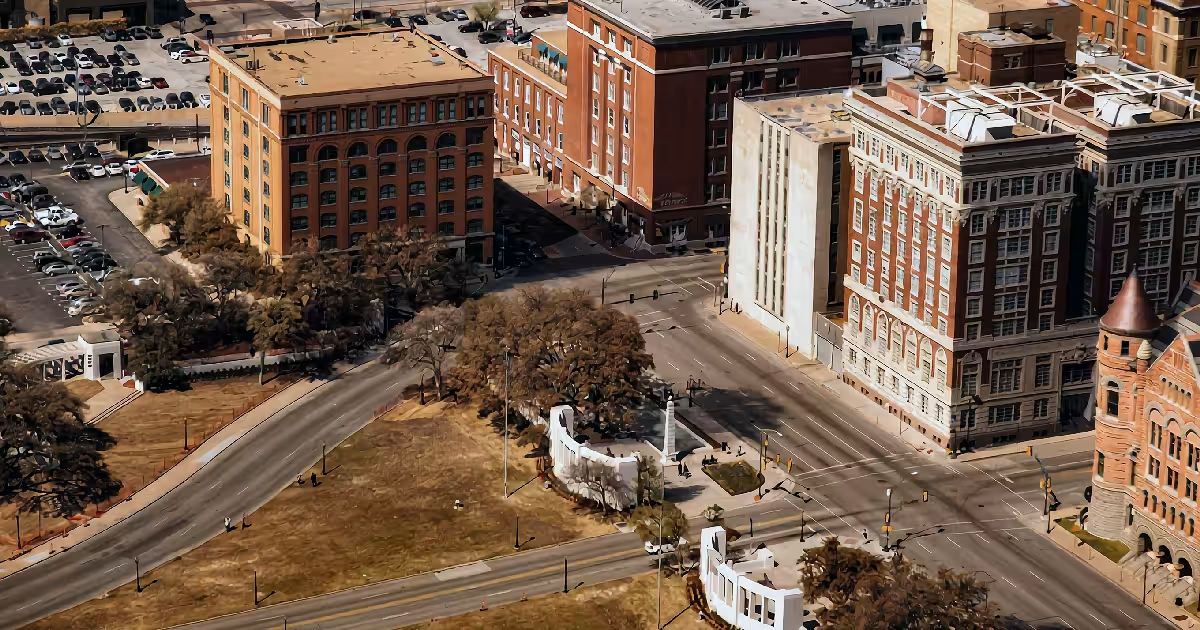
Dealey Plaza from above, with the old Book Depository at the top left.
Illustration, not a photograph.
Opening
At 12:30 p.m. on Friday 22 November 1963, President John F. Kennedy was shot as his open-top limousine passed through Dealey Plaza in Dallas, Texas. He was hit in the upper back and the head and was pronounced dead at Parkland Hospital half an hour later. Texas Governor John Connally, riding in the seat in front, was badly wounded. Within ninety minutes police had arrested Lee Harvey Oswald, a 24-year-old former Marine who worked in the Texas School Book Depository overlooking the route. Two days later, before he could be tried, Oswald was shot dead in the basement of Dallas police headquarters, live on national television. More than sixty years and millions of released pages later, most Americans still do not believe the official account.
Timeline
22 November 1963, 11:55 a.m. The motorcade leaves Love Field. The weather has cleared, so the limousine's bubble top is left off.
12:30 p.m. Shots ring out as the car passes the Book Depository on Elm Street. Most witnesses hear three. Secret Service agent Clint Hill runs from the following car and climbs onto the back of the limousine.
1:00 p.m. Kennedy is pronounced dead at Parkland Memorial Hospital.
1:15 p.m. Dallas police officer J. D. Tippit is shot dead in the Oak Cliff neighbourhood after stopping a man on the street.
About 1:50 p.m. Oswald is arrested in the Texas Theatre, where he had slipped in without paying.
2:38 p.m. Lyndon Johnson is sworn in as president aboard Air Force One, with Jacqueline Kennedy beside him.
24 November. Nightclub owner Jack Ruby shoots Oswald in the police basement as he is being moved to the county jail.
September 1964. The Warren Commission reports that Oswald acted alone, firing three shots from the sixth floor of the Depository, and that Ruby also acted alone.
1979. The House Select Committee on Assassinations concludes that Kennedy was "probably assassinated as a result of a conspiracy", largely on the strength of a police radio recording said to capture a fourth shot. A National Academy of Sciences panel later rejects that recording analysis.
1992. After Oliver Stone's film JFK reignites public anger, Congress passes the JFK Records Act, requiring the government to release its assassination files.
2017 to 2025. Successive presidents release more of the remaining records. In March 2025, after an executive order from President Trump, tens of thousands of pages are published with most redactions removed.
Key figures
Lee Harvey Oswald was a former Marine who defected to the Soviet Union in 1959, worked in a radio factory in Minsk, married a Russian woman, Marina, and came back to the US in 1962. Weeks before the assassination he visited the Cuban and Soviet embassies in Mexico City. To this day, his life is the centre of every theory.
Jack Ruby ran a Dallas strip club, knew many local police officers, and had links to small-time organised crime. He said he killed Oswald out of grief. He died of cancer in 1967 while awaiting a retrial.
Earl Warren, the Chief Justice of the United States, led the official inquiry. A young commission lawyer, Arlen Specter, developed its most debated conclusion, the "single-bullet theory".
On the paper
The evidence against Oswald as the gunman is strong: his rifle was found on the sixth floor, his palm print was on it, he had bought it by mail order under a false name, and he fled the building and shot a police officer within the hour. The Warren Commission's report ran to 888 pages, with 26 further volumes of evidence.
The disputes are about everything around that. The single-bullet theory holds that one bullet passed through Kennedy's neck and caused all of Connally's wounds, ending up nearly intact on a stretcher at Parkland; critics call it the "magic bullet". Abraham Zapruder's home movie, 26 seconds long, shows Kennedy's head going backwards at the fatal shot, which many people read as a shot from the front. And Oswald, the one person who could have answered the questions, never stood trial.
Things you might not know
- The rifle cost $19.95. Oswald ordered the Italian Mannlicher-Carcano from a Chicago mail-order company under the name "A. Hidell", with a scope included and shipping on top.
- The last words Kennedy heard. Seconds before the shots, Nellie Connally, the governor's wife, turned to him and said, "Mr. President, you can't say Dallas doesn't love you."
- The pink suit was never cleaned. Jacqueline Kennedy refused to change out of her bloodstained pink suit for the rest of that day. It is kept in the National Archives, out of public view, under an agreement with her family that runs until 2103.
- The president's brain is missing. It was preserved after the autopsy and later went missing from the National Archives. It has never been found.
- The car went back to work. The limousine, code-named SS-100-X, was rebuilt with armour and a fixed roof and stayed in presidential service until 1977. It is now in the Henry Ford Museum in Michigan.
- The Umbrella Man was real. A man holding an open black umbrella on a sunny day became a famous conspiracy clue. In 1978 Louie Steven Witt told Congress it was him, and that he was heckling Kennedy over his father's support for appeasing Hitler.
- Oswald was dug up. In 1981 his body was exhumed to test the claim that a Soviet impostor had been buried in his place. Dental records confirmed it was Oswald.
- The theatre was showing a war film. When Oswald was arrested in the Texas Theatre, the double feature was War Is Hell and Cry of Battle.
Competing explanations
Oswald alone. The Warren Commission's finding, still supported by most historians who have studied the physical evidence: one man, three shots, one rifle.
A conspiracy. Candidates have included the Mafia, angry over Robert Kennedy's prosecutions; anti-Castro Cubans and their CIA handlers, angry over the Bay of Pigs; the CIA itself; and Cuba or the Soviet Union. The HSCA's 1979 "probable conspiracy" finding gave this view official backing for a time.
Oswald as gunman, but not alone. A middle view: Oswald fired, but others knew, helped or encouraged him. Oswald's Mexico City trip and the CIA's surveillance of him there, much of it only released in recent years, keep this reading alive.
Later life of the case
The assassination created the modern American conspiracy theory. Polls have found for decades that a majority of Americans believe more than one person was involved. The 2025 releases added detail about CIA operations and its interest in Oswald before the shooting, but no document has yet named a second gunman or a plot.
Finding
The physical evidence points strongly to Oswald as the man who fired the shots from the sixth floor. Whether he acted alone is the question that has never been settled, partly because he was killed before he could be tried, and partly because the government kept so much secret for so long that it made a cover-up look likely.
What still will not resolve: what Oswald was doing in Mexico City, and how much the CIA knew about him before 22 November. The files are almost all out now. The answer to the oldest question in American conspiracy may be in them, or may have died with Oswald in that police basement.