DENVER AIRPORT
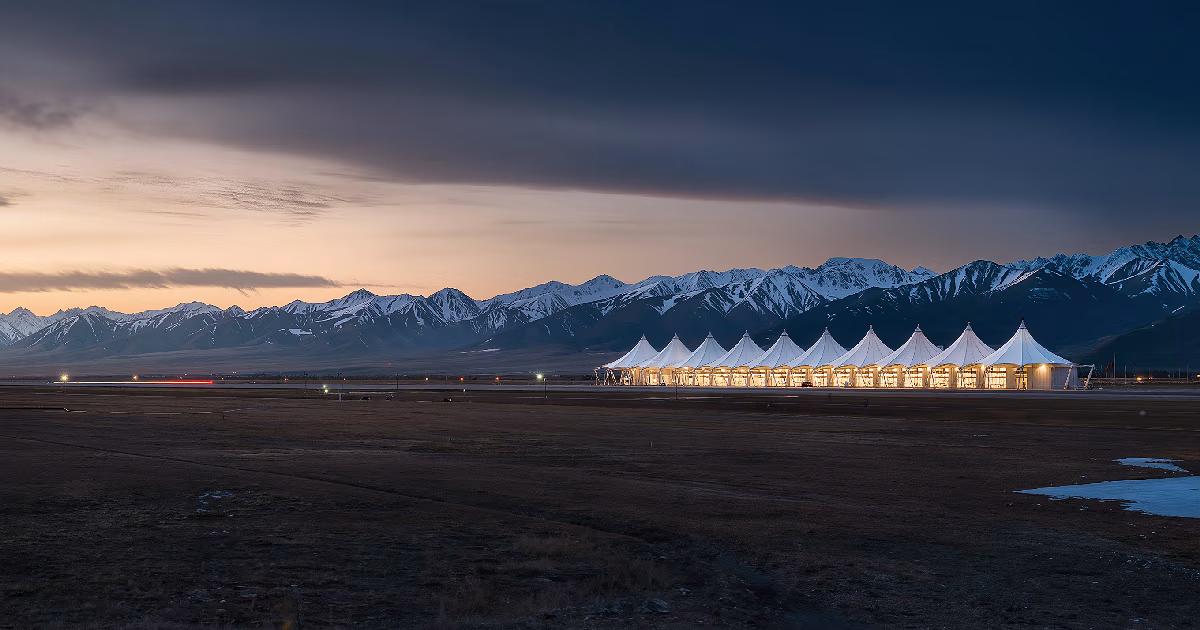
A tented white airport roof under snowy peaks at dusk.
Illustration, not a photograph.

Archive / Conspiracy / BOT313-0439
CON-199528 FEB 1995ConspiracyPUBLIC ART
THE AIRPORT IN ON THE JOKE
Fig. 01 A tented white airport roof under snowy peaks at dusk. Illustration, not a photograph.
Opening
Denver International Airport opened on 28 February 1995, sixteen months late and nearly $2 billion over its budget, at a final cost of about $4.8 billion. It sits on 33,531 acres of prairie northeast of the city, the largest airport site in the United States, on land Adams County voters agreed to let Denver annex in 1988. It replaced Stapleton.
It also opened with a pair of enormous murals about war and extinction, a time capsule under a Masonic cornerstone, and, thirteen years later, a 32-foot blue horse with glowing red eyes beside the road in. The internet did the rest. By 2018 the airport had decided to join in.
Timeline
1988Adams County voters approve Denver's annexation of 54 square miles for the new airport.
September 1989Ground is broken.
19 March 1994A granite capstone is dedicated, set with a Masonic square and compasses and the names of two Grand Lodges. A time capsule inside is addressed to "the people of Colorado in 2094".
April 1994A demonstration of the automated baggage system for the press fails.
28 February 1995The airport opens.
September 2005The automated baggage system is finally abandoned.
June 2006Sculptor Luis Jiménez is killed in his studio in New Mexico when part of the horse sculpture falls and severs an artery in his leg.
11 February 2008The finished sculpture, completed by others, is unveiled.
2016The airport mounts an exhibit, "Conspiracy Theories Uncovered", walking visitors through its own rumours.
2018Construction walls around a renovation go up covered in posters from the agency Karsh Hagan, under the name DEN Files.
2018Leo Tanguma's two murals are taken down and put in storage for the renovation.
March 2019An animatronic gargoyle nicknamed Greg starts talking to passengers.
April 2019The airport declares a "supernatural sister airport" relationship with Roswell, New Mexico.
August 2026"In Peace and Harmony with Nature" goes back up on Level 5. "Children of the World Dream of Peace" is due back in 2028.
Key figures
Wellington Webb was Denver's mayor when it opened. Leo Tanguma painted the murals, and Luis Jiménez made the horse. Kim Day, the airport's CEO from 2008, chose to lean into the rumours rather than deny them, and the Denver agency Karsh Hagan wrote the 2018 posters. Charles Ansbacher, conductor of the Colorado Springs Symphony, is the person behind the "New World Airport Commission" that conspiracy writers treat as a secret body.
Physical and documentary trail
The murals, the horse, the capstone, the tunnels and the floor markings all exist and can be walked up to. The baggage system's failure is in the airport's own history and in years of press. The time capsule's contents are reported to include coins, a baseball from the new Coors Field, a pair of Mayor Webb's sneakers and casino tokens from Black Hawk.
The "New World Airport Commission" is the one piece with two official answers. Wikipedia and Visit Denver say no such body exists. The Denver Public Library holds eleven boxes, collection WH858, of records from a temporary committee of that name formed by Ansbacher, who took the name from Dvořák's New World Symphony.
Construction, or cover up?
Things you might not know
- The horse killed its maker. The sculpture's title is Blue Mustang. Locals call it Blucifer. Jiménez died in June 2006 when a section of the 32-foot fibreglass horse fell on him, and it was finished without him.
- The red eyes are a family reference. Jiménez's father ran a neon sign shop, and the glowing eyes were his tribute. The model was his own horse, a blue roan called Black Jack.
- The murals are about peace. Tanguma's two two-part works, "Children of the World Dream of Peace" and "In Peace and Harmony with Nature", set scenes of war and environmental destruction beside scenes of children at peace with each other and with nature. The titles rarely appear in the theories.
- The numbers add up to 33. The airport's own DEN Files trivia noted that the capstone's dedication date, 19 March 1994, sums as 1 + 9 + 1 + 9 + 9 + 4 = 33, the top degree of Scottish Rite Freemasonry.
- The gargoyles sit in suitcases. Terry Allen's "Notre Denver" sculptures are gargoyles sitting in open Samsonite cases, a nod to the luggage company founded in Denver.
- The floor words are Navajo. Inlaid words in the terminal are in Navajo, and a mining cart marked "Au Ag" uses the chemical symbols for gold and silver.
- The tunnels are short. They were built for the trains and the abandoned baggage system. The airport says they run less than two miles.
Competing explanations
An expensive airport with odd public art. The murals were commissioned civic art about peace and the environment. The capstone was a standard Masonic cornerstone ceremony, common on public buildings. The runways' pinwheel layout lets several operate at once. The baggage tunnels exist because the baggage system existed.
A coded warning. Online, the murals are read as prophecy, the horse as something demonic, the capstone as proof of a secret society and the layout as a swastika. None of these readings cites a document from the airport's builders.
A joke the airport now owns. Since 2016 the airport has turned its own mythology into an exhibit, a poster campaign and a talking gargoyle. The 2018 construction walls joked about the end of the world and asked passengers to decide for themselves whether the work was construction or a cover-up. Karsh Hagan says the campaign cost nothing and earned about $8 million in free coverage.
Later life of the case
The theories peaked on television, including an episode of Jesse Ventura's Conspiracy Theory, and settled into permanent internet furniture. A 2010 statue of Anubis, installed for a travelling Tutankhamun exhibition, briefly joined the canon. Tanguma's murals, the original evidence for many viewers, spent eight years in storage and started coming back in 2026.
Finding
Nothing in the public record supports a bunker, a cult or a prophecy at Denver International Airport. Every physical feature that feeds the stories has an ordinary, documented origin: commissioned art, a failed baggage system, a Masonic cornerstone, a temporary arts committee named after a symphony. The airport's own posters are comedy, not confession.
What still will not resolve: what the time capsule actually contains when someone opens it in 2094, and why a perfectly ordinary airport inspires this much invention. That part is about the audience, not the building.
Evidence signature
4/9 Solid
- Witnesses
- one person, or a tradition
- Instruments
- photo, film or physical traces
- Paper
- official records at the time
How well documented the case is, not whether it's true. A strong record can still have an ordinary answer, and a thin one can still be real.
You decide · DENVER AIRPORT
What do you think happened?
One vote per case, anonymous. You'll see how other readers voted once you've voted.