DUGWAY SHEEP
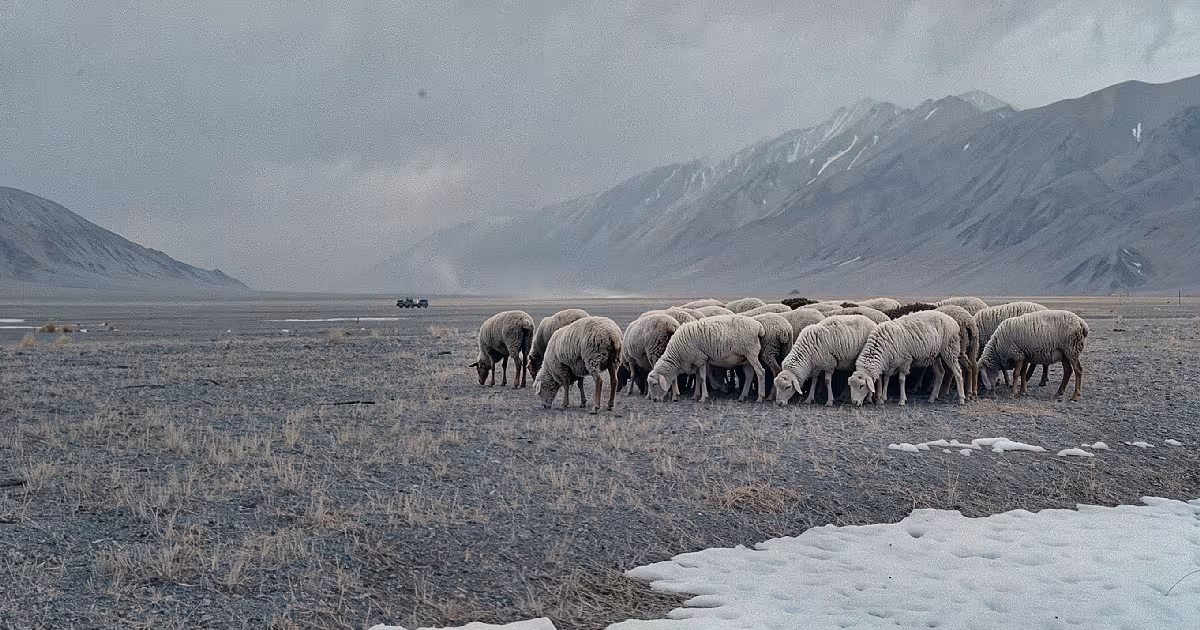
Grazing sheep stand on a grey valley floor under a low sky.
Illustration, not a photograph.

Archive / Conspiracy / BOT313-0450
CON-196813 MAR 1968ConspiracyDOCUMENTED
SKULL VALLEY AND THE VX
Fig. 01 Grazing sheep stand on a grey valley floor under a low sky. Illustration, not a photograph.
Opening
On 13 March 1968 an Air Force F-4 Phantom flew a VX nerve agent spray test for the Army over Dugway Proving Ground in western Utah. One of its spray tanks did not empty fully, and agent continued to trail from the aircraft as it climbed away. Over the following days thousands of sheep died on ranges in Skull Valley, about 27 miles from the test area. The commonly quoted figure is about 6,000, reported totals ran from 6,000 to 6,400, and Dugway's own safety office counted 3,843.
The Army first denied that any test had taken place, then accepted the test but not the blame, and paid the ranchers without admitting fault. Its own laboratory found VX in the valley within weeks, and that finding stayed classified until 1978 and out of the newspapers until 1998. The Army has never formally accepted responsibility. This is one of the cases in the archive where the government's own paperwork, rather than any witness, is the strongest evidence.
Timeline
13 March 1968The F-4 spray test takes place. Two other nerve agent operations run at Dugway the same day: a chemical artillery test, and the open-pit burning of about 160 gallons of nerve agent.
17 March 1968, 12:30 amThe first telephone report reaches Dugway that about 3,000 sheep are dead or dying in Skull Valley.
Mid-March 1968Dugway officials deny that chemical testing took place in the relevant period. The denial holds for about a week.
21 March 1968Senator Frank Moss of Utah releases a Pentagon document confirming the 13 March VX operation. The Army now accepts that the test happened but says it has not been shown to have killed the sheep.
1968The Army settles with the rancher Alvin Hatch, whose flocks made up about 90 per cent of the dead, for $376,685, without admitting liability. The carcasses are buried.
4 February 1969NBC's First Tuesday broadcasts a report on American chemical and biological weapons, including Dugway. Representative Richard D. McCarthy of New York begins a congressional examination of the programmes.
1969President Nixon announces that the United States will renounce biological weapons and reaffirms a no-first-use policy on chemical weapons. Open-air testing of chemical agents is halted. Skull Valley is widely cited as one of the reasons.
1970Researchers at Edgewood Arsenal in Maryland complete a report on the incident. It finds VX in snow and grass samples taken about three weeks after the deaths, in quantities sufficient to account for them.
1978The Edgewood report is declassified, but not publicised.
June 1994Lee Davidson of the Deseret News reports that the family of Ray Peck, another rancher who lost sheep and who was outdoors that day, has suffered nervous-system illnesses resembling low-level VX exposure.
January 1998Jim Woolf of the Salt Lake Tribune publishes the contents of the Edgewood report, which calls the evidence of VX exposure "incontrovertible". Defence officials say it was never published because it "wasn't particularly revealing".
Key figures
Frank Moss forced the first public confirmation. Alvin Hatch was the rancher who lost most of the flock and accepted the settlement. Ray Peck and his family carried the human side of the story into the 1990s. Fay Gillette, the Tooele County sheriff, saw the dead sheep and spoke to the reporter Seymour Hersh, whose reporting on chemical and biological warfare brought the case to a national audience. Richard McCarthy turned it into a congressional issue. Jim Woolf brought the Edgewood findings into the open thirty years after the event. I found no Army officer who ever took personal responsibility.
Physical and documentary trail
The chain runs from the Pentagon document Moss released on 21 March 1968, through the Hatch settlement, to the Edgewood Arsenal report of 1970, declassified in 1978 and reported in 1998. The Edgewood report is the key document, because it is the Army's own laboratory finding VX in the valley. The 1968 field investigation records, the full necropsy results and the settlement papers are not among the published sources I found. The sheep count is disputed by about a third depending on who counted, and the amount of agent that reached the valley has never been published.
I've never seen such a sight in my life.
Things you might not know
- VX was not the only agent in use that day. An artillery test and an open-air burn of nerve agent also took place on 13 March.
- The ranchers were paid but nobody admitted anything. The settlement with Alvin Hatch carried no admission of liability.
- The proof sat on a shelf for decades. The Edgewood report was finished in 1970, declassified in 1978 and only reported in 1998.
- Dugway's open-air tests were on a large scale. Later accounts put the open-air release of nerve agents at the site at around 500,000 pounds, alongside hundreds of open-air biological tests.
- Some of the evidence did not fit. A number of surviving sheep showed internal bleeding and normal breathing, which is not typical of nerve agent poisoning, and other animals in the valley did not appear to be affected.
Competing explanations
VX drift from the F-4 test. The spray tank failure, the wind toward Skull Valley and the Edgewood samples all point the same way. This is the explanation the Army's own laboratory supported, and it is the strongest reading of the record.
A different Dugway release, or a combination. The artillery test and the open-pit burn on the same day are alternative or additional sources. The Edgewood report addresses VX, and the published record does not show whether the other operations were ruled out.
A cause other than nerve agent. At the time, the Army pointed to the symptoms that did not fit nerve agent poisoning and to the absence of other animal deaths, and suggested other causes. The 1970 VX findings make this the weakest reading, but the anomalies in the symptoms have never been fully explained in public.
Later life of the case
Skull Valley became a reference point in the argument over chemical weapons in the late 1960s and remains one in the history of open-air testing. The Peck family's illnesses and the 1998 disclosure kept it in Utah's news into the 21st century. The Army has never published a full account, and has never formally accepted that its test killed the sheep.
Finding
The record here is unusually strong. A VX test went wrong on 13 March 1968, thousands of sheep died downwind within days, the Army paid for them, and its own laboratory found VX in the valley in amounts enough to kill them. The strongest reading is that the test killed the sheep. That is documented by the Army's own scientists, even though the Army itself has never said so formally.
What still will not resolve: how much agent reached the valley, why some of the sheep showed signs that do not fit nerve agent poisoning, and what the full 1968 investigation and necropsy records say.
Evidence signature
8/9 Strong
- Witnesses
- trained, independent witnesses
- Instruments
- radar or measured data
- Paper
- formal investigation, court or declassified file
How well documented the case is, not whether it's true. A strong record can still have an ordinary answer, and a thin one can still be real.
You decide · DUGWAY SHEEP
What do you think happened?
One vote per case, anonymous. You'll see how other readers voted once you've voted.