IRAN-CONTRA
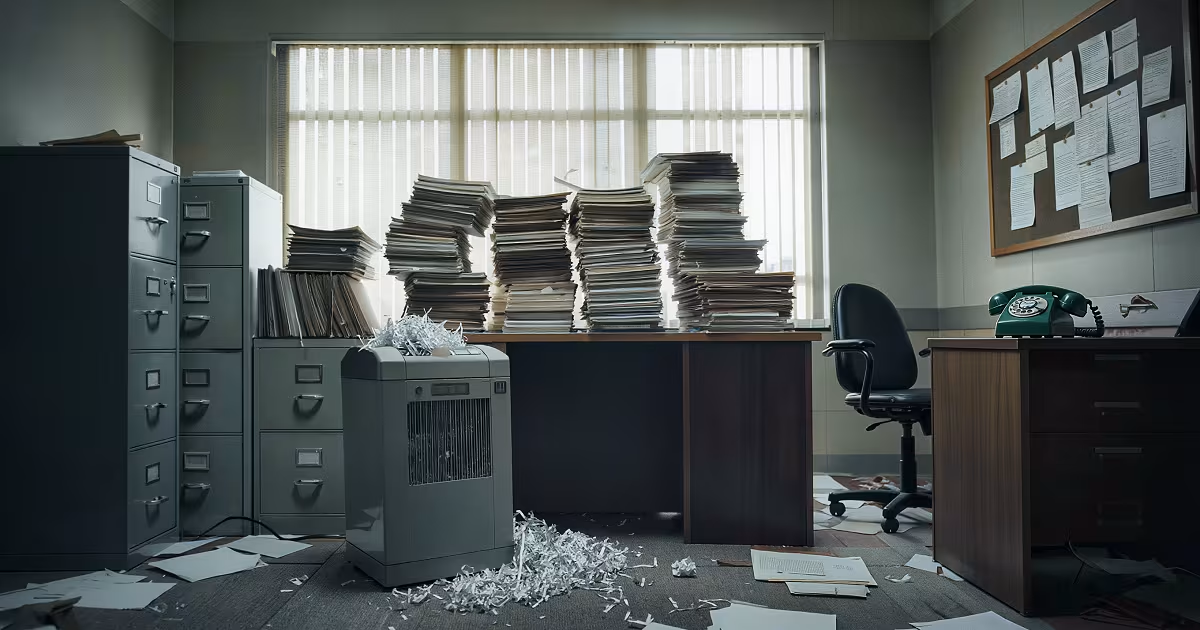
1980s NSC office. Shredder and papers, no readable text.
Illustration, not a period photograph.
Opening
On 5 October 1986 a C-123 went down in Nicaragua. Eugene Hasenfus survived and talked. That wreck is the public break. Behind it sat two streams the Reagan White House had tried to keep in different rooms: arms to Iran in hope of hostages, and aid to the Contras after Congress had used the Boland amendments to shut the front door. Money and cutouts tied the rooms. Oliver North at the NSC sat in the later telling as the desk. John Poindexter sat above him. William Casey sat in the argument about how much the CIA director had known. Ronald Reagan sat in the argument about how much a president can forget.
The Tower Commission, then Congress, then Lawrence Walsh's independent counsel spent years on paper. Some convictions were overturned. Some pardons arrived. The Boland language remains the statute the bypass had to dance around. Hasenfus remains the man who did not die in the trees.
The spine of the file is a wreck and a statute. Iran-Contra is a bypass that broke in November 1986. It is not a rumour that no plane flew.
Timeline
Boland amendments through the mid-1980s. NSC staff look for other doors. Iran arms track runs in parallel.
5 October 1986 Hasenfus. 25 November 1986 North is sacked and the public story cracks.
1987 Tower and joint hearings. 1980s-90s Walsh. Pardons in 1992.
Later memoir wars are later life. The wreck and November are first.
Boland was not a press release. It was appropriations language that closed a door the NSC then walked around. Iran was the other room: hostages and missiles and a country the White House was not supposed to arm. Hasenfus is where the two rooms smelled like one hangar.
Key figures
Eugene Hasenfus owns the wreck that talked.
Oliver North owns the desk the hearings put on television.
John Poindexter and William Casey own the floor above. Reagan owns the memory fight.
Lawrence Walsh owns the long counsel. Congress owns Boland.
Physical and documentary trail
On the paper, 1984-87 give you four hard objects and no empty hangar.
One: Boland language shutting official Contra aid.
Two: the Iran arms track and the cutouts.
Three: the 5 October 1986 C-123 and Hasenfus.
Four: Tower, the hearings, and Walsh. Tower Commission Report, 1987, and the Hasenfus shoot-down, 5 October 1986, are the originating public trays.
There is no page that makes Boland a suggestion. There is no page that makes the plane a myth. There is no single signed order everyone accepts as Reagan's hand on every cutout.
The wreck and Boland are the stay-behinds. A presidential order on the cutouts would finish the memory fight. November 1986 already finishes the break.
I was told I was working for private people. The plane still had a government smell.
Competing explanations
A rogue desk. This is the early White House line. It has North. It has a president who did not remember.
A policy that used cutouts because the statute blocked the front door. Fits Boland and the wreck.
A full presidential conspiracy. Possible as a reading. Walsh did not get that verdict clean.
Hybrid caution. A statute closed a door. A plane still flew. A man in the trees talked.
Later life of the case
Pardons and memoir fights. I keep those on the later-life shelf. Hasenfus and November stay first.
Finding
A C-123 went down in Nicaragua on 5 October 1986, Hasenfus talked, and the hearings that followed showed NSC staff moving money around Boland and through Iran. Believe the wreck. A cargo plane does not invent itself for a later pardon.
What still will not resolve: a signed presidential order on every cutout, or a page that makes the desk truly lone. Either one would finish the memory fight. The proving object is still that order, held in a file Walsh did not get whole.