ROBERTSON PANEL
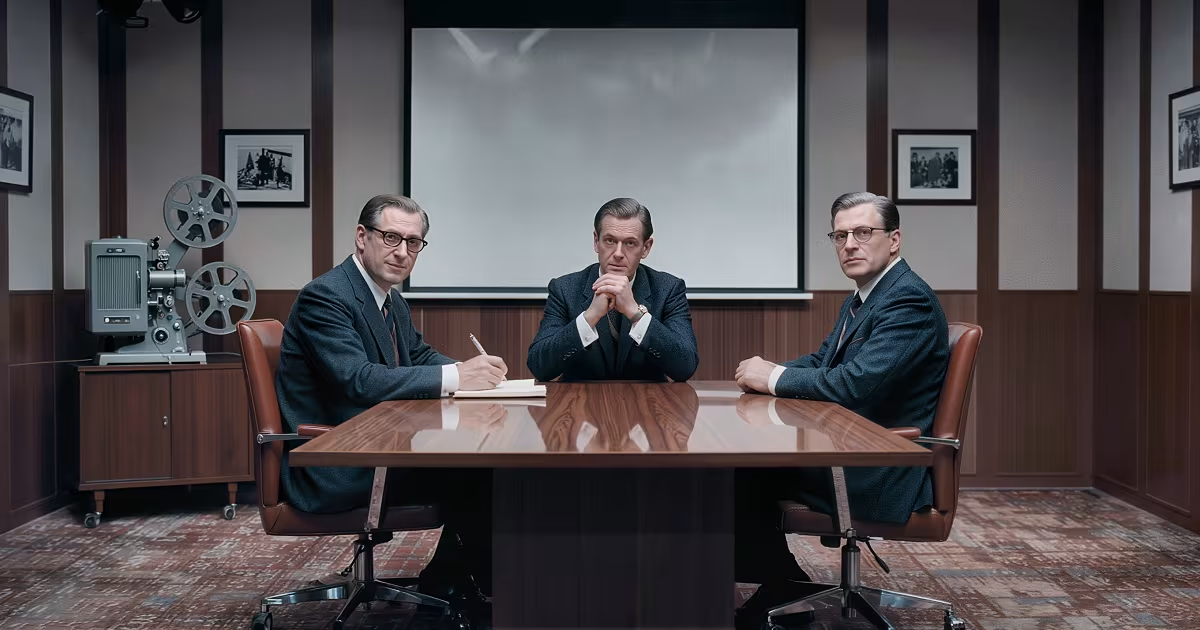
Three men in suits at a table, a film projector and screen behind.
Illustration, not a period photograph.

Archive / Conspiracy / BOT313-0258
CON-195317 JAN 1953ConspiracyADMITTED
THE CIA'S PLAN TO DEBUNK UFOS
Fig. 01 Three men in suits at a table, a film projector and screen behind. Illustration, not a period photograph.
Opening
In January 1953, at the CIA's request, a panel of five prominent scientists met for four days to review a selection of US Air Force UFO case files and recommend how the government should handle the subject. In about twelve hours of formal sessions they looked closely at 23 cases out of the 2,331 on record, roughly one percent.
Chaired by physicist H.P. Robertson, the panel recommended stripping UFOs of their "special status" and "aura of mystery", a public education and "debunking" campaign through mass media, Walt Disney cartoons among them, and watching civilian UFO groups. It was not a field investigation but a policy meeting about public perception, and Air Force UFO handling hardened in the years after it.
Timeline
1952, backgroundA wave of UFO reports, including the widely publicized Washington, D.C., radar-visual sightings of July, alarms officials. CIA analysts settle on two concerns: that public credulity could be exploited by enemy psychological warfare, and that floods of reports could clog air defense channels and mask a real attack.
4 December 1952The Intelligence Advisory Committee agrees that the Director of Central Intelligence will enlist selected scientists to review the evidence.
Before the formal sessionsIn a private meeting with no outsiders, according to member Thornton Page's later account, Robertson tells the members that their job is to reduce public concern and show that UFO reports could be explained conventionally.
14 to 17 January 1953The panel meets on four consecutive days. Members are chairman H.P. Robertson, a physicist and CIA consultant; physicist and radar expert Luis Alvarez, a future Nobel laureate; nuclear physicist Samuel Goudsmit; astrophysicist Thornton Page; and physicist Lloyd Berkner, who attends only from the afternoon of the third day. CIA officer Frederick Durant serves as secretary.
Same sessionsBlue Book chief Captain Edward Ruppelt presents the Air Force's work, astronomer J. Allen Hynek, Blue Book's consultant, sits in as an associate member, and Major Dewey Fournet, who had coordinated UFO matters at the Pentagon, makes the case for the extraterrestrial hypothesis.
During the sessionsThe panel views two films, the 1950 Great Falls, Montana, footage and the 1952 Tremonton, Utah, film. Navy photo analysts report that the Tremonton objects were not birds, balloons or aircraft. The panel disagrees, judging the Tremonton lights most likely birds and the Great Falls objects aircraft reflections. It rejects Fournet's cases as "raw, unevaluated reports".
The core conclusion. The panel concludes unanimously that the evidence shows no direct physical threat to national security and nothing that relates the objects to space travelers, attributing the cases to misidentified conventional phenomena, with a residue that it believed further study would explain.
The recommendations. The report calls for an education program to train personnel and reduce public interest, using television, motion pictures and popular articles built on puzzling cases later explained. Durant's notes record that Walt Disney Inc. animated cartoons were among the means discussed, along with psychologists, amateur astronomers and civic groups.
The most-cited passage. The panel also says civilian groups such as the "Civilian Flying Saucer Investigators" of Los Angeles and the Aerial Phenomena Research Organization of Wisconsin "should be watched" because of their potential influence on mass thinking if widespread sightings occurred, adding that "the possible use of such groups for subversive purposes should be kept in mind." Among the dangers it lists is the public's susceptibility to "mass hysteria".
After the reportThe CIA abandons plans for a formal intelligence directive on UFOs and forbids any mention of its sponsorship of the panel. December 1953 brings JANAP 146 and 1954 a revision of Air Force Regulation 200-2, which set penalties for unauthorized release of UFO information.
1956 to 1966Ruppelt's book The Report on Unidentified Flying Objects reveals that the panel existed, without naming its members. In 1958, after a request from the civilian group NICAP, the Air Force releases three summary paragraphs and the members' names. A nearly full version of the report appears in the Saturday Review in 1966.
Later assessmentHistorians and ufologists link the panel to a more dismissive Blue Book posture through the rest of the 1950s, and it becomes one of the most cited documents in claims of a deliberate effort to reduce interest in UFOs. That claim rests on the report's released language, not on speculation. Defenders note that the panel never claimed to be hiding physical evidence and framed its concerns as panic management and the security of defense channels.
Key figures
Robertson is the namesake and chair. His standing as a respected physicist lent policy recommendations a scientific authority that critics argue the brief, limited review had not fully earned.
Alvarez, Goudsmit, Berkner and Page were scientists of real independent standing. Their participation gives the technical conclusion, no sign of extraterrestrial craft in the cases reviewed, weight that is separate from the debate over the public-relations advice attached to it.
Durant's notes, later known as the Durant Report, are the main record of what happened in the room.
The CIA convened the panel. Its motives, enemy exploitation of public panic and the risk of overloaded defense channels, are documented in its own 1952 memos and in the report itself.
Hynek moved from associate to critic. He later wrote that the panel had made UFOs "scientifically unrespectable".
Physical and documentary trail
The record holds the panel's formal report, released in stages from 1958 and in near-full form in 1966, giving its members, its four-day schedule, its case sample and its education and monitoring recommendations in quotable language. Alongside it sit the Durant notes, the CIA's 1952 memos that set the agenda, and the 1953 and 1954 reporting regulations that followed.
There is no evidence the panel was shown, reviewed or suppressed any physical evidence beyond the case files, photographs and two films then available to Blue Book. Its documented scope was a policy and public-perception review, not an inquiry into recovered material.
That the national security agencies take immediate steps to strip the Unidentified Flying Objects of the special status they have been given and the aura of mystery they have unfortunately acquired.
Things you might not know
- The Navy spent 1,000 hours on one film. Navy Photo Interpretation Laboratory analysts put about 1,000 man-hours into frame-by-frame plots of the Tremonton footage before concluding the objects were "self-luminous". The panel was not persuaded.
- They watched seagulls. At Page's request the panel screened a short film of gulls in bright sunlight to test whether birds could look like the Tremonton lights. It decided they could.
- Berkner nearly missed it. He first attended on the afternoon of Friday 16 January, the third day, and reviewed the draft report that night.
- The Air Force saw the draft before it was final. On the last morning the CIA's assistant director for scientific intelligence told the panel he had shown the rough draft to the Air Force's Director of Intelligence, "whose reaction was favorable".
- Its consultant turned critic. Hynek later wrote that for nearly 20 years afterwards "not enough attention was paid to the subject to acquire the kind of data needed even to decide the nature of the UFO phenomenon."
- The public learned of it from Ruppelt. His 1956 book was the first public account of the panel, and it left out every name.
Competing explanations
A brief but genuine scientific review that reached an honest technical conclusion, that the evidence showed neither a defense threat nor an extraterrestrial presence, and separately recommended practical communication measures to prevent panic and keep defense channels clear, with no deeper cover-up of physical evidence.
A deliberate debunking campaign that used scientific credibility to reduce public and institutional interest in UFO reports whatever the merits of individual cases. This reading draws on the report's released text, the word "debunking" included, and on Page's account that the goal of reducing public concern was set before the formal sessions began.
A narrower security measure focused on the risk of channels being overloaded during a real crisis, treating the education and monitoring recommendations as a Cold War precaution rather than evidence of a broader conspiracy to hide a confirmed phenomenon.
Later life of the case
The Robertson Panel stands out in the UFO-secrecy literature because its recommendations survive in released, quotable form rather than resting on testimony or inference. Its link to the reporting regulations and the more dismissive Blue Book that followed gives it a practical consequence beyond one week's paperwork.
Finding
The Robertson Panel was a real, brief, CIA-convened review that found no evidence of extraterrestrial visitation or a direct defense threat in the cases it examined, and that explicitly recommended a debunking-style education campaign and the watching of civilian UFO groups. Those recommendations are on the record in the declassified report. Tighter reporting rules and a more dismissive Air Force posture followed.
What still will not resolve: whether any material beyond the case files the panel saw exists in classified form, and how to weigh its stated security rationale against its wider public-perception advice. The core facts are unusually well confirmed. Whether the panel was a sensible security precaution or a coordinated debunking campaign is the genuinely open question.
Evidence signature
5/9 Solid
- Witnesses
- one person, or a tradition
- Instruments
- photo, film or physical traces
- Paper
- formal investigation, court or declassified file
How well documented the case is, not whether it's true. A strong record can still have an ordinary answer, and a thin one can still be real.
You decide · ROBERTSON PANEL
What do you think happened?
One vote per case, anonymous. You'll see how other readers voted once you've voted.