PROJECT A119
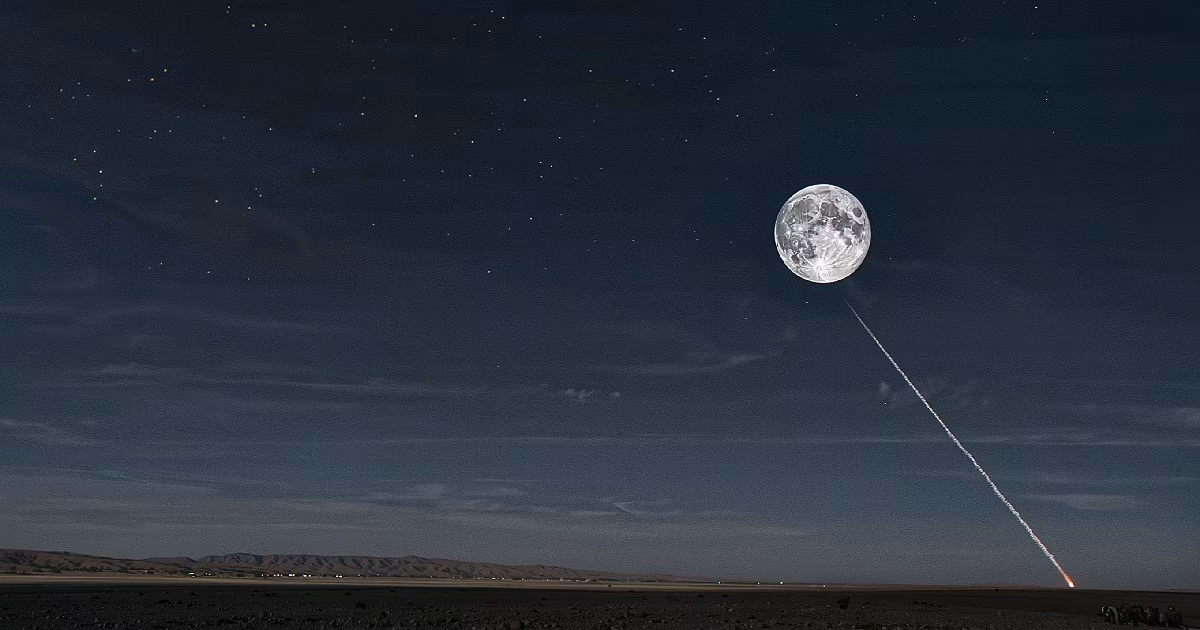
A full Moon over a dark horizon with a pale rocket trail.
Illustration, not a photograph.

Archive / Conspiracy / BOT313-0501
CON-1958ConspiracyDOCUMENTED
THE AIR FORCE PLAN TO NUKE THE MOON
Fig. 01 A full Moon over a dark horizon with a pale rocket trail. Illustration, not a photograph.
Opening
In 1958, a year after the Soviet Union launched Sputnik, the United States Air Force quietly studied the idea of detonating a nuclear bomb on the Moon. The study was called Project A119, formally "A Study of Lunar Research Flights". The plan was to send a missile carrying a small warhead to the dark edge of the lunar disc, so that the flash would be visible, perhaps even to the naked eye, from Earth.
The aim was part scientific, part military and part political. A blast on the Moon would raise American morale at a moment when the Soviets seemed to be winning the space race, and it might show the world what the United States could do. The project was cancelled in January 1959. It stayed secret for about forty years, until a biographer noticed a clue in the early career of a famous astronomer, and the project's leader decided to speak.
Timeline
4 October 1957The Soviet Union launches Sputnik 1, beginning the "Sputnik crisis". The launch shows that the Soviets could in principle deliver a warhead anywhere in the world. Late-1957 press reports, citing an anonymous source, claim the Soviets plan a nuclear blast on the Moon timed to a November eclipse. Accounts of the project treat this as rumour.
May 1958The Air Force asks Leonard Reiffel of the Armour Research Foundation, in Illinois, to fast-track research on a nuclear explosion on the Moon. The ten-member team includes the astronomer Gerard Kuiper and his doctoral student Carl Sagan.
1958Reiffel and his team write a series of studies over several months. The main paper, "A Study of Lunar Research Flights, Volume I", carries the emblem of the Air Force Special Weapons Center. Soviet planning documents show an E-series project, begun in January, that includes an E-4 nuclear strike on the Moon. It is also cancelled.
January 1959The Air Force cancels A119. Officials judge the risks greater than the benefits.
March 1959Sagan applies for a graduate fellowship at Berkeley and lists the titles of classified A119 papers on his application, which Reiffel later described as a breach of security.
1999The biographer Keay Davidson, researching a life of Sagan, finds the story. A 1999 review in the journal Nature draws attention to the listed titles.
2000Reiffel, then 73, publicly reveals the project in a letter to Nature, and tells newspapers he was horrified. A Freedom of Information request leads to the release of Volume I.
9 October 2009NASA deliberately crashes a spacecraft into the Moon to search for water. It is the only bombing of the Moon so far, and it is not nuclear.
Key figures
Leonard Reiffel led the study. He later told The Observer that damaging a pristine lunar environment would carry a huge scientific cost, and that the Air Force was mainly concerned with how the explosion would look on Earth. He is reported to have told the Los Angeles Times that the Air Force saw the Moon as "military high ground". He said he believed the detonations would have been visible to people on Earth, and that he was horrified by the idea.
Gerard Kuiper, a planetary astronomer, was a member of the team. So was his student Carl Sagan, who modelled how the dust cloud from the explosion would expand. Sagan held a Top Secret clearance with the Air Force and a Secret clearance with NASA. His later interest in using nuclear explosions in space is said to have grown out of this work.
Edward Teller had proposed nuclear detonations on the Moon earlier, to study the effects.
Keay Davidson found the story, and Reiffel's letter confirmed that Sagan had listed the titles. Davidson and Reiffel regarded it as a breach of security, and the account I found presents this as their view. The sources I found differ on when Davidson found it, putting it in the mid-1990s or after Sagan's death in 1996.
Physical and documentary trail
The record: Volume I of the study, released after more than forty years; Reiffel's 2000 statements; Davidson's 1999 biography; and Sagan's application. The other volumes were destroyed in the 1980s by the Illinois Institute of Technology, which had taken over the Armour Research Foundation. The United States government has never officially acknowledged its involvement.
The plan itself is in the released volume. A hydrogen bomb was rejected as too heavy for the missile, so the team chose the 1.7 kiloton W25 warhead. It would detonate on the Moon's surface, avoiding craters, near the terminator between the lit and dark sides, so that the Sun lit the rising dust cloud. There would be no mushroom cloud, and the flash might be faintly visible to the naked eye if it occurred on the surface and not inside a crater. The authors listed three motives: scientific, military and political. The scientific aim, which the sources describe only as new insights into the Moon, is the least detailed part. Reiffel said Air Force missile progress could have made the launch feasible by 1959.
What is missing is nearly everything after the first volume: the other volumes are gone, and the Air Force has never explained the cancellation. The reasons, that the risks outweighed the benefits and that a failed launch could harm the public, are officials' judgments reported in secondary accounts.
Things you might not know
- Carl Sagan was on the team. He modelled the expanding dust cloud as a graduate student, and he used the project's existence on a scholarship application.
- It came out by accident. Davidson found it while researching a biography, not through a leak or an inquiry.
- The Moon was called high ground. Reiffel said the Air Force saw it that way.
- Most of the records are gone. The other volumes were destroyed in the 1980s.
- The Soviets had a parallel idea. Soviet documents show an E-4 nuclear strike on the Moon in an E-series of projects from 1958. That was also cancelled, reportedly over launch vehicle safety and reliability.
- The warhead was small. A 1.7 kiloton W25 was chosen because a hydrogen bomb was too heavy for the missile.
- The Air Force never said so. The government has not acknowledged its part to this day.
Competing explanations
A morale and propaganda project. The strongest reading, and the one the documents and Reiffel's own account support. The aim was a visible show of power after Sputnik, with some scientific value, such as studying the Moon's composition.
A serious scientific study. Some of the team treated it as research. Sagan's involvement suggests the scientific questions were real, and the planning included detailed modelling.
Cancelled because of risk. The Air Force judged the risks greater than the benefits, with a fear of harm to the public if the launch failed, according to one account. That is an interpretation, since the reasons for cancellation are not fully documented. Reiffel also pointed to fallout concerns for future lunar research and colonisation, and a Moon landing was seen as a more popular achievement.
Later life of the case
A119 is now cited as an example of how far Cold War thinking went, and as a case of a secret that came out by chance. The Outer Space Treaty of 1967 later banned nuclear weapons in orbit and on celestial bodies. The Soviet rumour that started the story has never been verified, and the Soviet documents date from 1958, not the 1957 of the rumour.
Finding
Project A119 was real. The Air Force studied a nuclear detonation on the Moon in 1958 and 1959 and cancelled it, and the one released volume shows how seriously it was worked out. What was not shared was the reasoning for stopping, which we know only in part. The strongest reading is a plan born of the Sputnik shock and dropped when the risks outweighed the gain.
What still will not resolve: what the destroyed volumes contained, and whether the Air Force ever formally recorded why it cancelled the project.
Evidence signature
5/9 Solid
- Witnesses
- several people
- Instruments
- nothing on record
- Paper
- formal investigation, court or declassified file
How well documented the case is, not whether it's true. A strong record can still have an ordinary answer, and a thin one can still be real.
You decide · PROJECT A119
What do you think happened?
One vote per case, anonymous. You'll see how other readers voted once you've voted.