PROJECT HORIZON
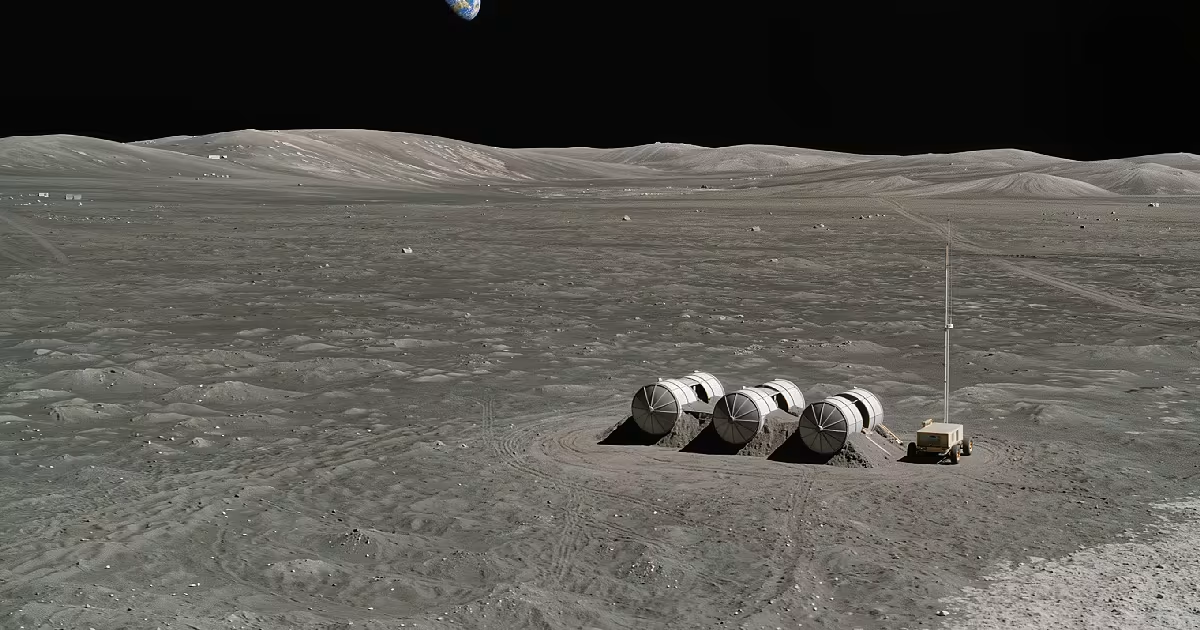
Small tank modules and a rover on grey lunar dust under a black sky.
Illustration, not a photograph.

Archive / Conspiracy / BOT313-0512
CON-19598 JUN 1959ConspiracyDOCUMENTED
THE ARMY'S 1959 PLAN FOR A MOON BASE
Fig. 01 Small tank modules and a rover on grey lunar dust under a black sky. Illustration, not a photograph.
Opening
On 8 June 1959, the United States Army Ballistic Missile Agency in Huntsville, Alabama, published a multi-volume study with the title Project Horizon: A U.S. Army Study for the Establishment of a Lunar Military Outpost. It was a plan for a base on the Moon, with a crew that the sources give as twelve soldiers, or between ten and twenty, to be in place by the end of 1966, at an estimated cost of six billion dollars. It was written under Wernher von Braun, a few months before a civilian agency, NASA, took over the American space programme.
The study's premise was stated plainly: there is a requirement for a manned military outpost on the Moon. It listed what such a base would do: protect American interests there, improve space reconnaissance, serve as a communications relay, map the Earth, and act as a laboratory and a low-gravity launch station. The plan was never approved. It never went beyond a feasibility study, and in the end it was rewritten as a civilian proposal and handed to NASA. It is one of the clearest records of how the military of the late 1950s expected to use the Moon.
Timeline
1957The Soviet Union launches Sputnik, and the American services compete to propose space projects.
March 1959Lieutenant General Arthur G. Trudeau, the Army's chief of research and development, directs the chief of Army Ordnance to determine what would be needed for a manned lunar station by 1966. Von Braun's agency begins a 90-day study.
8 June 1959The Army Ballistic Missile Agency publishes the multi-volume report. A National Security Archive copy of the two main volumes, Summary and Supporting Considerations and Technical Considerations and Plans, carries a date of 20 March 1959, so the sources differ on the dating.
1959The civilian NASA takes primary responsibility for the space programme.
25 March 1960Major General John B. Medaris, commander of the Army Ordnance Missile Command, is told that the project has been forwarded to the Secretary of Defense, who has sent it to NASA for such use as may be desired.
The plan's own scheduleIn 1964, forty Saturn launches; in January 1965, cargo deliveries begin; in April 1965, the first crewed landing, by two soldiers; in November 1966, the outpost is staffed after sixty-one Saturn A-1 and eighty-eight Saturn A-2 launches; and from December 1966, the first operational year with sixty-four launches.
Key figures
Wernher von Braun headed the Army Ballistic Missile Agency and appointed Heinz-Hermann Koelle to lead the project and the Saturn development at Redstone Arsenal.
Arthur Trudeau asked for the study. John Medaris commanded the Army Ordnance Missile Command and described it as a team effort: the Army, he said, grabbed every specialist it could get its hands on.
The chief of engineers was responsible for the design, construction and maintenance of the outpost, and the chief signal officer for communications and support.
President Eisenhower is often said to have rejected the plan when NASA took over. The Army's own history says instead that it was forwarded to the Secretary of Defense and then to NASA, and the National Security Archive says only that the civilian lunar programme, with international political considerations, helped to preclude military outposts.
Physical and documentary trail
The record: the 1959 Army reports, which are primary sources, and the Army's own later history. The plan called for about 147 Saturn A-1 launches to carry components to a low Earth orbit assembly point built from spent tanks, and a landing-and-return vehicle on a Saturn A-2 that could shuttle up to sixteen astronauts at a time. The Army history gives different launch figures: seventy-five Saturn II rockets to carry 245 tons of construction materials and equipment, and sixty-four more rockets a year for supplies such as food and water. A direct ascent alternative needed a booster of twelve million pounds of thrust, which the study said could not be developed in time.
The site and layout were shaped by rocket energy limits. The base was to lie within a roughly 20 by 20 degree area near the lunar equator, with three candidate sites: the northern Sinus Aestuum near Eratosthenes, the southern Sinus Aestuum near Sinus Medii, and the southwest coast of Mare Imbrium north of the Montes Apenninus. The Army history says no specific site was chosen. The basic modules were cylindrical tanks, ten feet across and twenty feet long, buried in the lunar surface for insulation and radiation protection, and reactors were to power the quarters: two in one account, four in another. The living quarters were to include dining and recreation space, a hospital area, communications sections, storage and two science laboratories. Two types of surface vehicle were planned, one for earthmoving and one for long-range hauling and rescue.
The defence of the base was minimal. Against a Soviet attack overland the plan relied on manually fired weapons: unguided Davy Crockett rockets with low-yield nuclear warheads, and Claymore mines modified to puncture pressure suits. The sources are not consistent with each other on several numbers. The crew is twelve in some accounts and ten to twenty in the Army history, the cost is six billion dollars in two accounts and absent in another, and the date for the operational outpost appears as both November and December 1966.
Things you might not know
- It was a military base. The stated aims included lunar surveillance of Earth and a communications relay.
- It was a ninety-day study. The Army Ballistic Missile Agency was asked in March and published in June.
- It needed about 150 launches. Or seventy-five Saturn II rockets plus sixty-four a year, depending on the account.
- The defences were small arms. They were manually fired, such as Davy Crockett rockets and modified Claymore mines.
- It would have used nuclear reactors. Two or four, in shielded pits, to power the early quarters.
- The base was to be a set of buried tanks. Ten feet wide and twenty feet long, covered in lunar soil.
- It was handed to NASA. The Secretary of Defense sent it on in 1960 for such use as might be desired, and officials had it revised for a strictly civilian mission.
- It ran in parallel with other plans. The Air Force was at that time studying a nuclear blast on the Moon in Project A119.
Competing explanations
A military feasibility study. The strongest reading and the one the documents support. The Army wanted a role in space, and Horizon was its case, argued in terms of defence and surveillance.
An argument for the Army's rockets. One source adds that the programme would also have assured demand for the rockets the agency was designing. The plan was also a bid by one service to keep its space programme, which was lost when NASA was created and von Braun's team moved with it.
A forerunner of later plans. Some see it as an ancestor of later lunar base proposals. The idea of a buried, modular outpost with its own power supply recurs in many of them.
Later life of the case
Horizon is often cited by writers on the militarisation of space, and by those who argue that the Moon landings had military roots. The Outer Space Treaty of 1967 bars military bases on the Moon, and the plan stayed on paper. The people who wrote it moved to NASA and built Saturn rockets of their own. The National Security Archive has published the two main volumes as part of a collection on American and Soviet lunar programmes.
Finding
Project Horizon is a documented, never-built plan for a permanent American military presence on the Moon, produced by von Braun's Army team in 1959. It does not show a secret base. It shows what an Army engineering group thought was possible and desirable at the dawn of the space race, and how quickly the idea was folded into a civilian programme.
What still will not resolve: how seriously the plan was considered by the Army itself, and by whom, and what led officials to revise it for a strictly civilian mission, since the study survives but the discussion around it is thinly documented.
Evidence signature
3/9 Thin
- Witnesses
- nothing on record
- Instruments
- nothing on record
- Paper
- formal investigation, court or declassified file
How well documented the case is, not whether it's true. A strong record can still have an ordinary answer, and a thin one can still be real.
You decide · PROJECT HORIZON
What do you think happened?
One vote per case, anonymous. You'll see how other readers voted once you've voted.