GLEIWITZ INCIDENT
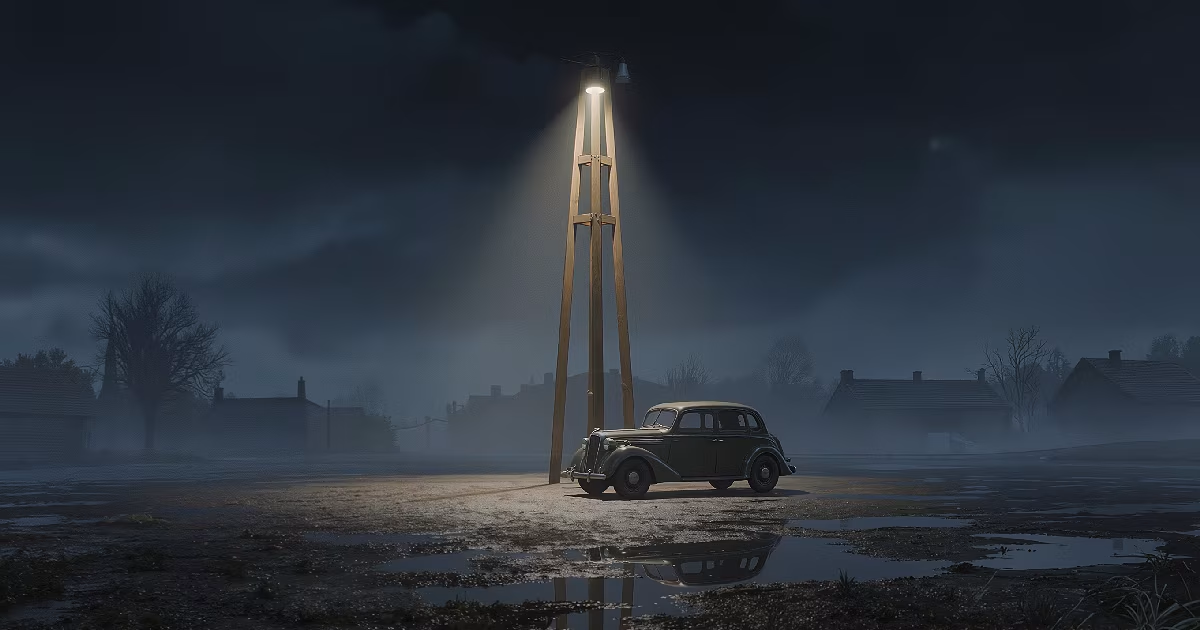
A lit wooden mast over a parked car in a foggy village.
Illustration, not a photograph.

Archive / Conspiracy / BOT313-0520
CON-193931 AUG 1939ConspiracyDOCUMENTED
THE FAKE POLISH ATTACK OF 1939
Fig. 01 A lit wooden mast over a parked car in a foggy village. Illustration, not a photograph.
Opening
On the night of 31 August 1939, a small group of armed men took over the Sender Gleiwitz radio station in Gleiwitz, a German town on the Polish border that is now Gliwice, Poland. They broadcast a short message in Polish, fired shots in the studio and left a body behind. The next morning German newspapers and officials said Poland had attacked. Germany invaded Poland on 1 September 1939.
The attackers were German. They were SS men in Polish uniforms, and the raid was one of about two dozen staged incidents known together as Operation Himmler, meant to give the invasion a pretext. It is among the best documented false flag operations in history, and nearly everything we know about what happened inside the station comes from one man.
Timeline
Mid 1939By this point the Abwehr's Breslau office has secretly prepared thousands of Polish-born Germans for sabotage, meant to provoke reprisals that could be shown as provocations.
10 August 1939Reinhard Heydrich assigns Alfred Naujocks to lead a small group to seize the Gleiwitz station.
22 August 1939Hitler tells his generals that he will supply a propagandistic reason for starting the war, and that its credibility does not matter.
26 August 1939The date first set for the operations. Shifting diplomacy delays them to 31 August and 1 September.
30 August 1939The SS arrests Franciszek Honiok in Ostwalde, now Połomia. He is held briefly at the police barracks in Beuthen.
31 August 1939The signal is the codeword Grossmutter gestorben, grandmother has died. Naujocks's group seizes the station and broadcasts an anti-German message in Polish. Honiok, drugged and shot, is left at the scene in the uniform of a saboteur. Several prisoners, likely from Dachau and code-named Konserve, canned goods, are killed and left at other staged sites.
1 September 1939Hitler tells the Reichstag of 21 border incidents. He does not name Gleiwitz. Germany launches Case White.
3 September 1939Britain and France declare war.
1945At Nuremberg, Naujocks says Heydrich and Heinrich Müller ordered the operation. Erwin von Lahousen of the Abwehr also testifies.
Key figures
Alfred Naujocks was born in Kiel in 1911 and joined the SS in 1931. Before Gleiwitz he had led an undercover attack in 1935 on an anti-Nazi radio station at Slapy in Czechoslovakia, in which Rudolf Formis was killed, a killing he confessed to in 1944. After Gleiwitz he took part in the Venlo incident of 9 November 1939, headed an SD unit forging British banknotes, fell out with Heydrich in 1941 and was demoted, and from December 1943 led a terror and sabotage group in Denmark. He surrendered to US forces around November 1944, testified at Nuremberg as a witness, was convicted in Denmark in 1947 and sentenced to fifteen years, and was released in 1950 after the sentence was cut to four. He later sold his story to the press under the title The Man who Started the War. He died in Hamburg on 4 April 1966, aged 54.
Reinhard Heydrich supervised the operation and Heinrich Müller, head of the Gestapo, managed it. Erwin von Lahousen testified that his Abwehr division supplied the Polish uniforms. The operation was planned from the Sławięcice Palace. The source I read adds that Oskar Schindler, working as an Abwehr agent, helped supply uniforms and weapons.
Franciszek Honiok was born in Upper Silesia in 1896, called himself a Silesian and fought on the Polish side in the 1921 uprisings. He returned to Germany in 1925, fought deportation as far as the League of Nations, and was known in his home village of Hohenlieben, now Łubie, as a supporter of the Polish cause. He is often called the first victim of the Second World War.
Physical and documentary trail
The record: Naujocks's sworn affidavit and testimony at Nuremberg, Lahousen's evidence, Hitler's remarks of 22 August and what the world saw the next day. American correspondents were taken to the scene, and the Germans showed a body as proof. No neutral party investigated in detail, and international opinion was sceptical of the German account at the time.
Naujocks is the sole source for what he personally did that night. The historian Jak Mallmann Showell has suggested he may have embellished his account to win favourable treatment from the Allies. Lahousen's evidence on the uniforms backs part of it. The sources differ on what the broadcast said, and the number of bodies is not settled by what I found. The sources also differ on Honiok himself: some call him a Pole, others a German Silesian who sympathised with Poland. The one account I found says the location of his body is unknown and that no memorial exists, but it cites no sources, so I would treat that as unconfirmed.
Things you might not know
- It was one of about two dozen. The planned incidents included the Jabłonków railway pass, the Hochlinden customs station, the Pitschen forest station, the Neubersteich communications station and the Alt-Eiche railway station.
- The codeword was grandmother has died. The signal for the operation was Grossmutter gestorben.
- The corpses had a code name. The prisoners were called canned goods, and the operation is also known as Operation Konserve.
- The first victim had a record. Honiok had fought in the Silesian uprisings and taken a deportation case to the League of Nations.
- The same man ran a counterfeiting unit. Naujocks later headed an SD team that forged British banknotes.
- He lived to tell it. He served only a few years for crimes in Denmark and was a businessman in Hamburg when he died in 1966.
- It also fed propaganda afterwards. German propaganda exaggerated reprisals, including the Bydgoszcz events known in German accounts as Bloody Sunday.
Competing explanations
A German operation. The documented reading, supported by the participants' own testimony and by Lahousen's evidence.
A small piece of a larger plan. The raid was one of about two dozen incidents, and the German account convinced very little international opinion. It was a pretext, and the invasion followed orders already given. Hitler may also have hoped to confuse Poland's allies and delay their declarations of war.
A story told by one man. Because Naujocks is the sole source for his own part, the details of the raid, such as the exact message, the number of men and the fate of the prisoners, depend on him. The core is solid because other witnesses and the context confirm it. The finer detail is his word.
Later life of the case
Gleiwitz is the standard example in teaching on false flag operations. It sits beside Operation Northwoods, an American plan that was never carried out, and the Gulf of Tonkin affair.
Finding
The Gleiwitz incident was a staged attack by German forces, in Polish uniforms, meant to justify the invasion of Poland. The testimony of those who planned and took part, together with the context of the other staged incidents, puts this beyond reasonable doubt.
What still will not resolve: who the dead were, apart from Honiok, since the prisoners killed to make the scene were not named in the records I found, and what exactly happened inside the studio, since that rests on the word of a man who had reasons to shape it.
Evidence signature
6/9 Solid
- Witnesses
- several people
- Instruments
- photo, film or physical traces
- Paper
- formal investigation, court or declassified file
How well documented the case is, not whether it's true. A strong record can still have an ordinary answer, and a thin one can still be real.
You decide · GLEIWITZ INCIDENT
What do you think happened?
One vote per case, anonymous. You'll see how other readers voted once you've voted.