MOON LANDING HOAX
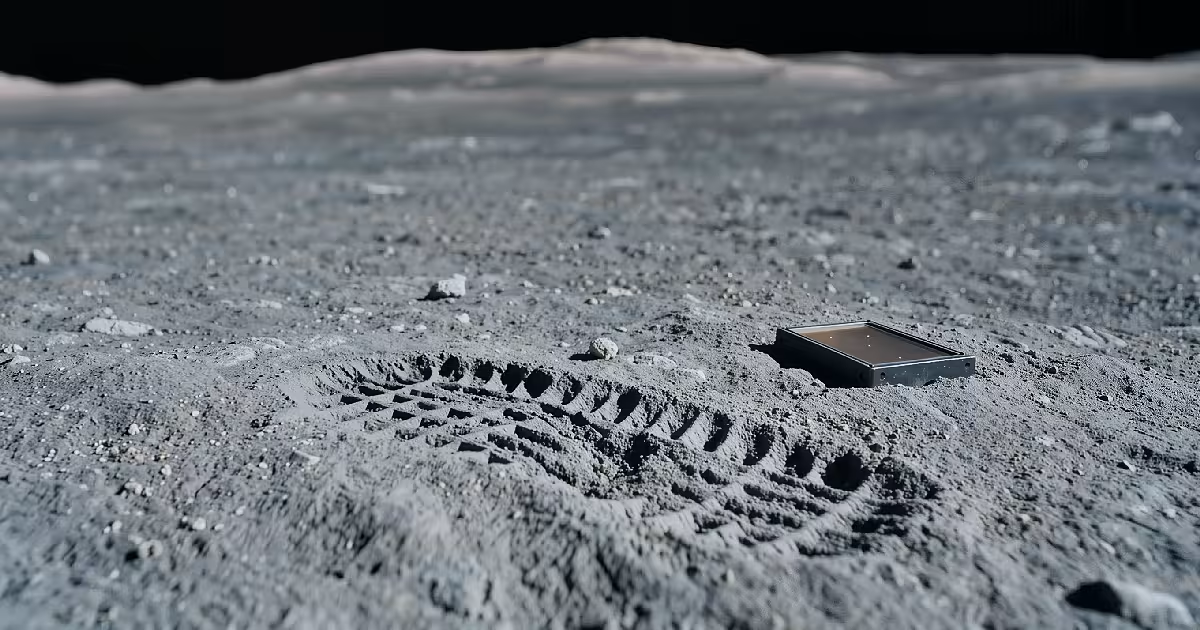
A footprint in grey lunar dust beside a small reflector panel.
Illustration, not a photograph.

Archive / Conspiracy / BOT313-0544
CON-196920 JUL 1969ConspiracyEVIDENCE HOLDS
THE CLAIM AND THE ROCKS
Fig. 01 A footprint in grey lunar dust beside a small reflector panel. Illustration, not a photograph.
Opening
Between July 1969 and December 1972, NASA landed twelve astronauts on the Moon in six Apollo missions. They brought back 382 kilograms of lunar rock and soil, left instruments that still work, and were tracked from launch to splashdown by observatories around the world, including the Soviet Union's.
In 1976 a former technical writer at the rocket-engine maker Rocketdyne, Bill Kaysing, self-published a book called We Never Went to the Moon, arguing the landings were filmed on Earth. The idea has never gone away. Polls between 1994 and 2009 found that between 6 and 20 per cent of Americans, a quarter of Britons and more than a quarter of Russians surveyed believed the landings were faked.
Timeline
20 July 1969Apollo 11 lands. Neil Armstrong and Buzz Aldrin walk on the Moon while Michael Collins orbits above. The broadcast is watched by an estimated 600 million people.
1 August 1969Astronomers at Lick Observatory in California bounce a laser off the reflector Apollo 11 left on the Moon, eleven days after it was placed there.
1969 to 1972Apollo 12, 14, 15, 16 and 17 land. Apollo 13 turns back after an explosion. Astronauts leave laser reflectors, seismometers and other experiments on the surface. When Apollo 14 deploys its reflector on 5 February 1971, McDonald Observatory in Texas detects it the same day.
1976Bill Kaysing publishes We Never Went to the Moon: America's Thirty Billion Dollar Swindle. He claims NASA's own odds of a successful landing were tiny and that the footage was staged.
1978The film Capricorn One, about a faked Mars mission, gives the idea a popular picture.
1980The Flat Earth Society accuses NASA of faking the landings, claiming they were filmed in Hollywood and directed by Stanley Kubrick.
1995A spoof posted to a Usenet humour group "reveals" that Kubrick faked the footage, inventing a Communist brother called Raul to make it funnier. Kubrick had no such brother, but the joke is repeated as fact and becomes the best-known version of the Kubrick claim.
15 February 2001Fox broadcasts Conspiracy Theory: Did We Land on the Moon?, bringing the claims to a prime-time audience.
2002NASA commissions the space writer James Oberg to write a book answering the hoax claims, for $15,000, then cancels it the same year after complaints that a reply would only dignify them.
9 September 2002In Beverly Hills, filmmaker Bart Sibrel confronts Buzz Aldrin, calls him a coward and a liar, and pushes a Bible at him demanding he swear on it. Aldrin, then 72, punches him. No charges are brought.
May 2008Japan's space agency reports that its Kaguya (SELENE) orbiter has photographed a pale "halo" on the ground at the Apollo 15 landing site, left by the lander's engine exhaust.
August 2008The TV series MythBusters tests the best-known hoax claims, including the flag, the lighting and the footprint, and finds that every one has an ordinary explanation.
2009 to 2012NASA's Lunar Reconnaissance Orbiter photographs the Apollo landing sites from orbit, showing the descent stages, equipment and the astronauts' tracks in the dust. Images show five of the six flags still standing; the Apollo 11 flag was knocked over by the ascent engine, as Aldrin reported at the time. India's Chandrayaan-1 and China's Chang'e 2 also photograph traces of the landings.
December 2015A video circulates of Kubrick apparently confessing on camera to faking the landings. It is a clip from a mockumentary, with an actor playing Kubrick.
2019A C-SPAN/Ipsos poll for the fiftieth anniversary finds 6 per cent of Americans think the landings were faked, rising to 11 per cent among millennials.
Key figures
Bill Kaysing started the modern hoax theory. Bart Sibrel was its most confrontational campaigner. Buzz Aldrin became the reluctant face of the dispute. The physicist James Van Allen, whose radiation belts are a favourite hoax argument, publicly rejected the claim that they made the journey impossible.
Physical and documentary trail
The record is one of the largest of any event in history: thousands of hours of film and audio, tens of thousands of photographs, mission transcripts, the lunar samples, studied in laboratories in many countries, and the retroreflectors left by Apollo 11, 14 and 15, which observatories on Earth still bounce lasers off to measure the Moon's distance. The Soviet Union, which had every reason to expose a fake, tracked the missions and reported the landings as fact.
The rocks are the hardest part of the record for a hoax to explain. Scientists around the world have studied them for more than fifty years, and no peer-reviewed paper disputes that they come from the Moon: they contain no water-altered minerals, carry the scars of impacts on a world with no air, and most are older than the oldest rocks found on Earth. The Soviet Union's robotic Luna missions brought back only 326 grams in total, and all the lunar meteorites ever found on Earth add up to roughly 30 kilograms, far too little to stand in for Apollo's haul.
Some original material is missing. NASA concluded in 2009 that the original Apollo 11 slow-scan video tapes had been erased and reused in the 1970s and 1980s, though copies of the broadcast survived and were restored.
Things you might not know
- The reflectors still work. Scientists fire lasers at the mirrors left by Apollo 11, 14 and 15 and time the returning light.
- A hoax would need hundreds of thousands of people. Researchers estimate around 400,000 people worked on Apollo. One study calculated a secret that size would come out within about four years.
- The flag "waves" because it was folded. It hung from a horizontal rod and kept the creases from storage; in film it moves only while the astronauts are handling the pole.
- The stars are missing for a photographer's reason. The cameras were set for a bright, sunlit surface, which leaves faint stars invisible.
- Kubrick's own film proves the point. In 2001: A Space Odyssey dust billows up when spacecraft land, which cannot happen in a vacuum. The Apollo footage shows dust flying in clean arcs and falling straight down.
- The Soviets got 326 grams. Their three robotic sample missions together returned less than a thousandth of Apollo's 382 kilograms.
- The hammer and the feather. On Apollo 15 David Scott dropped a hammer and a feather together to show they fall at the same speed in a vacuum. They hit the ground together.
Competing explanations
The landings happened. The physical samples, the instruments still on the surface, independent tracking, orbital photographs and the testimony of hundreds of thousands of people all agree.
The landings were faked. The hoax case rests on anomalies in photographs and film: the missing stars, the flag, shadows, the absence of a blast crater, and the radiation belts. Each has a physical explanation, and no part of the hoax theory explains the samples, the reflectors or the Soviet tracking.
Later life of the case
The hoax theory has outlived several of the astronauts, and polling suggests it remains a minority but persistent belief. In 2023 a former head of Russia's space agency voiced doubts publicly, and was rebuffed when he asked for evidence. For a space-age case where real secrecy fed decades of suspicion, see Roswell.
Finding
Twelve men walked on the Moon between 1969 and 1972, and the evidence that they did is physical, independent and still in use: rock in laboratories and mirrors on the surface. The hoax theory has never explained that evidence away.
What still will not resolve: why a belief with so much evidence against it has stayed so steady for fifty years, which is a question about people, not about the Moon.
Evidence signature
9/9 Strong
- Witnesses
- trained, independent witnesses
- Instruments
- more than one sensor agrees
- Paper
- formal investigation, court or declassified file
How well documented the case is, not whether it's true. A strong record can still have an ordinary answer, and a thin one can still be real.
You decide · MOON LANDING HOAX
What do you think happened?
One vote per case, anonymous. You'll see how other readers voted once you've voted.