IRON MOUNTAIN REPORT
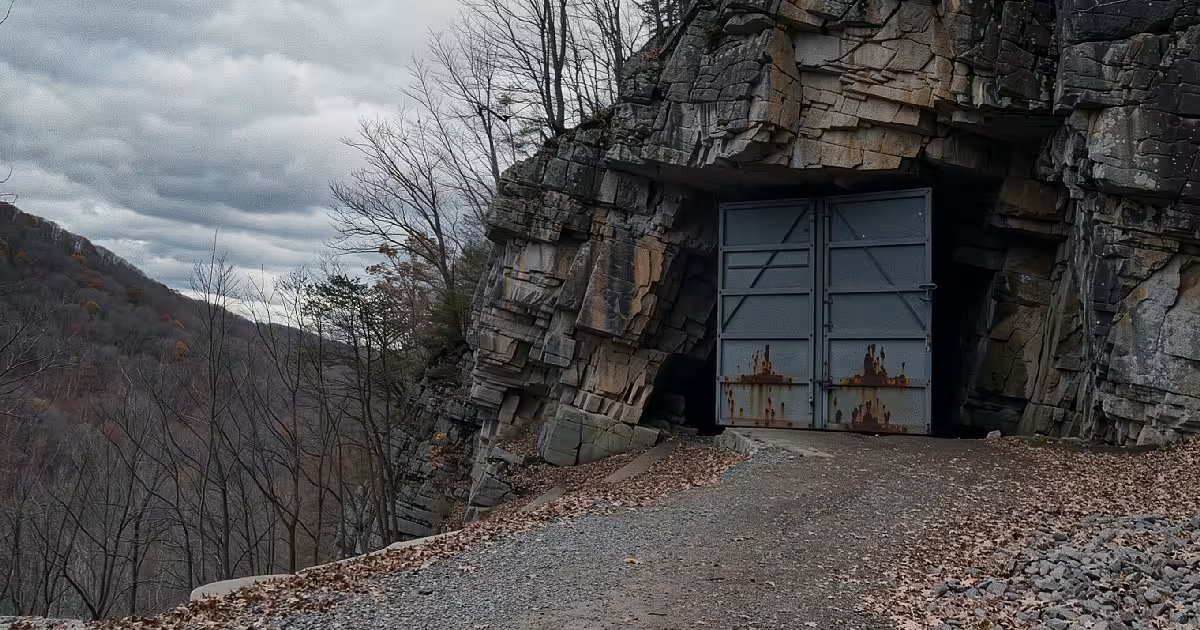
A closed grey steel door set in a rock wall of a disused mine.
Illustration, not a photograph.

Archive / Conspiracy / BOT313-0492
CON-1967ConspiracyAUTHOR ADMITTED
THE LEAKED PEACE STUDY THAT WAS A SATIRE
Fig. 01 A closed grey steel door set in a rock wall of a disused mine. Illustration, not a photograph.
Opening
In 1967 the Dial Press published a book called Report from Iron Mountain on the Possibility and Desirability of Peace. It claimed to be the leaked findings of a secret government think tank, the Special Study Group, set up under the Kennedy administration to plan for a world at peace. Its answer was that peace would be a disaster. War, it said, does jobs for a society that nothing else does: it controls the economy, holds nations together, and gives people an enemy. A permanent war-and-peace agency, and perhaps an invented threat such as hostile space aliens, would have to take its place.
It was a satire, written by an author named Leonard Lewin, but it was published as fact, with no author named. It became a bestseller and was translated into fifteen languages. It has been cited ever since by people who believe it is real. Lewin said he wrote it in 1972. The case is a rare one where the hoax has been confessed and the conspiracy theory has outlived the confession.
Timeline
1960sVictor Navasky and other editors of the satirical magazine Monocle come up with the idea after a newspaper ties a stock market fall to a "peace scare".
1967Dial Press publishes the book as nonfiction. E. L. Doctorow, then the press's editor-in-chief, agrees to the plan. The economist John Kenneth Galbraith reviews it under the pseudonym Herschel McLandress, a character from his own satire.
20 November 1967U.S. News & World Report claims the report is real and quotes an unnamed official who says President Johnson "hit the roof". That claim has never been verified.
March 1972Lewin writes in the New York Times Book Review that he wrote the book.
1980The book goes out of print.
Early 1990sLiberty Lobby and Noontide Press issue an edition and call it a public-domain government document. Lewin sues for copyright infringement. The case settles in 1994.
1996The Free Press publishes an authorised edition with a foreword by Navasky. A paperback follows in 2008.
2013Navasky says Galbraith was McLandress and had been in on the hoax from the beginning.
Key figures
Leonard Lewin was the author. He wrote the report with help from Galbraith and the Monocle editors Marvin Kitman, Richard Lingeman and Navasky.
Victor Navasky, later editor of The Nation, supplied the original idea and wrote a foreword for the 1996 edition.
John Kenneth Galbraith, an economist and former adviser to Kennedy, lent the book credibility with a review under a pseudonym. His later statements about it were inconsistent: at first he implied he was part of the "conspiracy", then he said he was in general a member of it but not its author.
E. L. Doctorow published it as a Dial Press editor.
Physical and documentary trail
The record: the book itself; Lewin's 1972 statement in the Times; the accounts of Navasky and others; and the litigation over the 1990s edition. The book is modelled on RAND-style studies. It lists the non-military functions of war, such as regulating the economic cycle and giving a national identity, and says that substitutes like health care and education would not be enough. It then suggests manufactured enemies and selective pollution.
What exists in the way of evidence that the report is real is a magazine paragraph with an unnamed source. No government agency has ever acknowledged a Special Study Group, no member has been identified.
Things you might not know
- It was a bestseller. The book reached the New York Times list and was translated into fifteen languages.
- A fake review helped. Galbraith's review under a pseudonym lent the hoax weight.
- He received the bootlegs. After the 1990s dispute, Lewin was sent more than a thousand copies of the unauthorised edition, according to the Times.
- Some readers rejected the confession. Conspiracy theorists have said Lewin's 1972 account was itself part of the cover.
- It is named after a mine. The real Iron Mountain near Germantown, New York, is a decommissioned iron mine.
- It circulated among militias. After it went out of print it was passed around online, including in militia circles.
Competing explanations
A satire, as its author said. Lewin's 1972 statement, Navasky's account and the litigation are all consistent. The Monocle editors and Galbraith were involved, and the book has no official provenance.
A real government study. This is the claim of the 1967 magazine item and of later believers. There is no document, no named participant and no agency to support it, and the author has confessed.
A satire that predicted a real policy. Some readers say the book is fiction but describes how governments really think. That is a comment on politics, not a claim about the document.
Later life of the case
The book was cited by writers on both the left and right as proof of a hidden war economy. The bootleg edition's claim of public-domain status failed in court. The authorised edition came back in 1996. It is still read as satire and still quoted as fact.
Finding
The report from Iron Mountain is a hoax, and a confessed one: the author said he wrote it in 1972, his collaborators have confirmed it, and no government record supports it. It is also one of the most successful literary hoaxes of its century. The conspiracy theory it created has outlasted its debunking, because the ideas in it, about the uses of war, are ones people recognise.
What still will not resolve: why a book that was meant to be recognised as satire was believed, and whether any official actually read it as a real memo, as the 1967 magazine story claimed.
Evidence signature
4/9 Solid
- Witnesses
- one person, or a tradition
- Instruments
- nothing on record
- Paper
- formal investigation, court or declassified file
How well documented the case is, not whether it's true. A strong record can still have an ordinary answer, and a thin one can still be real.
You decide · IRON MOUNTAIN REPORT
What do you think happened?
One vote per case, anonymous. You'll see how other readers voted once you've voted.