MONTAUK
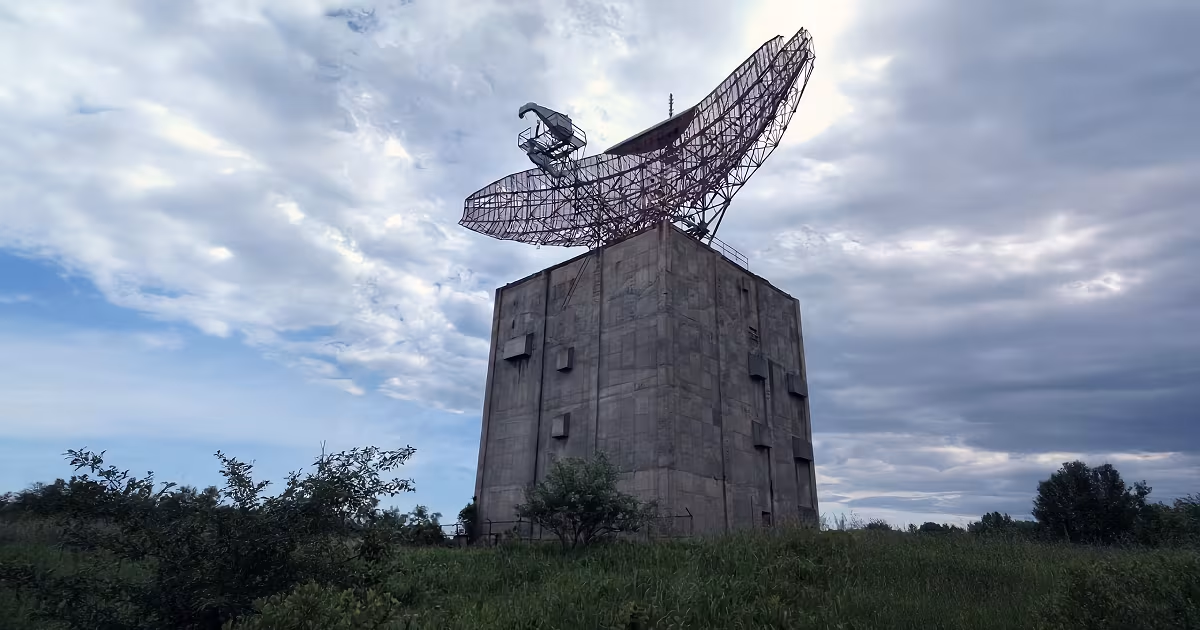
Camp Hero radar building. Empty park and overcast.
Illustration, not a period photograph.
Opening
Montauk, a small town at the far eastern tip of Long Island, carries two separate legends that keep getting folded into one another, and it's worth being precise about why. The first is the Montauk Project: a conspiracy theory claiming the U.S. government ran secret mind-control, time-travel, and psychic-warfare experiments, including on abducted children, at the decommissioned Camp Hero Air Force Station, originating entirely from one self-published 1992 book. The second is the Montauk Monster: a real, physically documented, badly decomposed animal carcass that washed ashore on Ditch Plains beach in July 2008, photographed, published, and never recovered for formal study. They share a location, a general atmosphere of government-secrecy suspicion, and, less obviously, a real nearby facility, Plum Island's federal animal disease research center, that residents reach for to explain both.
Timeline
Early 1980s. Stories referencing what would become known as the Montauk Project begin circulating informally, years before any book collects or names them.
1992. Preston B. Nichols, a self-described Long Island electronics engineer, publishes The Montauk Project: Experiments in Time with co-author Peter Moon. Nichols claims to have recovered suppressed memories of working at Camp Hero in the late 1970s and early 1980s on a classified program involving mind control via electromagnetic frequencies generated by the base's AN/FPS-35 radar tower, psychic warfare research, opening interdimensional portals, and the abduction of local children for experimentation. The book explicitly frames much of its own content as "soft facts," with Nichols and Moon writing in their first chapter, "Whether you read this as science fiction or non-fiction, you are in for an amazing story."
Following years. The book spawns three sequels, a self-identified community of "Montauk survivors," and figures including Al Bielek and Stewart Swerdlow who separately claim connection to the program and, in Bielek's case, link it explicitly to the earlier, similarly unverified 1943 Philadelphia Experiment.
2008. Researcher Christopher Garetano begins investigating claims from three men stating they were brainwashed and used in experiments at Camp Hero during the 1970s-80s; Garetano also hires a geophysicist to survey the ground beneath the decommissioned base, reportedly finding evidence of large underground structures not shown on official maps, though no excavation or independent confirmation of their purpose has followed.
12 July 2008, separately and around the same period. Montauk resident Jenna Hewitt, then 26, walking Ditch Plains beach with friends Rachel Goldberg and Courtney Fruin, spots a bloated, hairless, leathery-skinned carcass with clawed limbs and a beak-like face. Hewitt borrows a camera and photographs it; the group, only half-joking, wonders aloud whether it might be "something from Plum Island," the real federal Plum Island Animal Disease Center visible from parts of the region.
23 July 2008. The East Hampton Independent runs Hewitt's photo, in black and white, under the deliberately tongue-in-cheek headline "The Hound of Bonacville," floating theories ranging from Satan to a mutant turtle before quoting East Hampton's own director of Natural Resources, Larry Penny, suggesting simply that it looked like a raccoon missing its upper jaw.
Following days. Gawker picks up the photo, and it becomes a genuine internet sensation within the week, drawing television crews and national media attention; the carcass itself, however, is never recovered by any official body for formal necropsy, and disappears from the beach shortly after being photographed.
Following weeks. Paleontologist Darren Naish publishes a detailed anatomical argument identifying the animal as a water-degraded raccoon (Procyon lotor), pointing specifically to the elongated, dexterous, human-like fingers visible in the photograph, a distinctive raccoon trait, and directly countering claims that the legs were disproportionately long by overlaying a raccoon skeleton onto the image. Wildlife expert and television personality Jeff Corwin separately reaches the same raccoon identification in a Fox News interview.
2009, 2011, 2012. Similar hairless, bloated carcasses reportedly wash up at other nearby locations, Montauk again, Shelter Island, and beneath the Brooklyn Bridge, each briefly photographed, each disappearing again before formal examination, and each subsequently identified by the same general raccoon-and-saltwater-decomposition explanation.
2015. Montauk Chronicles, a documentary film featuring Nichols, Bielek, and Swerdlow discussing the Montauk Project conspiracy, wins best documentary at the Philip K. Dick Science Fiction Film Festival and is covered by Coast to Coast AM and The Huffington Post.
2016 onward. Netflix's Stranger Things, whose creators have acknowledged drawing inspiration from Montauk Project stories (the show was even given "Montauk" as a working title before production), brings the underlying mythology to a vastly larger audience than the original 1992 book ever reached on its own.
Key figures
Nichols is the Montauk Project mythology's sole originating source; nothing in the story predates his own claimed recovered memories, and no second, independently corroborating primary witness has ever come forward with a separate, unconnected account of the same specific program.
Garetano is the most methodologically serious independent investigator of the Camp Hero claims specifically, and his own stated conclusion is notably narrower than Nichols's original story: he has publicly said, "forget all the alien and MKUltra crap," while still suspecting some kind of unexplained experimentation on children or runaway teenagers may have occurred at the site, a meaningfully smaller and more specific claim than the full time-travel mythology.
Hewitt is the Montauk Monster's sole photographer and effectively its only direct witness of record, alongside her two friends; her own account, including the half-joking Plum Island remark, has never wavered in its basic details even as the photo took on a life far beyond her original beach walk.
Naish and Corwin are the case's key identifying experts, both independently and separately reaching the same raccoon conclusion through direct anatomical analysis of the one surviving photograph, the closest thing this case has to a settled scientific verdict.
Penny, East Hampton's own director of Natural Resources, offered the mundane explanation from the very first published article, before the story had gone viral or acquired any national mythology at all, a detail worth noting since it shows the "just a raccoon" reading was the original local response, not a later corrective imposed from outside.
Physical and documentary trail
On the paper, this file splits cleanly into two very different evidentiary states. The Montauk Project has no physical evidence of any kind beyond Nichols's own books and the personal accounts of a small number of self-identified "survivors," no declassified document, no confirmed former Camp Hero staff member outside this circle, and Garetano's geophysical survey, while intriguing, has never been followed by excavation or independent confirmation of what, if anything, lies beneath the site.
The Montauk Monster has exactly one surviving piece of physical evidence, Hewitt's photograph, since the carcass itself was never collected by any official agency and vanished from the beach before formal examination. That single photograph has nonetheless been subjected to genuine expert anatomical analysis, with two independent specialists reaching the same identification through visible, checkable physical details rather than speculation.
Forget all the alien and MKUltra crap. I think there was some type of experimentation out there using kids or teenagers, maybe runaways from New York.
Competing explanations
For the Montauk Project: a modern myth built from one man's self-published, self-described "soft facts," which absorbed and repackaged genuinely real but unrelated Cold War-era programs, the real Philadelphia Experiment legend, the real MKUltra revelations, the real Operation Paperclip Nazi scientist relocations, some of whom genuinely did work at nearby Plum Island, into a single, more dramatic narrative anchored to one specific, now-decommissioned base. This reading accounts well for the story's origin (one author, one book, zero independent corroborating witnesses) and for its geographic logic (a real, abandoned military site is a plausible blank canvas for exactly this kind of story).
Genuine but narrower unexplained activity at Camp Hero, short of time travel or interdimensional portals. Garetano's own more limited claim, unconfirmed but not obviously fabricated experimentation involving children or teenagers, sits in a middle position between full mythology and full dismissal, and his geophysical survey findings remain a specific, checkable claim that has simply never been followed up on by anyone with excavation authority.
For the Montauk Monster: a decomposed raccoon, water-degraded to the point of losing recognizable fur and facial structure. This is the reading supported by direct, independent anatomical analysis from two named experts, and it is strengthened by the fact that nearly identical carcasses, later identified the same way, have washed up repeatedly at other unrelated locations with no connection to Montauk or Camp Hero at all.
A hoax staged specifically to generate internet attention, given the missing carcass, the total absence of independent physical recovery, and speculation from at least one online analyst that the animal may have been deliberately killed, decomposed, and placed for photography before removal. This reading does not require dismissing the raccoon identification, since a hoax could equally well have used a real decomposed raccoon rather than a fabricated object.
A genuine escapee or byproduct from the real, nearby Plum Island Animal Disease Center. This reading has no confirmed supporting evidence but persists specifically because Plum Island is a real federal facility with a documented history of secrecy around its research, giving the joke Hewitt and her friends made on the beach a level of plausibility neither pure folklore nor a fabricated cryptid claim would otherwise carry.
Later life of the case
The two Montauk stories continue to reinforce each other in popular retelling specifically because they share a location and a general flavor of government secrecy, even though one rests on zero physical evidence and one rests on a single photograph that expert analysis has reasonably well explained. Stranger Things' enormous popularity has kept the Montauk Project mythology circulating globally decades after Nichols's original, self-published book, while the Monster's recurring "sequels" at other East Coast beaches have kept the raccoon-carcass phenomenon itself a minor but persistent seasonal news story independent of any connection to Camp Hero at all.
Finding
These are two different kinds of claim wearing the same town's name. The Montauk Project rests entirely on one author's self-described "soft facts," with no independent corroborating witness, no declassified document, and no confirmed connection to any of the genuinely real Cold War programs it borrows atmosphere from. The Montauk Monster is a real, once-photographed carcass that two independent wildlife and anatomy experts have identified, through visible physical details rather than assumption, as a water-degraded raccoon, though the animal itself was never recovered for confirming necropsy.
What still will not resolve: Garetano's specific, narrower, unconfirmed claim about unexplained activity at Camp Hero involving children or teenagers, which remains neither corroborated nor disproven; and, for the Monster, formal necropsy confirmation of the raccoon identification, which the vanished carcass makes permanently impossible to obtain. Both threads share a real place and a real nearby secretive facility in Plum Island; neither shares much else beyond that geography and the reputation it has accumulated.