PROJECT AZORIAN
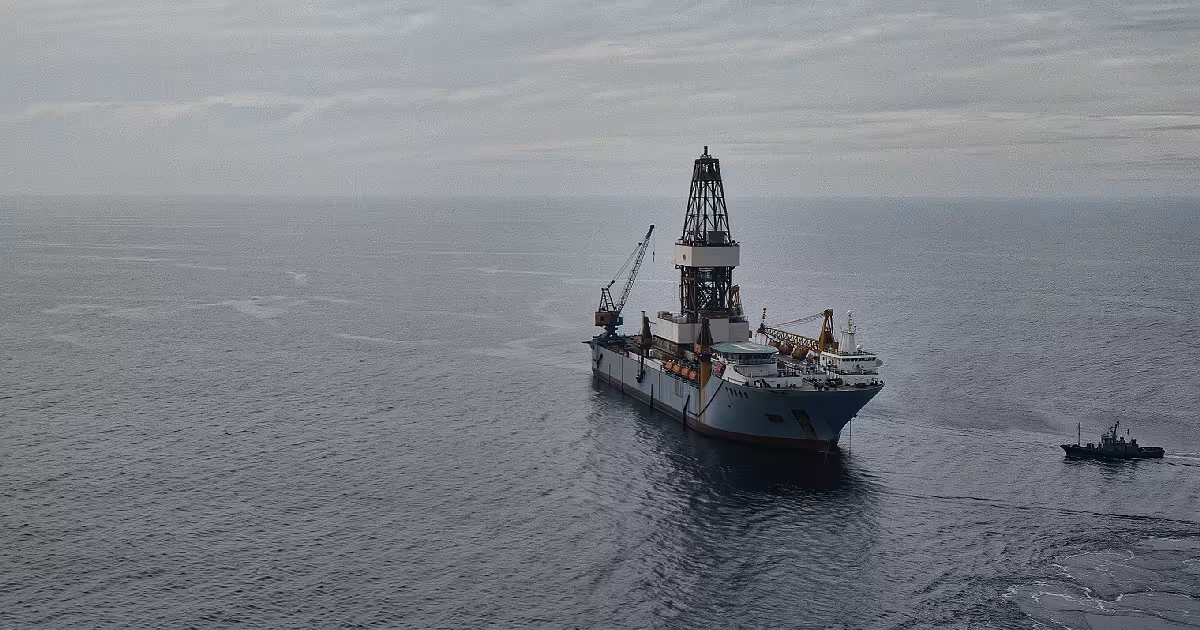
A huge drilling ship alone on a calm grey ocean, a small ship nearby.
Illustration, not a photograph.

Archive / Conspiracy / BOT313-0465
CON-19748 AUG 1974ConspiracyDOCUMENTED
THE CLAW AND THE SOVIET SUBMARINE
Fig. 01 A huge drilling ship alone on a calm grey ocean, a small ship nearby. Illustration, not a photograph.
Opening
In March 1968 the Soviet ballistic missile submarine K-129 sank in the middle of the Pacific, about 1,560 miles northwest of Hawaii, with all of its crew, reported as 98 men. It was carrying three nuclear missiles. The Soviet navy searched and never found it. The United States Navy, listening through its underwater hydrophone networks, did. The wreck lay about 16,500 feet down, more than three miles below the surface, far deeper than anything had ever been raised from.
The CIA decided to raise it anyway. Over six years it designed and built a 619-foot ship with a giant mechanical claw and a hidden moon pool in its belly, and told the world it belonged to the eccentric billionaire Howard Hughes and was going to mine the seabed for metal. In the summer of 1974 the ship parked over the wreck, with a Soviet vessel watching, and began to lift. Part of the submarine came up. The rest, and most of the story, stayed classified for decades, and the agency's answer to the first journalist who asked about it gave the language a new phrase: "neither confirm nor deny".
Timeline
March 1968K-129 leaves Kamchatka on patrol and is lost after an internal explosion. The cause is still argued over.
July 1968The American submarine USS Halibut finds the wreck and takes more than 20,000 close-up photographs.
1 July 1969The CIA sets up a Special Projects Staff to plan the recovery. In August President Nixon approves it, and the work goes into a secret compartment code-named "Jennifer". Early estimates give it a 10 percent chance of success.
1971 to 1972Costs climb, and senior officials twice recommend cancelling. Nixon orders it to continue. The keel of the Hughes Glomar Explorer is laid at Sun Shipbuilding in Chester, Pennsylvania, in November 1971.
5 June 1974Burglars break into the Los Angeles offices of Hughes's company, Summa Corporation. Among the papers taken is believed to be a memo about the secret project. It is never recovered.
20 June to 4 July 1974The ship sails from Long Beach and reaches the site on Independence Day. Nixon has ordered that the recovery must not begin until he is home from a summit in Moscow.
July 1974Two Soviet naval vessels shadow the operation for almost two weeks. On 18 July the crew stack crates on the helicopter deck in case the Soviets try to land, and prepare to destroy classified material.
1 to 8 August 1974The claw, called Clementine, grabs the hull and the long lift begins. Partway up, several of the claw's arms fail and most of the submarine falls back to the seabed. A section of the bow, about 38 feet long, is brought into the ship and secured on 8 August.
4 September 1974The bodies of six Soviet sailors found in the recovered section are buried at sea in a formal military ceremony, which the CIA films.
8 February 1975The Los Angeles Times reports that the CIA has been after a sunken Soviet submarine.
18 and 19 March 1975Jack Anderson breaks the story on the radio, and Seymour Hersh's report runs in The New York Times. A second mission, code-named Matador, is put on hold and finally dropped that summer.
1976In Phillippi v. CIA, the courts uphold the agency's refusal to confirm or deny its link to the ship.
1992CIA Director Robert Gates gives the film of the burial to Russian President Boris Yeltsin.
2010The CIA releases a heavily redacted history of the project, written by a participant for its in-house journal in 1985.
Key figures
The crew of K-129 are at the centre of it: nearly a hundred Soviet sailors whose families waited decades to learn where the boat lay, and that six of the men had been brought to the surface and buried with honours.
John Parangosky ran the CIA's Special Projects Staff. Global Marine designed and operated the ship, and Lockheed built the capture vehicle.
Howard Hughes lent his name and his company's cover. By most accounts his own part ended there.
Harriet Ann Phillippi, a journalist, asked for the records under the Freedom of Information Act. The reply she got is why lawyers still talk about a "Glomar response".
Physical and documentary trail
What exists: the CIA's own history, released in 2010 after a request from the National Security Archive; White House and National Security Council papers on the approvals and the leaks, now in the State Department's published Foreign Relations volumes; the 1975 press coverage; the court ruling; and the burial film.
What the record still holds back is what came up. The CIA history is redacted at exactly the points where it would say what was recovered. Accounts by people who were there, and later books, say the raised section held two nuclear-tipped torpedoes, code books and the ship's bell, which was later returned to Russia. Seymour Hersh reported in 1975 that no missiles were recovered. The official record does not confirm or deny any of it.
It is now clear that the Soviets have no intention of allowing us to conduct a second mission without interference.
Things you might not know
- It cost about as much as a space mission. Estimates run from $500 million in 1974 dollars to around $800 million, several billion in today's money.
- The ship opened from underneath. The submarine was lifted up through the hull into a huge enclosed well, out of sight of the Soviet watchers alongside.
- The cover story started a real boom. The public talk of mining manganese nodules from the deep ocean floor helped spark genuine commercial and political interest in seabed mining.
- It became an oil drillship. Converted in 1997 and renamed GSF Explorer, the ship drilled for oil from the Gulf of Mexico to Angola before it was sent for scrap in 2015.
- The burglary may have been just a burglary. Government papers say an attempt was made to sell the stolen documents back, then abandoned. Some accounts suggest the leak came from official briefings instead.
Competing explanations
A partial success. This is the usual reading: the CIA got the bow section and some of what it held, but missed the missiles and the code room it most wanted, and lost the rest when the claw broke.
A bigger success than admitted. Some writers have argued that more came up than the CIA lets on, and that the story of a broken claw was itself a cover. Nothing released supports this.
A failure dressed as a secret. Others see an enormously expensive operation that recovered little of value, and was kept secret as much to hide the cost as the haul. The redactions leave room for both of these.
Later life of the case
The "Glomar response" became a standard legal tool, used by agencies across the American government to avoid saying whether records exist at all. The project has been the subject of documentaries and books, including Norman Polmar and Michael White's Project Azorian, which the CIA itself has recommended. In Russia the loss of K-129 is still felt by the families of its crew, and the question of what really sank it has never been settled to everyone's satisfaction.
Finding
Project Azorian happened, and it is one of the most remarkable things an intelligence agency has ever attempted: a ship built around a lie, sent to lift a nuclear submarine from three miles down, with a Soviet vessel watching. It partly worked. A section of the submarine was raised, and six of its crew were given a burial that the Soviet Union never knew about until much later.
What still will not resolve: exactly what was recovered, which the CIA's own history still blacks out, and what caused the explosion that sank K-129 in the first place.
Evidence signature
8/9 Strong
- Witnesses
- trained, independent witnesses
- Instruments
- radar or measured data
- Paper
- formal investigation, court or declassified file
How well documented the case is, not whether it's true. A strong record can still have an ordinary answer, and a thin one can still be real.
You decide · PROJECT AZORIAN
What do you think happened?
One vote per case, anonymous. You'll see how other readers voted once you've voted.