ACOUSTIC KITTY
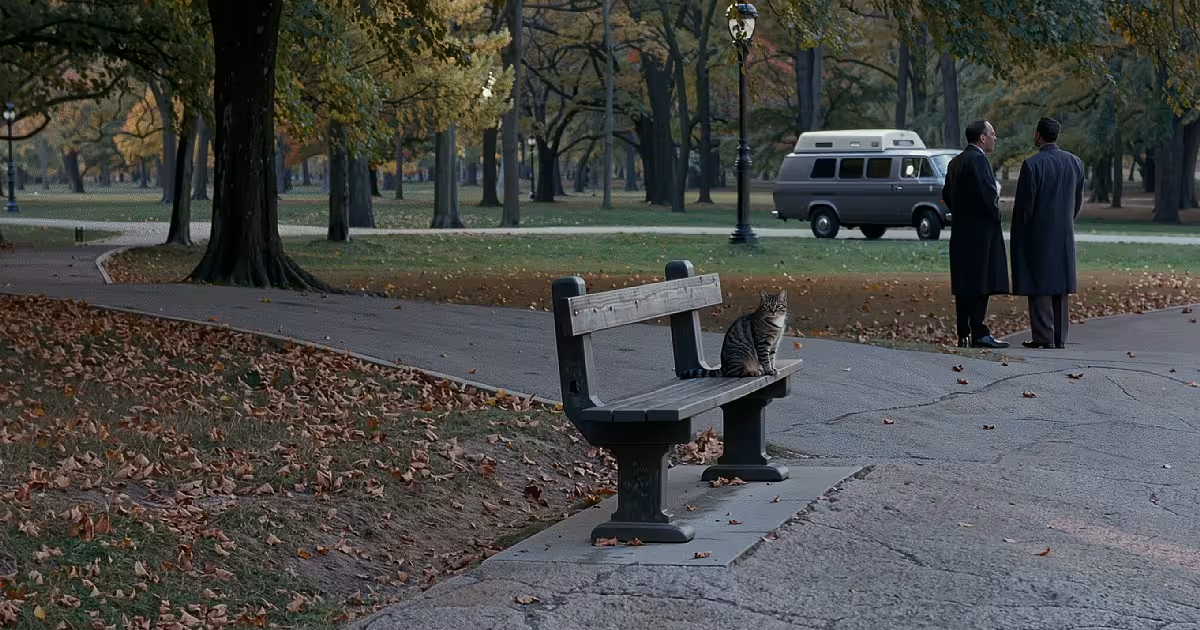
A tabby cat on a park bench with two men and a van behind.
Illustration, not a photograph.

Archive / Conspiracy / BOT313-0511
CON-1966ConspiracyFAILED PROGRAMME
THE CIA'S SPY CAT
Fig. 01 A tabby cat on a park bench with two men and a van behind. Illustration, not a photograph.
Opening
In the 1960s the Central Intelligence Agency tried to turn a cat into a spy. Surgeons cut open a living cat and fitted a microphone into its ear canal, a transmitter, three-quarters of an inch to an inch long, at the base of its skull, small batteries inside its rib cage and a fine antenna wire running under the fur from the spine to the tail. The idea was that the cat could be sent to sit near two people on a park bench, or to wander around a Soviet compound, and its hidden microphone would record their talk. The project was called Acoustic Kitty.
It sounds like a joke, and for decades it was told as one. It is also documented: a CIA report from March 1967, released in 2001, records the conclusion that cats could be trained to move short distances but that the technique would not lend itself in a practical sense to the agency's highly specialised needs. Almost everything else is disputed, including the most repeated story about it, that the first cat was killed by a taxi.
Timeline
About 1962CIA officers come up with the plan to implant a microphone and transmitter in a cat. The work is developed by the Office of Technical Service and the Office of Research and Development, at Langley.
1962 to 1966About five years of development, surgery and training. The researchers test the equipment on dummies first, then on live cats.
1966The first field test, near Lafayette Square in Washington, D.C. A van is parked a few blocks from the former Soviet embassy on Sixteenth Street, now the Pullman House. A cat is sent to approach two people on a park bench.
March 1967A report titled Views on Trained Cats, with parts redacted, concludes that the technique is not practical. A meeting on animal projects also questions further spending on cats.
1969Memos still mention cats as an option for audio surveillance, but an executive director is reluctant to fund more.
10 September 2001The National Security Archive publishes over forty declassified CIA and intelligence documents, among them material on Acoustic Kitty, which it describes as the attempt to use cats as mobile bugging devices. The documents were obtained through Freedom of Information requests, the National Archives and the CIA's public affairs office.
2013Robert Wallace, a former head of the Office of Technical Service, disputes the taxi story and says the cat lived a long life.
Key figures
Victor Marchetti, a former executive assistant to the CIA Director, said a taxi struck the cat on its first trip and that the project cost about $20 million. He also called it a monstrosity.
Robert Wallace, former director of the Office of Technical Service, said that the project was abandoned because the cat was hard to train, and that after it ended the equipment was removed, the cat was re-sewn and lived a long and happy life.
Jeffrey Richelson, a senior fellow of the National Security Archive and an intelligence historian, obtained the documents for his book The Wizards of Langley, about the CIA's Directorate of Science and Technology. Of the cat in the taxi story he has said that he was not sure how long it would have survived the operation even if it had not been run over.
Bob Bailey, a former Navy dolphin trainer, is credited in one account with the idea, after observing cats wandering into secure areas in Asia. The animal projects team later looked at dogs, dolphins, ravens, cows and pigeons into the 1970s.
Physical and documentary trail
The record: the March 1967 report, a short set of declassified documents including a 15-page set on animal training, and the later recollections of former officers. The report is heavily redacted, and its full title is Views on Trained Cats [redacted] for [redacted] Use. It says that cats can indeed be trained to move short distances, which it calls a remarkable scientific achievement, and concludes that the program would not lend itself in a practical sense to the agency's highly specialised needs. It is the only declassified document I found that names the project, and it concerns environmental and security factors that make the technique impractical in a real foreign setting.
The details are thin. The cost is given as $10 million, $15 million, $20 million or over $25 million in different sources, all estimates. Training sessions tested attention, endurance and range, with audio tones in the ear to signal left and right. Cats could be guided short distances in a laboratory, but they often walked off the job when hungry or bored, and technicians reportedly added a wire to override hunger. The taxi story rests mainly on Marchetti, and the principal on the project disputed that the cat was hit on its first day. Much of the project is still classified.
Things you might not know
- It was a real report. The March 1967 document that names the project was published in 2001.
- The report called it remarkable. It described the training of cats to move short distances as a remarkable scientific achievement, before concluding it was impractical.
- The transmitter was small. About three-quarters of an inch to an inch, at the base of the skull.
- The microphone was in the ear canal. The batteries were in the rib cage.
- The cats walked off. They often wandered away when hungry or bored.
- The idea may have come from a dolphin trainer. Bob Bailey, a former Navy dolphin trainer, is credited with it.
- The cost is not known. Estimates run from $10 million to over $25 million.
- The later descendants are insects. In 2006 DARPA asked for cyborg insects for espionage, and in 2009 Berkeley researchers reported a controllable cyborg beetle.
Competing explanations
A real but failed programme. The strongest reading. The report, the surgery details and the accounts of former officers all agree that the CIA tried it and it did not work well enough to use.
A story that grew. The taxi death, the compound and the precise cost are told in different ways by different sources. The most colourful versions come from a single former officer, and the officer who ran the project disputes them. Even the historian who obtained the documents is cautious about the cat's fate.
A bigger programme. Some accounts report more success, and the later animal projects continued into the 1970s. I have found no document that supports a working operation.
Later life of the case
Acoustic Kitty is a regular item in lists of strange Cold War programmes, and it is a fixture of CIA lore. It sits beside the better-known Project MKUltra and Project Bluebird, though it is a different thing: an engineering experiment, not a programme of control.
Finding
Acoustic Kitty was real. The CIA spent several years and a great deal of money implanting equipment in cats, tested it in Washington in 1966, and concluded in 1967 that it was not practical. The famous taxi ending is uncertain, and the account of the officer who ran it is quite different.
What still will not resolve: what happened to the first cat on its first mission, since the two former officers who describe it give opposite accounts, the historian who published the documents is unsure, and the surviving paperwork does not settle it.
Evidence signature
4/9 Solid
- Witnesses
- several people
- Instruments
- nothing on record
- Paper
- official records at the time
How well documented the case is, not whether it's true. A strong record can still have an ordinary answer, and a thin one can still be real.
You decide · ACOUSTIC KITTY
What do you think happened?
One vote per case, anonymous. You'll see how other readers voted once you've voted.