PROJECT PLOWSHARE
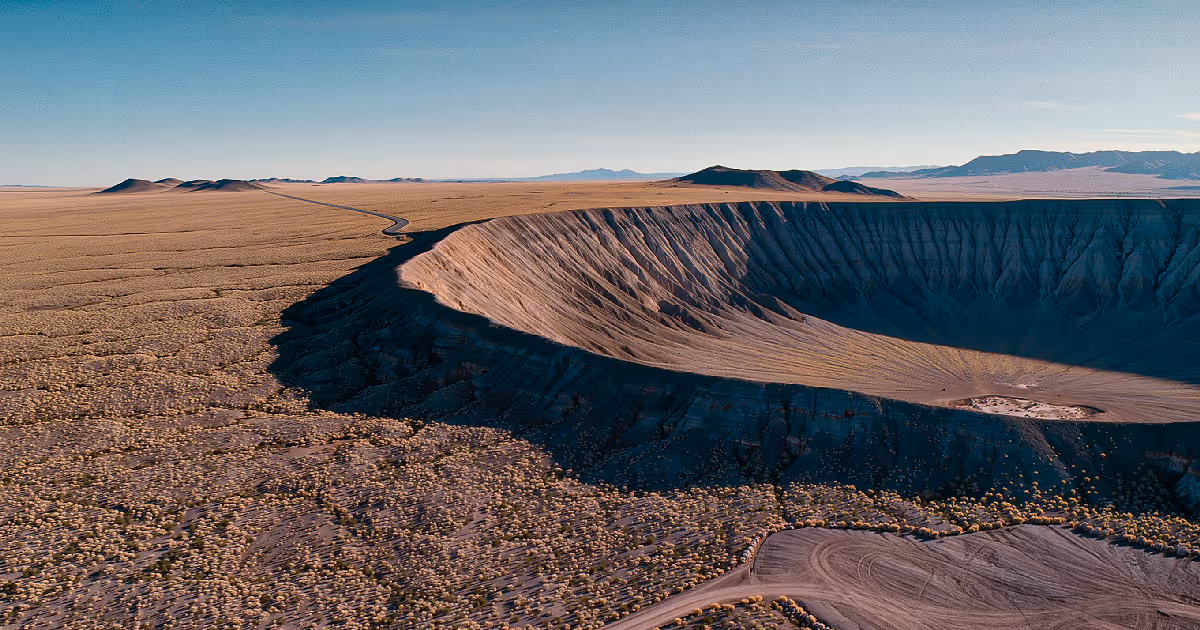
A huge crater in a flat desert beside a dirt road.
Illustration, not a photograph.

Archive / Conspiracy / BOT313-0502
CON-19576 JUL 1962ConspiracyDOCUMENTED
THE ATOMIC PLAN TO REMAKE THE EARTH
Fig. 01 A huge crater in a flat desert beside a dirt road. Illustration, not a photograph.
Opening
Between 1957 and 1977, the United States ran a programme to find peaceful uses for nuclear explosions. It was called Project Plowshare, after the Biblical line about beating swords into ploughshares. The idea was that a nuclear blast could dig a harbour, cut a canal, quarry a mountain pass, or free trapped natural gas from rock, far more cheaply than bulldozers and dynamite.
Twenty-seven tests, using thirty-five devices, were carried out. Some made craters you can still see from the air. None delivered a commercial product that anyone would use. Plowshare is documented, it was run openly, and it reads like a conspiracy theory: a government that planned to blast a harbour in Alaska, a second Panama Canal across Nicaragua, and a canal through Israel's Negev desert. It belongs in this archive because the plans were real.
Timeline
June 1957Plowshare is organised under the Atomic Energy Commission as part of the Atoms for Peace effort.
10 December 1961Project Gnome, in a salt bed in New Mexico: 3.1 kilotons. It vents radioactive steam while the press watches. Only its geophysical objective is counted a success.
6 July 1962Sedan, at the Nevada Test Site: a 104 kiloton cratering shot that displaces about twelve million short tons of soil and leaves a crater roughly 320 feet deep and 1,280 feet wide. A radioactive dust cloud rises to about 12,000 feet and drifts northeast, then east towards the Mississippi.
1963Project Carryall proposes about twenty-two nuclear explosions to cut through the Bristol Mountains for Interstate 40 and a railway. A Lawrence Livermore memo proposes 520 two-megaton blasts for a canal through Israel's Negev as a Suez alternative.
10 December 1967Gasbuggy, in New Mexico: 29 kilotons, the first joint government and industry experiment, to stimulate gas flow.
10 September 1969Rulison, in Colorado: 43 kilotons.
17 May 1973Rio Blanco, in Colorado: three simultaneous detonations. The blast cavities do not connect as hoped, and the gas still contains unacceptable levels of radioactivity.
1973Time magazine calls the programme "Project Dubious".
1977The programme ends.
Key figures
Edward Teller, the physicist, was the programme's chief advocate. Lewis Strauss, chairman of the Atomic Energy Commission, is credited in the sources with saying the programme would help create favourable world opinion towards weapons development and testing. The quote is flagged as needing verification.
The Inupiat people of Cape Thompson, Alaska, lived near the site of Project Chariot, the planned harbour, and their concerns were part of why it was cancelled.
The Soviet Union ran a parallel programme, Nuclear Explosions for the National Economy, with 124 tests.
The historians Benjamin Sovacool and Michael Payne offer different accounts of why it failed: Sovacool stresses the radioactive gas that consumers would not buy, and Payne the shift in public opinion, the court cases and general hostility.
Physical and documentary trail
The record: the test data and craters; the Atomic Energy Commission's studies; the Livermore memo on the Negev canal; and the financial figures. By 1974 about $82 million had been spent on the gas stimulation work, with an estimate that only 15 to 40 percent of the investment would be recouped. The programme's overall cost is given as over $770 million, with no detailed breakdown.
The gas from the tests proved too radioactive for commercial use, and none of it entered the supply lines. Sedan's dust cloud and the Gnome vent are the best-known releases. The sources I found do not describe where the Sedan fallout settled or what followed, and published yields and locations differ slightly between reports. Other proposals, such as the Australian Harbor Project, were stopped for lack of an economic basis in 1969, and a sea-level canal across Nicaragua was studied but not built.
Things you might not know
- The Negev canal would have used 520 bombs. At two megatons each, to rival the Suez Canal.
- Cost was a selling point. The Negev canal was priced at $575 million, about $5 billion in 2021 dollars.
- Time named it. "Project Dubious" was the magazine's 1973 verdict.
- The press watched Gnome. Journalists were present when the test vented radioactive steam.
- Chariot was stopped by locals. The Alaskan harbour, which would have used several hydrogen bombs, was cancelled over concerns for Inupiat communities and the weak case for the harbour's value.
- The Soviets did more. Their programme ran 124 tests against the American 27.
Competing explanations
A genuine engineering idea. In the 1950s nuclear explosives looked like cheap, powerful tools, and the programme's supporters, including Teller, believed they could solve real problems. This is how the documents describe it.
A public relations programme. The Strauss quote, if accurate, suggests a further aim: to make nuclear technology look beneficial. The sources flag it as unverified.
A failure of economics and public trust. Sovacool and Payne give different weights to the factors, but agree that the programme was ended by the contaminated gas, cheaper non-nuclear techniques developed later, and public opposition. Both are plausible, and both are supported by the record.
Later life of the case
The Sedan crater remains. The programme is cited in discussions of nuclear risk and in comparison with the Soviet programme, which had some successes, including Project Neva in 1976, a gas stimulation effort without the customer contamination problem.
Finding
Plowshare was real, public and thoroughly planned, and it was a failure on its own terms: the gas could not be used, the canals were not dug, and the public did not want it. What makes it unusual is how normal the plans were considered at the time.
What still will not resolve: the full public health record of the fallout from tests such as Sedan, since the sources I found do not trace where it settled or what followed.
Evidence signature
9/9 Strong
- Witnesses
- trained, independent witnesses
- Instruments
- more than one sensor agrees
- Paper
- formal investigation, court or declassified file
How well documented the case is, not whether it's true. A strong record can still have an ordinary answer, and a thin one can still be real.
You decide · PROJECT PLOWSHARE
What do you think happened?
One vote per case, anonymous. You'll see how other readers voted once you've voted.