HEIGHT 611
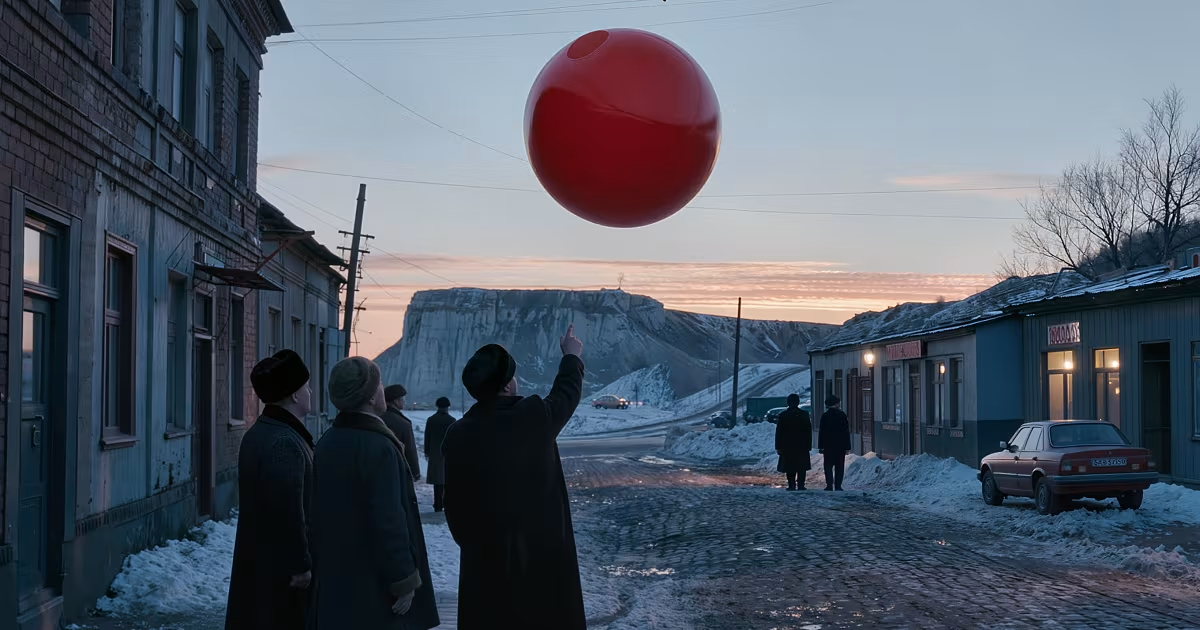
People on a snowy street watching a red sphere fly toward the hills.
Illustration, not a period photograph.

Opening
At about 7:55 p.m. on 29 January 1986, residents of Dalnegorsk, a mining town in the Soviet Far East, saw a reddish glowing ball cross the sky silently and come down on a hill known as Height 611, roughly a kilometre from the town. Witnesses reported flashes and a fire on the summit that burned for about an hour.
A local investigator, Valery Dvuzhilny, later collected small metal droplets, glassy particles, charred wood, and a fine "mesh" from a burned patch about two metres square. Claims about those samples made Height 611 the best-known Soviet crash case. The one laboratory paper I could trace is far more cautious than the claims.
Timeline
29 January 1986, about 19:55Witnesses describe a glowing ball, about two metres across in one account, moving silently and roughly level, in one version in jumps at an average of about 54 km/h. A 1988 seminar paper by Dvuzhilny and V. K. Zhuravlev describes it as a self-luminous ball with a trail that appeared to dip towards the hill. Popular accounts say it struck a limestone rock face.
29 January, eveningA fire is seen at the apparent point of descent for about an hour. One account compares the flame to electric welding.
1986 to 1988Dvuzhilny's group collects material from a burned patch near bedrock: black-grey ash, heat-marked rock, unusually porous charcoal, metal droplets, glassy particles up to about 30 milligrams, and scale-like "mesh". Popular accounts say samples went to 14 Soviet research institutions.
5 April 1986According to a later bibliography, the national newspaper Sotsialisticheskaya Industriya runs the first article, titled "The Dalnegorsk Riddle".
18 April 1988Dvuzhilny and Zhuravlev present their account at an interdisciplinary seminar in Tomsk, which calls for further geological and geophysical work.
1989Lead droplets and four pieces of charred stump from Height 611 are delivered to the E. O. Paton Electric Welding Institute in Kyiv for surface analysis.
22 November 1989A US government foreign-media digest summarises Soviet press coverage of the case, including scientists studying the "mesh", spheres, and glass, and competing plasmoid and rocket explanations.
May 1990Moscow radio reports a Soviet-Chinese ufology meeting held in Dalnegorsk.
1991The Paton Institute paper by O. D. Smiyan, L. M. Kapitanchuk, and S. O. Antonov appears in the proceedings of the April 1990 Tomsk seminar.
Key figures
Valery Dvuzhilny led the local investigation, collected the samples, and promoted the case for years. Most claims about the "mesh" trace back to him or to press summaries of his work.
V. K. Zhuravlev co-authored the 1988 Tomsk paper that is the earliest accessible technical account.
O. D. Smiyan, L. M. Kapitanchuk, and S. O. Antonov at the Paton Institute produced the only laboratory paper on Height 611 material that I could read in full.
The residents of Dalnegorsk were the witnesses. No list of names or original statements has been published.
Physical and documentary trail
The record has three layers. First, witness descriptions, available only through later summaries. Second, the claimed results from many institutes, which circulate as lists in popular accounts without the underlying lab reports. Third, the Paton Institute paper, which is specific and limited.
The Paton team found the lead droplets were 98 to 99 percent lead at the surface, with layered traces of other elements. They concluded the lead droplets could in principle be made with known technology, though one too expensive to use for objects like these. They could not quantify the charred stump samples and found an unusually wide range of elements in them, including barium. They did not analyse the "mesh".
The same paper also analysed a hard-surfaced iron sphere, which it states came from the Kerch Peninsula in Crimea, not from Height 611. Later retellings have sometimes folded it into the Dalnegorsk case.
There is no wreck, no published chain of custody for the samples, no site log showing who visited before collection, and no final report from any Soviet state body.
Things you might not know
- The "transuranic" elements weren't. A widely repeated summary says the lead beads contained rare "transuranium" elements, then lists zirconium, lanthanum, yttrium, and praseodymium. All four are much lighter than uranium.
- The mesh supposedly held gold. Popular accounts describe quartz threads about 17 microns thick, one with a fine gold wire inside it. No published analysis of this is available.
- The lab was a welding institute. The traceable analysis came from the Paton Electric Welding Institute of the Ukrainian Academy of Sciences, using a French-built Riber LAS-2000 surface analyser.
- Souvenir hunters took the evidence. A Russian account says that within a few years visiting tourists had picked the site clean of the beads.
- The hill is a viewpoint. The summit can be seen from the town market and many streets, which is why so many residents could say they saw the fire.
Competing explanations
An unknown craft. Dvuzhilny's view, based on the reported level flight, the long fire, and the unusual materials. The flight description is a recollection without instrument data, and the materials claims beyond lead and charcoal lack accessible lab reports.
A meteor or bolide. The 1988 seminar paper itself used the word bolide. A burning meteor can leave a trail and a fire. The reported slow, level path fits a meteor poorly, and witness estimates of speed at night are unreliable.
Rocket stage or re-entering space debris. Raised in Soviet press coverage by 1989. Debris could leave metal droplets. No launch or re-entry record for the time window has been published either way.
A plasmoid or ball lightning. Also raised in the Soviet press. It could account for a glowing ball and a fire, but not easily for metal residue.
Local industrial material. Dalnegorsk is a mining and ore-processing town. Lead droplets on a hill near such a town need a control sample before they mean anything, and none is recorded.
Later life of the case
Height 611 is often called the "Soviet Roswell" in Western writing. Russian accounts describe further lights over the hill in later years and anomalous readings at the site, none documented to a standard that can be checked. The case is cited far more often than its laboratory work is read.
Finding
Settled: many residents of Dalnegorsk reported a glowing object coming down on Height 611 on 29 January 1986, a fire burned there, and material was collected from the site. The only lab paper I could trace found lead droplets that known technology could make and charred wood it couldn't fully explain, without a custody chain linking either to the object. Unidentified, not proven exotic.
What still will not resolve: the "mesh". It is the strangest claim in the case and the one with no accessible analysis. A full, independent study of retained, documented samples is the thing that would change this report.
Evidence signature
4/9 Solid
- Witnesses
- several people
- Instruments
- photo, film or physical traces
- Paper
- press and later accounts
How well documented the case is, not whether it's true. A strong record can still have an ordinary answer, and a thin one can still be real.
You decide · HEIGHT 611
What do you think happened?
One vote per case, anonymous. You'll see how other readers voted once you've voted.