PETROZAVODSK
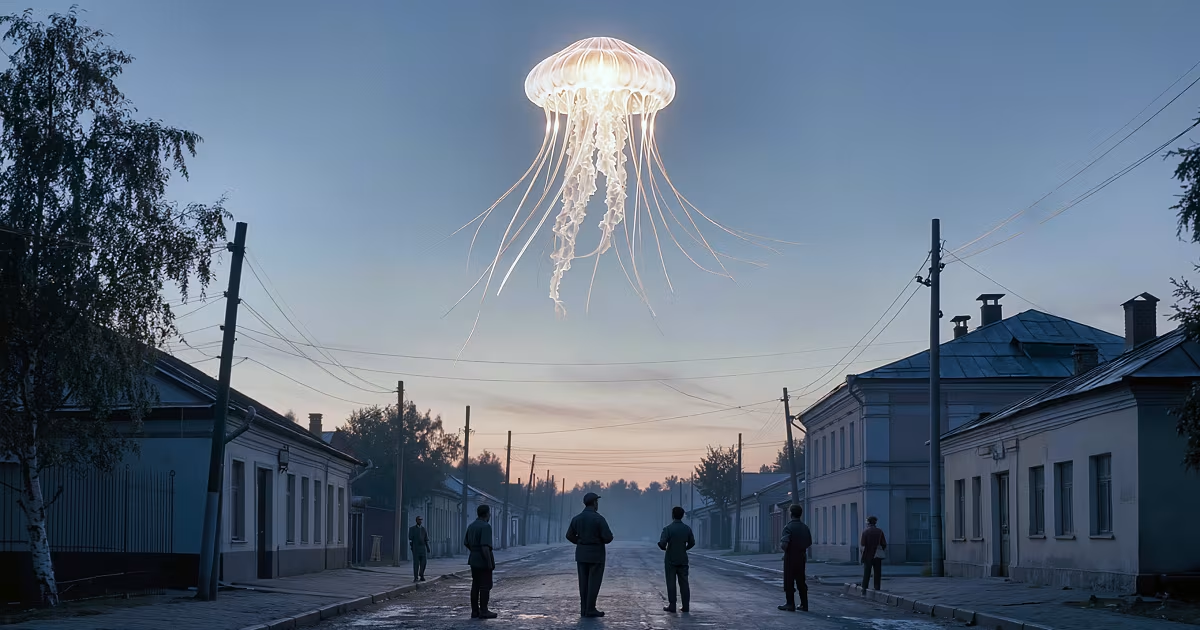
Karelian dawn street. Empty sky.
Illustration, not a period photograph.
Opening
On 20 September 1977 a glowing jellyfish-shaped object hung over Petrozavodsk in Soviet Karelia and, in the local telling, punched holes in windows and left a rain of fire. TASS ran a careful weather story. Western wires ran a landing. In 1994 and after, researchers tied the night to the launch of Kosmos 955 from Plesetsk a little earlier. Rocket clouds have looked like jellyfish before. The window holes remain the part a launch has to stretch for if they were real as punched.
Petrozavodsk is a city light plus a launch time. Keep both on the page. The jellyfish is the picture. The rocket is the clock.
The spine of the file is a dawn light and a Plesetsk time stamp. Petrozavodsk is 20 September 1977. It is not a stored craft in a Karelian shed.
Timeline
20 September 1977, early, the light over the city. Window and damage talk.
TASS language. Western ticker. Local drawings of a jellyfish.
Later Kosmos 955 identification from Plesetsk. Debate on holes versus condensation and panic.
Later catalogues keep the jellyfish. That picture is later life if the launch holds. The clock is first for the mundane door.
Plesetsk launching north-west can hang a jellyfish over Karelia. That clock is not a rumour. Window glass is the part that keeps the night from being only a plume paragraph.
Key figures
Petrozavodsk residents own the light and the window talk.
TASS owns the first official weather.
Plesetsk owns the launch time.
Later researchers own the Kosmos 955 tie.
Physical and documentary trail
On the paper, 20 September 1977 gives you four hard objects and no wreck.
One: city-wide sighting of a jellyfish light.
Two: window-hole and damage claims.
Three: TASS dispatch.
Four: Kosmos 955 launch timing. TASS on the Petrozavodsk phenomenon, 20 September 1977, and later Plesetsk launch correlation, are the two trays.
There is no craft. There is no official sample from a hole that a later lab kept as unknown. There is no launch paper that explains every pane if the panes were punched.
A launch time and a city full of eyes are the stay-behinds. A pane in a lab would finish the holes. The clock already finishes the shape as possible weather from a rocket.
A jellyfish of light hung over the city.
Competing explanations
An unknown object that damaged a city. This is the local hard reading. It has holes in the telling. It has no wreck.
A rocket plume from Plesetsk. The clock door. Has to carry punched glass if the glass was real as punched.
A TASS story that got away from weather. Incomplete. People were already in the street.
Hybrid caution. A city saw a jellyfish. A launch sat on the clock. Morning had no craft in the square.
Later life of the case
Later catalogues and the Kosmos papers. I keep the catalogues on the later-life shelf. The clock stays first for the close.
Finding
Petrozavodsk watched a jellyfish light on 20 September 1977, TASS put it on a wire, and a Plesetsk launch sits on the same clock. Believe the street. A Karelian city does not invent a dawn for a later rocket essay.
What still will not resolve: a pane held as punched by a lab, or a launch paper that owns every hole. Either one would pin the jellyfish. The proving object is still those windows, held as panic or as damage by more than a time stamp.