YUKON 1996
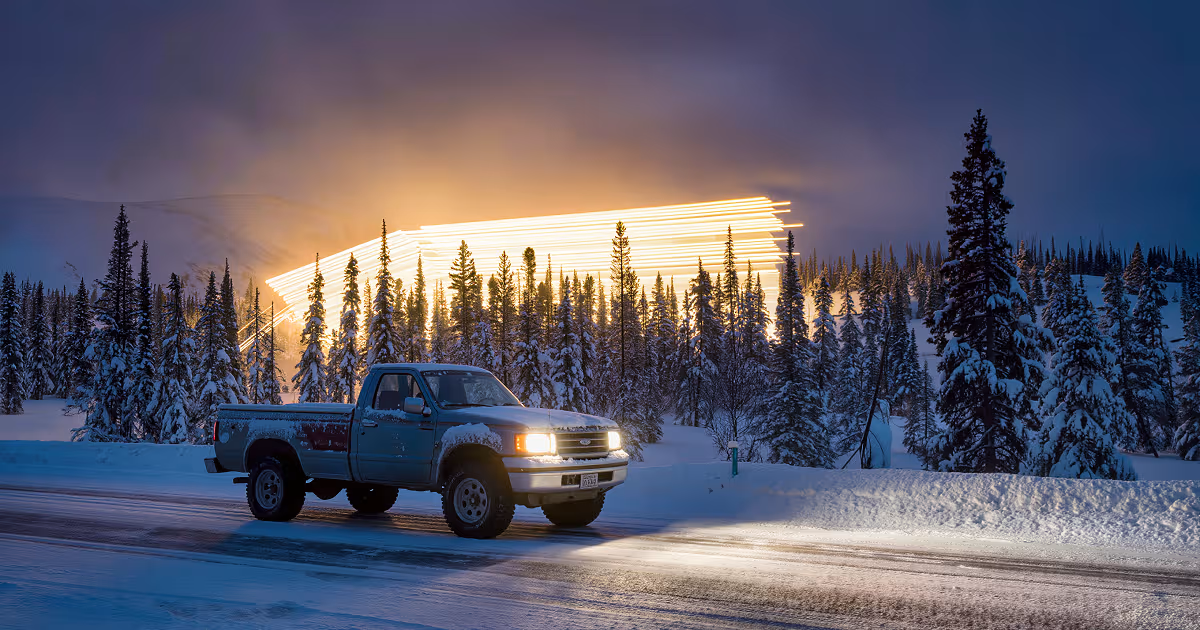
A pickup on a snowy road at night beside a huge band of lights.
Illustration, not a period photograph.

Opening
On the evening of 11 December 1996, people along the North Klondike Highway in Canada's Yukon Territory reported a gigantic object in the dark winter sky: a row of lights, or a structure studded with lights, moving slowly and silently. The first reports came from near Fox Lake, north of Whitehorse, and others followed from Carmacks, Pelly Crossing and Mayo.
Researcher Martin Jasek later collected statements from 31 witnesses, and many described something enormous, half a kilometre long or more. Satellite tracker Ted Molczan found that a Russian rocket stage had burned up in the atmosphere that same evening, low over the northern horizon. The two sides have argued about it ever since.
Timeline
11 December 1996, earlier that dayA Russian rocket launches the military satellite Cosmos 2335 into orbit.
About 7 to 8 p.mDrivers near Fox Lake on the Klondike Highway see a huge array of lights, some stopping their cars to watch. Witnesses describe it as stadium-sized or larger.
Later that eveningMore sightings come from Carmacks and Pelly Crossing, further north along the highway, and from Mayo. Reports run over roughly three hours.
About 8:30 p.mAccording to Molczan's calculation, the rocket's second stage re-enters the atmosphere, about 230 km from the witnesses, breaking up into a long train of glowing debris moving west to east.
1997 to 2000Jasek, a Whitehorse researcher, interviews witnesses and collects their drawings and size estimates. His report, Giant UFO in the Yukon Territory, makes the case famous.
2012Sceptic Robert Sheaffer publishes Molczan's re-entry match, calling the case "busted".
Key figures
Martin Jasek, a Yukon UFO researcher, gathered the witness statements and drawings and organised Yukon UFO conferences.
Ted Molczan, a respected amateur satellite tracker, identified the rocket re-entry.
The witnesses were ordinary residents and drivers spread along hundreds of kilometres of highway, most of whom didn't know one another.
Physical and documentary trail
The record: Jasek's witness statements and sketches, his report, Molczan's orbital calculations, and later articles by Sheaffer and others.
Still missing: any photograph, any radar data, and any police record of the sightings. Nobody called the RCMP that night.
Things you might not know
- Thirty-one witnesses. That makes it one of the largest multi-witness UFO sightings in Canadian history.
- Some said it was bigger than a stadium. Size estimates ran from several hundred metres up to more than a kilometre.
- The rocket launched that same day. Cosmos 2335 went up on 11 December, and its spent stage fell back within hours.
- Distance fools the eye. Molczan put the re-entry about 230 km away. A long train of burning debris at that distance can look like one huge, nearby object.
- The Yukon has had a UFO conference. Jasek's work led to public conferences in Whitehorse on the territory's sightings.
Competing explanations
A rocket re-entry. The timing, direction and appearance match a breaking-up rocket stage: a slow-moving line of lights, silent because it was so far away. Re-entries have produced "giant mothership" reports elsewhere too.
A giant craft. Jasek and supporters point out that sightings spread over about three hours, while a re-entry lasts minutes, and that some witnesses described the object hovering, which debris can't do. These timing differences have never been fully resolved.
Later life of the case
The Yukon mothership still appears on lists of the best UFO cases, and it is also a textbook example in sceptical writing of how a re-entry can produce extraordinary reports.
Finding
The strongest reading is that most of what people saw was the Cosmos 2335 rocket stage burning up: the date, time and direction fit closely. The reports from outside the re-entry window are the open part. They may be mistaken times, other lights, or something else.
What still will not resolve: what witnesses saw outside the few minutes of the re-entry, in the hours before and after.
Evidence signature
5/9 Solid
- Witnesses
- several people
- Instruments
- photo, film or physical traces
- Paper
- official records at the time
How well documented the case is, not whether it's true. A strong record can still have an ordinary answer, and a thin one can still be real.
You decide · YUKON 1996
What do you think happened?
One vote per case, anonymous. You'll see how other readers voted once you've voted.