KENSINGTON RUNESTONE
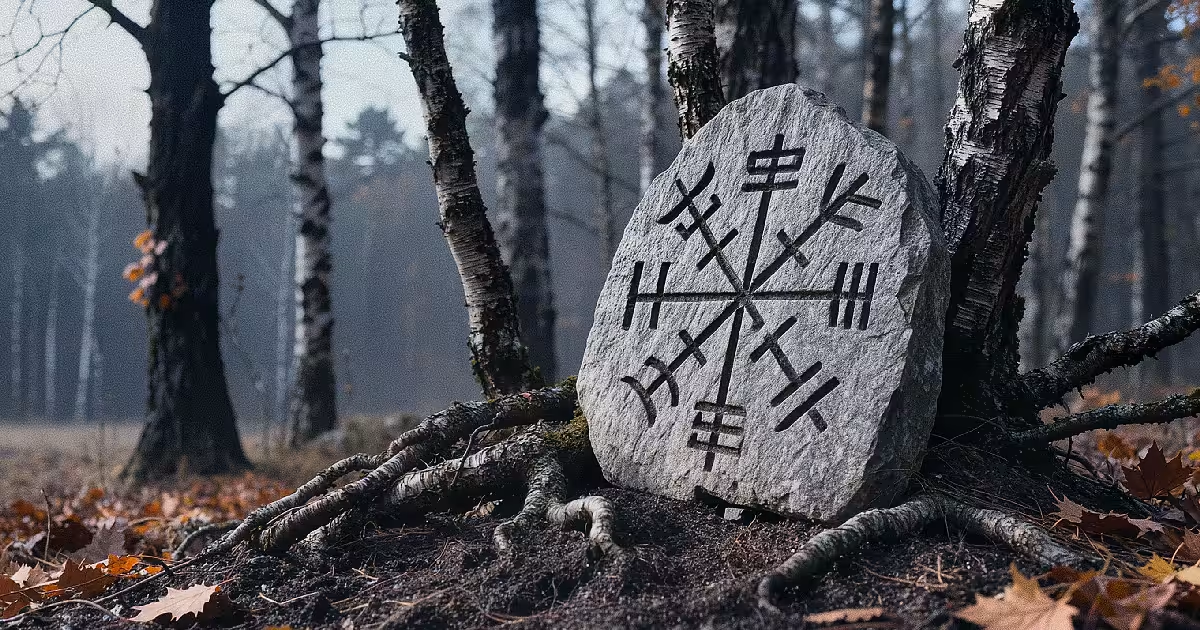
A grey stone slab carved with runes among birch roots and leaves.
Illustration, not a photograph.

Opening
In 1898, a Swedish immigrant farmer named Olof Ohman was clearing land near Kensington, in Douglas County, Minnesota, when he said he found a slab of greywacke stone, about 202 pounds in weight, with its roots tangled in a small poplar. The stone was covered in runes. Translated, the inscription says that a party of Götalanders and Norwegians on an exploring journey from Vinland found ten of their men dead, and it is dated 1362.
If genuine, it would mean that Norse explorers reached the middle of North America 130 years before Columbus. Most scholars have for a century classed it as a nineteenth-century hoax, and the case against it rests on language. Its defenders have not gone away. The Kensington Runestone is on display at the Runestone Museum in Alexandria, Minnesota, and the argument over it is one of the longest-running in American archaeology.
Timeline
1362The date in the inscription, which describes a journey from Vinland.
1883A sixteen-year-old in Minnesota, Edward Larsson, makes notes that contain rune forms similar to those on the stone.
8 November 1898The Minnesota Historical Society's preliminary report, based on three visits by the geologist Newton Winchell, gives this as the date of the find, on Ohman's farm in Solem Township. It names Ohman, his sons Olof Emil, aged twelve, and Edward, aged ten, and Nils Olof Flaaten, who owned the adjoining farm.
1898 to 1909The stone is examined and argued over. In July 1909, Ohman and Flaaten both write affidavits about the discovery. One summary of Ohman's later account places the find in August 1898, under a tree about five hundred feet from Flaaten's house, which conflicts with the November date.
1910A copy reaches the University of Minnesota, where Olaus Breda declares it a forgery, and academics there conclude that linguistic errors in the translated Old Norse show it is a contemporary hoax.
1911The Minnesota Historical Society holds a bill of sale for the stone, for ten dollars, even though Hjalmar Holand later claimed Ohman gave it to him.
The following decadesHoland promotes the stone for about forty years.
1949The stone is displayed at the Smithsonian.
1949 to 1951Thalbitzer and S. N. Hagen publish papers supporting it.
1976The Gran tapes are recorded: Frank Gran says that his father confessed that Ohman made the inscription. They are based on secondhand accounts and are not considered conclusive.
1982Robert Hall argues that the linguistic oddities could reflect dialect variation and that the physical evidence favours authenticity.
2019Runic inscriptions resembling those on the stone are found at Hassela, Sweden, near Ohman's home parish.
Key figures
Olof Ohman, the farmer, said he found the stone while clearing land, with his young sons nearby. Some critics accuse him directly of making it. His neighbour Nils Flaaten joined him in the 1909 affidavits.
Hjalmar Holand, a Norwegian-American writer, spent about forty years championing the stone. Newton Winchell, a geologist, visited the site three times for the Minnesota Historical Society and estimated the inscription was about 500 years old from weathering comparisons. A later geologist, Harold Edwards, described the letters as showing virtually no weathering.
Olaus Breda, a professor at the University of Minnesota, declared it a forgery in 1910.
Robert Hall is the most recent scholar to defend it. Runologists have criticised his readings of the runes.
Physical and documentary trail
The record: the stone, the inscription, Ohman's account and the 1909 affidavits, the bill of sale, and the linguistic and geological studies. The accounts of the find differ on the month, which is one of the points critics return to. The case against the stone is linguistic. A key term, usually reconstructed as "updagelsefard", meaning journey of discovery, is not attested before the sixteenth century. The language is closer to nineteenth-century Swedish than to fourteenth-century Swedish, and it lacks the case endings and plural verb forms typical of fourteenth-century texts. It uses pentadic numerals, which are mostly known from recent times, and at least seven runes are not found in any known medieval standard.
The question of where the runes came from has an answer that points to the nineteenth century. Larsson's 1883 notes contain similar forms, and so do the 2019 finds near Ohman's home. The inscription's abbreviation AVM stands for "Ave Virgo Maria" and is not a cipher.
What is missing is any other widely accepted evidence of Norse presence in the American interior. The Norse settlements in Greenland and at L'Anse aux Meadows are established, but nothing else supports the stone's account. The 1354 Knutson expedition is not known to have sailed, and a 1577 letter of Mercator does not support the stone's story.
Things you might not know
- It cost ten dollars. The bill of sale at the Minnesota Historical Society says so, which sits oddly with Holand's claim that Ohman gave it to him.
- Two boys were there. The historical society's report names Ohman's sons, aged twelve and ten, as present at the find.
- The month is disputed. The society's report says November 1898, while one account of Ohman's affidavit says August.
- It was exhibited at the Smithsonian. The stone was shown there in 1949.
- It has a musical. Runestone!, a 2022 musical, explores its effect on Ohman's family without deciding whether it is genuine.
- It has a television series. Peter Stormare hosted Secrets of the Viking Stone on the Science Channel in 2021.
- The weathering is disputed. One geologist said the inscription looked 500 years old, another that it showed virtually no weathering.
- It is heavy. The stone weighs about 202 pounds, 92 kilograms.
Competing explanations
A nineteenth-century hoax. The strongest reading. The language, the numerals and the runes point to the nineteenth century, and the rune forms have parallels in a Minnesotan teenager's notes and in inscriptions near Ohman's home. The Gran tapes are not conclusive.
A genuine 1362 inscription. Holand and his successors argued that the weathering and the runic features support the date. Linguists have disputed every key point, and Hall's arguments have not persuaded runologists.
Later life of the case
The stone is a tourist attraction and a local emblem in Alexandria, Minnesota. Defenders and sceptics continue to publish. The 2019 finds in Sweden strengthened the hoax case, because they show where someone in Ohman's circle might have learned the rune forms.
Finding
The best explanation is that the Kensington Runestone was made in the nineteenth century. The language is too late, the runes have recent parallels, and no other evidence supports a Norse presence in Minnesota in 1362. It does not follow that Ohman made it. The tapes about his confession are secondhand, and the accounts of the find do not agree on the month.
What still will not resolve: who carved it, since the evidence points to the period and the community but not to a named person.
Evidence signature
4/9 Solid
- Witnesses
- one person, or a tradition
- Instruments
- nothing on record
- Paper
- formal investigation, court or declassified file
How well documented the case is, not whether it's true. A strong record can still have an ordinary answer, and a thin one can still be real.
You decide · KENSINGTON RUNESTONE
What do you think happened?
One vote per case, anonymous. You'll see how other readers voted once you've voted.