MISSING 411
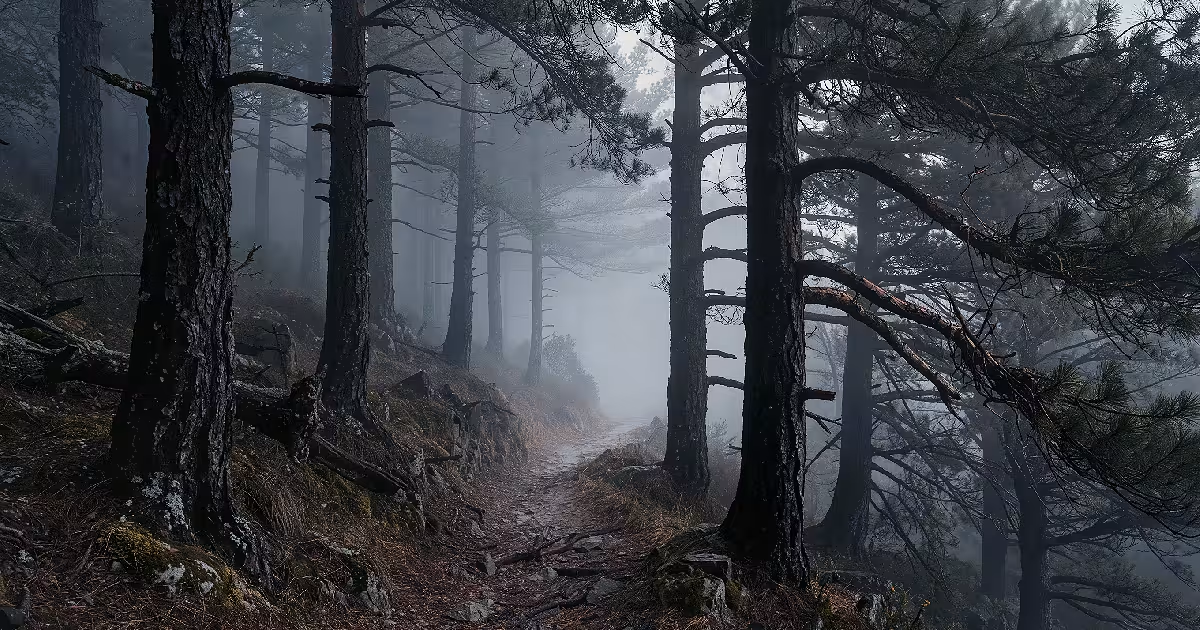
A misty forest trail disappears among dark pines.
Illustration, not a photograph.
Opening
Every year, people go missing in America's national parks and forests. Most are found, alive or dead, and the reason is clear: a fall, a heart attack, a river, a wrong turn. But former police officer David Paulides says a set of cases does not fit. People vanish in seconds, sometimes from right beside their families. Some are found miles away, over terrain they could never have crossed, sometimes in places already searched, sometimes without their shoes. Search dogs cannot pick up a scent. The weather turns. Paulides calls his project Missing 411, and his books and films have convinced many people that something is taking people in the woods.
Timeline
1977 to 2000. David Paulides serves with the San Jose Police Department in California, working in patrol, SWAT, street crimes and as a detective.
2008 and 2009. He publishes two books on Bigfoot, The Hoopa Project and Tribal Bigfoot, and founds the research group North America Bigfoot Search.
Late 2000s. By his own account, an off-duty park ranger approaches him with concerns about a number of strange missing-person cases in the parks, and asks him to look into them.
2011. He self-publishes Missing 411: Western United States and Canada, the result of what he describes as three years and more than 7,000 hours of research. He identifies 28 "clusters" of disappearances.
2011 onward. More Missing 411 books follow, covering different regions and themes, at least ten by 2021.
2017. The documentary Missing 411 is released, followed by Missing 411: The Hunted in 2019 and Missing 411: The UFO Connection in 2022.
Key figures
David Paulides is the founder and face of Missing 411. The families of the missing are at the heart of every case he writes about. On the sceptical side, data scientist Kyle Polich analysed the claimed patterns, and writer Susan Gerbic examined how cases were chosen. The National Park Service, which runs the parks where many disappearances happen, is a constant presence in his work.
Physical and documentary trail
Paulides's books draw on newspaper reports, search records, official files and interviews with families and rescuers. He has highlighted one genuine gap: the National Park Service does not keep a central, independent database of people who go missing in its parks, which makes it hard for anyone to study the numbers properly.
The patterns he describes, including missing shoes, bodies found in already-searched areas, boulder fields, water, sudden weather changes and dogs unable to track, are drawn from the cases he selected. He does not publish a theory of what is behind them.
Things you might not know
- It started with Bigfoot. Before Missing 411, Paulides was best known as a Bigfoot researcher, with two books on the subject.
- He never says what is doing it. Paulides presents the patterns and leaves the explanation open, which is part of why his work appeals to people with very different theories.
- The parks do not keep a single list. He helped publicise the fact that the National Park Service has no central database of missing persons in its parks.
- Missing shoes are a famous detail. Several cases he cites involve people found without their shoes, sometimes in rough terrain. Search experts say confused, hypothermic people sometimes remove clothing.
- One of the best-known cases is a little boy. Six-year-old Dennis Martin vanished in the Great Smoky Mountains in June 1969 while playing with family, sparking one of the largest searches in park history. He was never found.
- The films went to UFOs. The third Missing 411 documentary, in 2022, was subtitled The UFO Connection.
Competing explanations
Something unknown in the wilderness. Paulides's readers have suggested everything from Bigfoot to portals, UFOs and predators no one has identified. What they share is the sense that some cases are too strange for normal explanations.
Normal tragedies, selected. Critics argue that millions of people visit wild places every year, and that a small number of strange-seeming cases is exactly what chance would produce. Kyle Polich concluded that no case stood out and that the numbers were within normal expectations. Falls, drowning, exposure, medical crises and animal attacks explain most deaths, and hypothermia can make people behave strangely, including removing clothes.
Cherry-picking. Sceptics such as Susan Gerbic say the patterns appear because cases are picked to fit them, while the many disappearances that do not fit are left out.
Later life of the case
Missing 411 has a large following, especially online and on podcasts, and has made many people think twice about walking alone in the wilderness. It has also pushed for better record-keeping on missing persons in public lands. Paulides continues to publish books and films.
Finding
People do vanish in the wild in ways that are hard to explain, and some, like Dennis Martin, are never found. Paulides has brought attention to those families and to the lack of good national records. Whether the cases share a single mysterious cause has never been shown, and most researchers who have looked at the numbers think they do not.
What still will not resolve: the cases where nobody was ever found. Until those people are found, their families have no answers.